
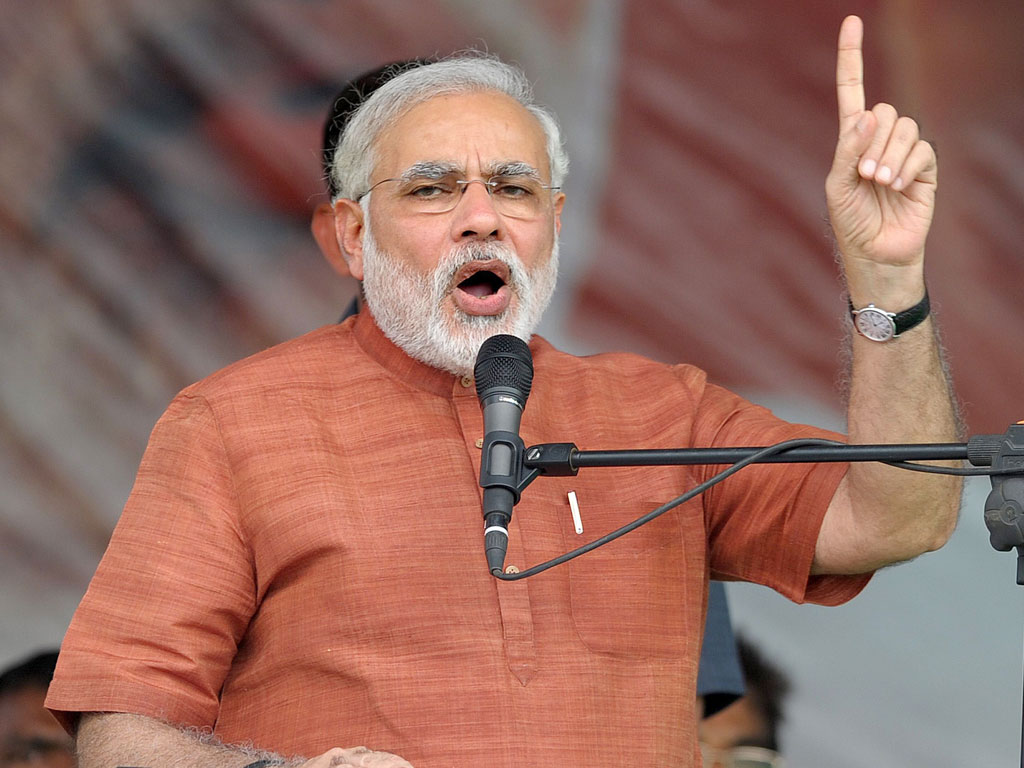

NEW DELHI, India — Narendra Modi appeared poised to become India’s next prime minister after exit polls projected a commanding victory for his opposition Bharatiya Janata Party in the country’s vast parliamentary election.
More than half a billion Indians participated in the weeks-long vote, then the largest democratic exercise in history. Polling estimates placed the BJP between 248 and 282 seats in the Lok Sabha, while the governing Indian National Congress was projected to secure between 92 and 102 seats. Official results were expected on Friday.
Modi campaigned as an experienced administrator capable of reviving economic growth, reducing corruption, and strengthening national security. Although he described himself as a proud Hindu nationalist, he attempted to emphasise practical governance, once summarising his priorities as “toilets first, temples later”.
His expected victory, however, intensified scrutiny of his political record, his association with Hindu nationalist organisations, and statements that critics said threatened India’s religious and social divisions.
1. His Immigration Rhetoric Alarmed Muslim Communities
The BJP emerged from a Hindu nationalist movement that sought to protect Hindu culture but has frequently been accused of depicting religious minorities, particularly Muslims, as outsiders.
During the election campaign, Modi repeatedly promised to act against people he described as illegal immigrants from Bangladesh. At one rally, he declared that after the election, he “will send these Bangladeshis beyond the border with their bags and baggages”.
Supporters viewed the pledge as an enforcement of India’s immigration laws. Critics warned that sweeping deportations could affect long-established Bengali-speaking Muslim communities whose members might struggle to prove their citizenship or secure acceptance from Bangladesh.
The rhetoric was especially sensitive in Assam, where tribal militants killed more than 40 Muslim villagers during the election period. Some communities in the region have long accused Bengali-speaking Muslims of settling illegally and competing for land and political influence.
Modi had delivered an anti-immigration speech in the area shortly before the killings. There was no evidence that his remarks caused the attack, but critics said such language risked worsening tensions in an already volatile region.
Concerns were also raised about Modi’s association with the Rashtriya Swayamsevak Sangh, or RSS, the Hindu nationalist volunteer organisation in which he began his political career. The movement has campaigned against policies it considers excessively favourable to Muslims and has supported restrictions on the slaughter of cows, which are sacred to many Hindus.
2. The Gujarat Riots Continued to Define His Record
No controversy followed Modi more closely than the deadly religious violence that engulfed Gujarat in 2002, when he was the state’s chief minister.
The unrest began after dozens of Hindu pilgrims died when a train carriage was set on fire. Hindu mobs subsequently attacked Muslim neighbourhoods, killing large numbers of people and destroying homes and businesses. Estimates placed the death toll at between 1,000 and 2,000, with Muslims accounting for most of the victims.
Human rights organisations alleged that some police officers failed to intervene or participated in the attacks. A leaked assessment prepared by British officials concluded that Hindu extremists had planned aspects of the violence and received support from elements within the state administration.
Modi consistently denied responsibility. Subsequent investigations did not establish sufficient grounds to prosecute him, although critics continued to accuse his government of failing to stop the violence quickly or pursue justice vigorously afterwards.
His refusal to offer an unequivocal apology deepened the anger. Asked about the violence in a 2013 Reuters interview, Modi used an analogy that provoked international criticism.
“Any person if we are driving a car, we are a driver, and someone else is driving a car and we’re sitting behind, even then if a puppy comes under the wheel, will it be painful or not?” he said. “Of course it is. If I’m a chief minister or not, I’m a human being. If something bad happens anywhere, it is natural to be sad.”
Modi maintained that the remark had been misunderstood and that he was expressing compassion for all suffering. His opponents argued that the analogy was insensitive to the scale of the killings.
3. He Branded Political Opponents Agents of Pakistan
Modi also adopted an uncompromising tone towards Pakistan, India’s nuclear-armed neighbour and longstanding rival.
During the campaign, he accused members of a rival political party of being “agents of Pakistan and enemy of India” because of their position on Kashmir, the disputed territory claimed by both countries. One BJP politician separately suggested that Modi’s critics should go to Pakistan.
Such language caused concern because India and Pakistan have fought several wars since partition in 1947, while military confrontations and militant attacks have repeatedly disrupted diplomatic relations.
The BJP added to those fears when its election manifesto promised to review India’s nuclear doctrine. Modi later sought to reassure voters and foreign governments that he would preserve the country’s “no first use” policy, under which India pledges not to deploy nuclear weapons unless it is attacked with them first.
Pakistan’s interior minister also accused Modi of provocative behaviour after the BJP leader promised to pursue a fugitive terrorism suspect believed to be living in Pakistan.
Not every Pakistani official regarded his likely election with alarm. Some expressed hope that a leader with a strong domestic mandate might possess the political authority necessary to revive stalled peace negotiations.
4. His Explanation for Malnutrition Provoked Outrage
Modi attempted to present himself as a supporter of women’s advancement and appeared to enjoy substantial support among female voters. A remark he made about malnutrition in Gujarat, however, raised questions about his understanding of the problem.
Asked in a 2012 interview with The Wall Street Journal why malnutrition remained prevalent in the relatively prosperous state, Modi attributed part of the problem to a “beauty-conscious” middle class.
“If a mother tells her daughter to have milk, they’ll have a fight,” he said. “She’ll tell her mother, ‘I won’t drink milk. I’ll get fat.’”
Public-health advocates criticised the explanation for reducing a complex problem involving poverty, food insecurity, sanitation, maternal health, and unequal access to public services to concerns about appearance.
Women’s rights campaigners also described Modi’s record in Gujarat as mixed. Although the state reported comparatively low levels of some crimes against women, female participation in the workforce remained limited, and advocates said programmes addressing domestic violence were severely under-resourced.
In Ahmedabad, Gujarat’s largest city, one officer responsible for domestic abuse cases reportedly faced a workload of approximately 800 complaints.
5. His Business-Led Development Model Divided Opinion
Modi’s strongest campaign argument was his economic record in Gujarat. Per-capita income increased substantially during his years in office, and the state developed a reputation for approving major industrial projects quickly.
He promised to take that model nationwide by reducing bureaucracy, improving infrastructure, confronting corruption, and attracting investment. The message appealed to voters frustrated by slowing economic growth and a succession of corruption scandals involving the Congress-led government.
Critics argued that Gujarat’s prosperity was distributed unevenly. They accused Modi’s administration of prioritising large corporations while giving insufficient attention to communities displaced or environmentally affected by mining, manufacturing, and infrastructure projects.
Writer and activist Arundhati Roy was among those who warned that powerful corporations expected a Modi government to suppress resistance to controversial development projects.
Sceptics also pointed to Gujarat’s social indicators. Economic expansion was not always accompanied by comparable improvements in education, sanitation, nutrition, public health, or child mortality. For Modi’s opponents, those disparities undermined claims that the Gujarat model offered a complete answer to India’s development challenges.
Modi’s apparent electoral success suggested that millions of Indians were prepared to place their confidence in his promises of growth and decisive leadership. The result would determine who governed India, but it was unlikely to end the argument over the political record and ideology of the man expected to lead it.