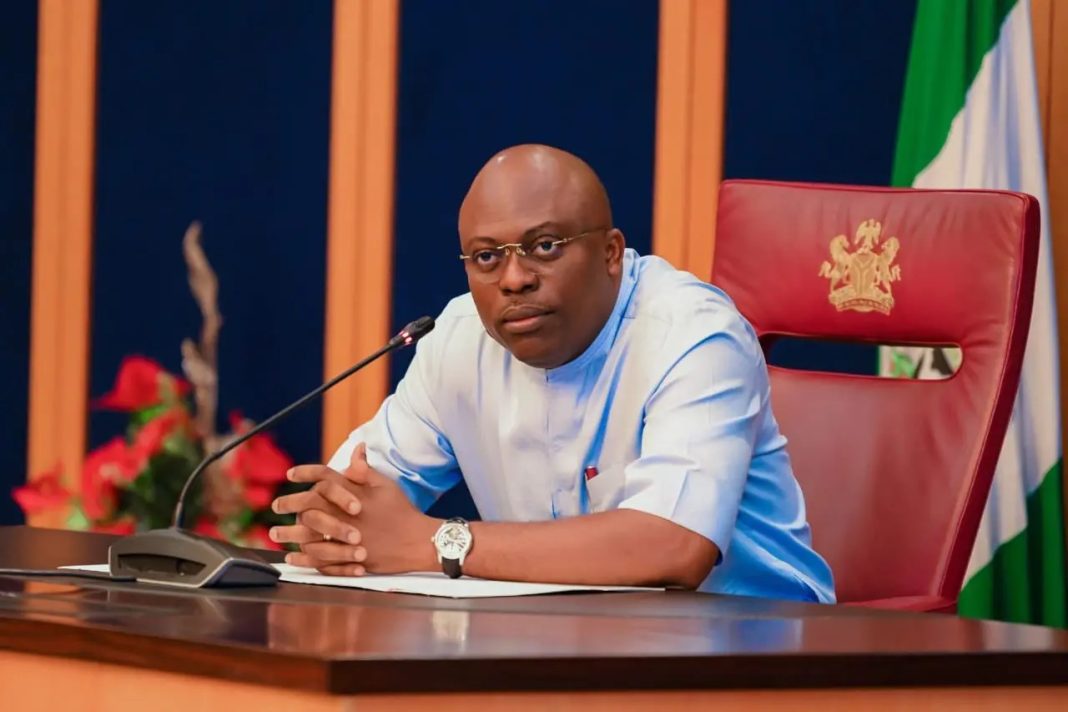

PORT HARCOURT, Nigeria — Siminalayi Fubara, the governor of Rivers State, on Tuesday, December 9, 2025, formally defected from the Peoples Democratic Party to the ruling All Progressives Congress, a move that further thins the ranks of Nigeria’s main opposition party and reshapes the political balance in the oil-rich southern state.
Fubara announced his decision during a stakeholders’ meeting at the Government House in Port Harcourt, the state capital.
Addressing political allies, lawmakers and party leaders, he said the decision to join the APC was taken as a response to the backing his administration has received from President Bola Tinubu since the political turmoil that engulfed the state in late 2023.
According to the governor, his defection was a “gesture of reciprocity” for what he described as the president’s consistent support, cooperation and encouragement during the months-long crisis that paralysed governance and split the Rivers State House of Assembly.
“We can’t support Mr President if we don’t fully identify with him; not backyard support,” Fubara said during the meeting.
“So, we have taken that decision today since we have gotten a pass. Everyone here, who followed and suffered with me, our decision today [is that] we are moving to APC.”
The announcement was greeted with cheers from supporters at the venue, marking a dramatic political turning point for a state that has long been a stronghold of the PDP.
Fubara’s defection comes less than a week after a major bloc of lawmakers in the Rivers State House of Assembly switched allegiance to the APC.
Fifteen members of the 32-member legislature, including the speaker, Martin Awaewhule, formally joined the ruling party in a move that signalled a widening realignment ahead of future elections.
Two days before the governor’s declaration, the Rivers assembly had passed a vote of confidence in Tinubu, urging him to seek re-election.
The resolution was seen by political observers as a clear indication of shifting loyalties within the state’s political establishment.
The crisis in Rivers erupted in late 2023 following a power struggle between Fubara and his predecessor, Nyesom Wike, now a senior figure in the federal administration.
The dispute triggered deep divisions within the state assembly, leading to parallel claims of leadership, legislative paralysis and violent clashes involving supporters of rival factions.
Tinubu’s interventions, including political mediation and federal backing for security enforcement, were widely seen as key to stabilising the situation, although tensions lingered beneath the surface.
With Fubara’s defection, the PDP’s hold on governorship positions across the country has continued to shrink.
The party now controls six state governments.
Political sources say Agbu Kefas of Taraba State and Caleb Mutfwang of Plateau State are also planning to join the APC, a development that could further consolidate the ruling party’s dominance.
The APC, already Nigeria’s largest political party by number of governors and legislators, has steadily expanded its influence since Tinubu assumed office in May 2023.
The defection of a sitting governor from the opposition underscores the scale of the party’s growing reach.
Neither the national leadership of the PDP nor the APC issued an immediate formal statement on Tuesday, December 9, 2025, beyond reactions at the Port Harcourt meeting.
However, senior party figures from both camps were seen in attendance during the announcement, suggesting that negotiations had been underway for some time.