
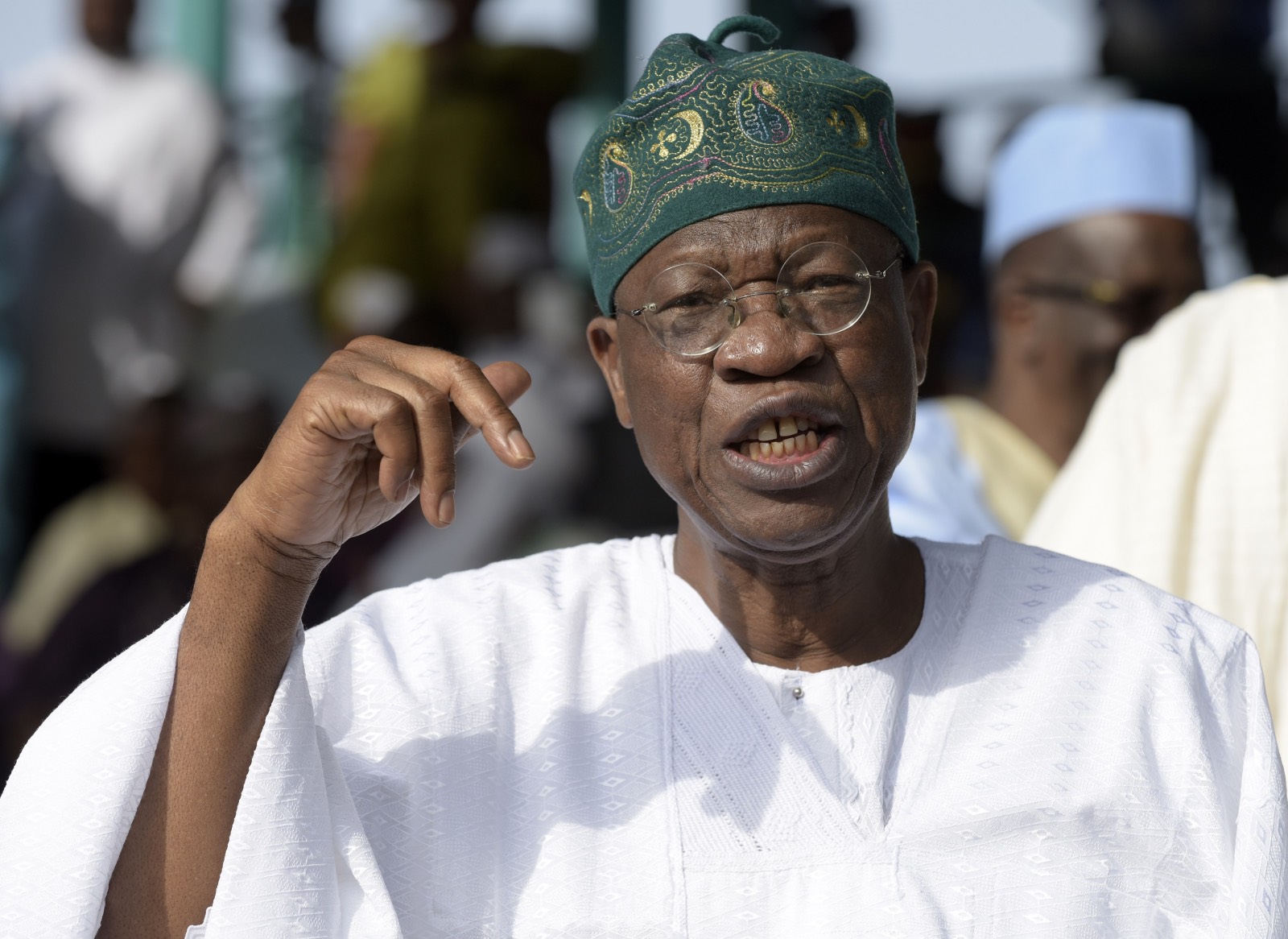

ABUJA, Nigeria — Lai Mohammed, Nigeria’s former minister of information, has again insisted that no “massacre” occurred at the Lekki tollgate during the #EndSARS protests of October 2020, restating a position that has remained one of the most contentious aspects of the nationwide anti-police brutality demonstrations.
In a live interview on Arise Television’s Prime Time programme on Wednesday, December 10, 2025, Mohammed defended his longstanding criticism of CNN’s reporting on the events, saying the international network relied on “second-hand information” and “manipulated” videos in its investigation into the shooting of protesters.
CNN’s widely circulated report alleged that soldiers fired live rounds at peaceful demonstrators on the night of 20 October 2020 — an allegation the Nigerian Army has repeatedly denied, insisting that only blank ammunition was used during an attempt to enforce the Lagos State curfew.
At the time of the incident, Mohammed, then serving as minister of information, wrote to Jonathan Hawkins, CNN’s vice-president for communications, arguing that the report “did not just fall short of journalistic standards but reinforces the disinformation that is going around on the issue”.
He accused the network of relying “heavily on manipulated social media videos” and said the “inciting” report had the potential to “set the country on fire”.
Speaking on Wednesday, December 10, 2025, Mohammed said his stance had not changed.
“You mentioned the issue of CNN. And honestly, that pushback, I still stand by it,” he said.
“Nobody ever said nobody died during the EndSARS. People died even in Abuja. They died in Lagos. They died in Kano. But what we were saying is that CNN was not at the tollgate. CNN relied on second-hand thought and information.”
He further argued that the absence of families claiming missing relatives from the Lekki tollgate five years later undermined claims of a massacre.
“If a man has a goat and the goat does not come home one night, he will go out and look for that goat. Now, five years on today, nobody has come to tell us that my son or my ward went to the tollgate and didn’t come back,” Mohammed said.
“#EndSARS was unfortunate, it was tragic, but that there was a massacre at the tollgate is fake news.”
Mohammed also recounted the personal toll the protests took on his family, revealing that his relatives had urged him to resign amid what he described as intense online and offline harassment.
“During the #EndSARS, one of the toughest moments in my life was when my family met. They had a meeting and they asked me to resign. They were bullied online. They were bullied offline. Their businesses… they’d had enough,” he said.
“They said, look, wait a minute. We are not benefiting from this thing. So why are you exposing us? And I had to sit them down and tell them it’s not as easy as that. There are things I know. There are things that I see that you cannot see.”
The former minister spoke as part of the publicity tour for his new book, Headlines and Soundbites: Media Moments That Defined an Administration, in which he revisits several major policy decisions of the Buhari presidency.
He described the 2021 suspension of Twitter (now X) operations in Nigeria as one of the most difficult decisions he helped implement.
The suspension followed a dispute over the platform’s removal of a tweet by then-President Muhammadu Buhari referencing separatist violence.
“One of the most difficult decisions I took was suspending Twitter’s operation in Nigeria. I had to take that decision in the national interest because a time came when Twitter became the platform of choice for all those who wanted to destabilise the country,” he said.
“There are some decisions that you have to take, not because you like them.”
He rejected suggestions that the suspension was retaliatory.
“I went to President Buhari and told him we needed to suspend Twitter’s operations. He asked me why and specifically said, ‘Is it because they deleted my tweet?’ I said no, sir, and I gave him instances and examples,” he said.