

OTTAWA, Canada — A new dispute has emerged between the United States and Canada after reports that American officials held multiple meetings with leaders of an Alberta-based separatist group, prompting renewed concerns in Ottawa over foreign involvement in domestic political movements.
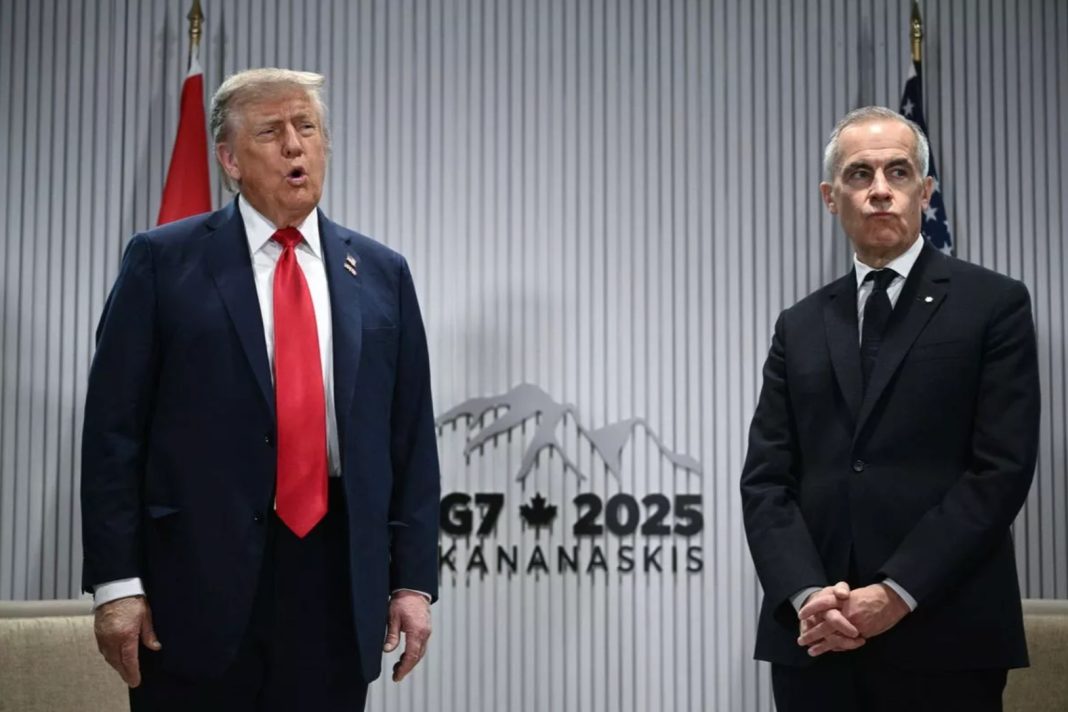
Prime Minister Mark Carney said this week that President Donald Trump should “respect Canadian sovereignty” following a report by the Financial Times that State Department officials had met three times since April 2025 with representatives of the Alberta Prosperity Project, a group advocating independence for the western province.
The organisation has been campaigning for a referendum on secession and has indicated plans to seek a $500 billion line of credit from the U.S. Treasury to support what it described as a transition to independence.
A White House official told CNN that the meetings did not signal official backing.
“Administration officials meet with a number of civil society groups. No support or commitments were conveyed,” the official said.
The contacts have nevertheless drawn criticism in Canada at a time when the federal government is seeking to maintain unity amid trade disputes and territorial tensions with Washington.
The premier of British Columbia described the outreach by the Alberta group as “treason.”

Alberta’s Political and Economic Profile
Alberta is an oil-producing province in western Canada with a population of about five million. It is roughly comparable in size to Texas and includes the Rocky Mountains and major tourist centres such as Banff and Lake Louise.
Often referred to as Canada’s “energy province,” Alberta’s oil sands account for about 84 percent of national crude oil production. Its economy is driven largely by energy and agriculture, and it is known for relatively low taxes and a strong emphasis on economic individualism.
Politically, the province is regarded as a conservative stronghold, though its major cities, Calgary and Edmonton, tend to vote more progressively.
Premier Danielle Smith has cultivated ties with conservative figures in the United States, including a visit to Mr. Trump’s Mar-a-Lago resort in January 2025. Other provincial leaders have taken a more confrontational stance toward Washington.
Roots of the Independence Movement
Supporters of Alberta’s separation from Canada argue that their interests are poorly represented by the federal government in Ottawa.
They have criticised climate policies that they say constrain the oil industry, complained about fiscal transfers, and said conservative views are marginalised by larger eastern provinces.
“Western alienation has existed since confederation and certainly since Alberta became a province in 1905,” said Michael Solberg, a partner at New West Public Affairs and a former aide to Prime Minister Stephen Harper.
“Though, it tends to rise during periods when Albertans feel Ottawa is making decisions that directly harm their way of life,” he said.
Mr. Solberg said the movement intensified after pandemic restrictions and extended Liberal Party rule at the federal level. Momentum increased further after Mr. Carney’s Liberals won the April 2025 election, aided by public opposition to Mr. Trump’s policies.
Soon after that election, Alberta’s legislature passed legislation lowering the threshold for organising a referendum on independence.
Despite the legislative change, the movement remains loosely organised. Mr. Solberg said it is “driven by a handful of outspoken activists and mostly amplified online,” and no separatist party currently holds seats in the provincial assembly.
Influence of U.S. Politics
Mr. Trump’s return to the White House has energised some Alberta separatists. At rallies in 2025, supporters wore “Make Alberta Great Again” hats and praised the president as a potential ally.
Some participants have promoted the idea of Alberta joining the United States. In February, a billboard between Calgary and Edmonton urged residents to tell Premier Smith that the province should “Join the USA!” It was funded by a group calling itself Canadians for the 51st State.
Senior American officials have also commented on the issue. Treasury Secretary Scott Bessent told Real America’s Voice last week that Alberta was a “natural partner for the US.”
“They have great resources. The Albertans are very independent people,” he said, adding that he had heard a referendum might be forthcoming.
“People want sovereignty. They want what the US has got,” he said.
Mr. Bessent also criticised Canada’s pipeline policies and suggested Alberta should deepen energy ties with the United States.
Prospects for a Referendum
Mr. Solberg said it was “highly likely” that Alberta would hold a referendum.
“All signs point to a referendum this Fall on whether Alberta should remain in Confederation,” he said.
Only Quebec has previously held such votes, most recently in 1995, when independence was narrowly rejected.
A separatist organisation known as Stay Free Alberta is collecting signatures for a petition to trigger a referendum. The group has until May to gather 177,732 valid signatures.
Polling indicates limited public support for secession. A January 2026 survey by Pollara Strategic Insights found that 19 percent of Albertans favoured independence.
Lori Williams, a political science professor at Mount Royal University in Calgary, said some supporters may be motivated by protest rather than a desire to leave Canada.
“Some of the people lining up to sign a petition to force a referendum on separation said they simply wanted to send a message to Ottawa,” she said.
An opposing petition supporting national unity has already collected more than 400,000 signatures.
Indigenous leaders have also raised objections, noting that their treaty rights predate Alberta’s creation. In response, the provincial government amended received amended referendum legislation to guarantee those rights regardless of the outcome.
Premier Smith has said she does not support secession but has declined to condemn its advocates, describing their concerns as “legitimate.”
Legal and Economic Uncertainty
Even if a referendum were successful, experts say separation would be difficult to implement.
Mr Solberg said the process would be “extraordinarily complex and destabilising,” with unresolved questions about borders, citizenship, debt, trade and whether Alberta would seek full independence or closer integration with the United States.
“There is no roadmap,” he said. “The legal and economic risks remain immense.”
For now, Canadian officials have focused on reaffirming sovereignty and discouraging foreign involvement, as tensions with Washington over trade, security and territorial rhetoric continue to test the bilateral relationship.