
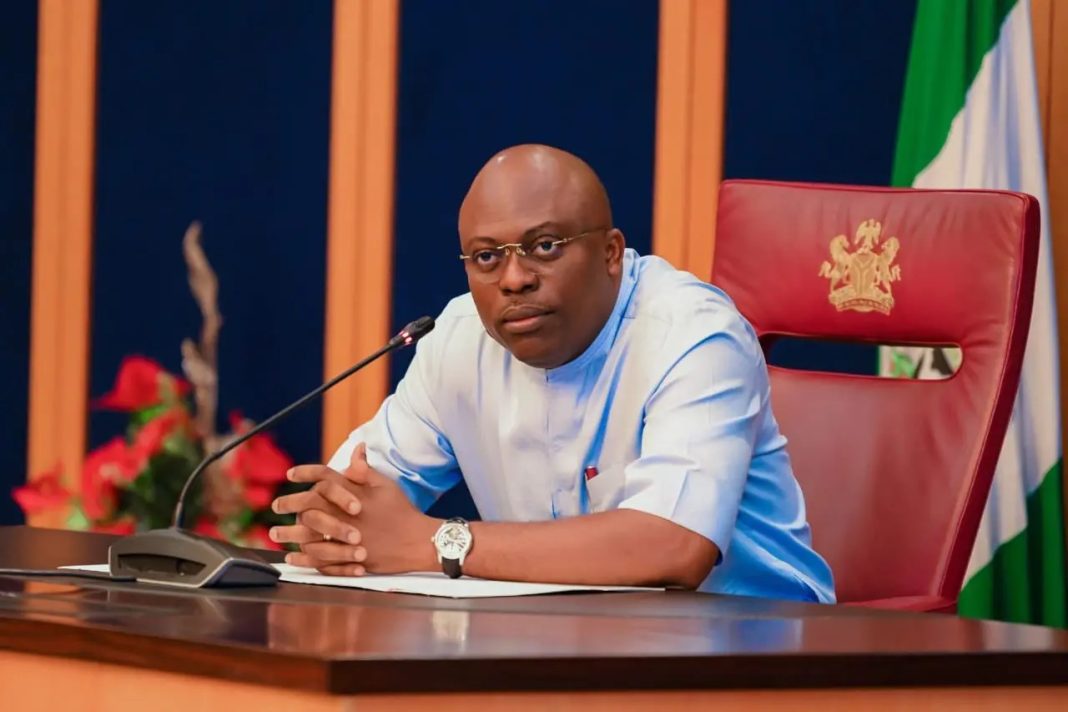

PORT HARCOURT, Nigeria — The Rivers State House of Assembly on Friday, January 16, 2026, escalated its confrontation with Governor Siminalayi Fubara by voting unanimously to ask the Chief Judge to constitute a panel to investigate allegations of gross misconduct.
The lawmakers target both the governor and his deputy, Ngozi Odu.
Lawmakers said the move was part of an impeachment process they intend to pursue to conclusion.
The Assembly also urged the Speaker, Martin Amaewhule, to reconvene the House for plenary sessions.
The development comes amid a prolonged political crisis in Rivers State, Nigeria’s oil-producing region, after relations between Fubara and the legislature deteriorated alongside a wider rupture involving Nyesom Wike, a former governor of Rivers State and the current Minister of the Federal Capital Territory.
Lawmakers Cite Constitutional Grounds
Speaking at a live press conference in Port Harcourt, lawmakers accused Fubara of blackmail and constitutional breaches, and said the governor and his deputy had sought to intimidate the Assembly to weaken legislative oversight.
Deputy Speaker Dumle Maol said the Assembly had exhausted political options and would proceed with constitutional measures.
“It is obvious that the only solution now is to apply the solution prescribed by the 1999 Constitution as altered, which is the impeachment of the incorrigible governor and the deputy governor,” Maol said.
“We therefore strongly appeal to leaders at all levels and the good people of Rivers State to kindly consider the problem at hand and understand that the impeachment process is the best way to go at this point.”
Maol also said lawmakers were calling on the Speaker to allow proceedings to continue without interference, and thanked President Bola Tinubu for past efforts to resolve the impasse.
“He did his best for the resolution of this impasse, but the governor and deputy governor are adamant,” Maol said.
Unanimous Vote in the Chamber
After the press briefing, lawmakers moved into the Assembly chambers for plenary, where members unanimously supported commencing an investigation into the allegations of gross misconduct against Fubara and Odu.
“This voting clearly shows the decision of the House,” Amaewhule said, urging the Chief Judge of Rivers State to establish a panel in line with constitutional provisions.
In a notable shift, four lawmakers who had previously called for a political solution withdrew that position and declared support for continuing the impeachment process.
Crisis Has Spanned Emergency Rule and Party Switch
The dispute has continued amid shifting political alignments in the state. Fubara recently defected from the Peoples Democratic Party (PDP) to the All Progressives Congress (APC), describing the move as an effort to align with Tinubu’s agenda, according to the lawmakers’ account.
The defection, announced in December 2025, followed months of political tensions, including the defection of several Assembly members to the APC.
The shift did not resolve the underlying conflict between the governor and lawmakers, many of whom the report said remained aligned with Wike.
The crisis previously triggered federal intervention.
In March 2025, Tinubu declared a state of emergency in Rivers State and suspended the governor, deputy governor and the Assembly for six months after tensions threatened governance and security.
A sole administrator was appointed during the emergency period, and the suspended officials were later reinstated, the account said.
Constitutional Steps in Impeachment Process
Under Section 188 of Nigeria’s 1999 Constitution (as amended), impeachment proceedings against a governor begin with allegations of “gross misconduct.”
The process requires a written notice signed by at least one-third of Assembly members, service of the notice on the governor, and an initial two-thirds vote to authorise an investigation.
If lawmakers approve investigation, the Speaker is required to ask the state’s Chief Judge to appoint a seven-person panel to review the allegations and submit a report.
If the panel finds the allegations proven, the Assembly can vote within 14 days to adopt the report, requiring a two-thirds majority to remove the governor.
If a governor is removed, the deputy governor becomes governor.
If both governor and deputy governor are removed, the Speaker becomes acting governor, and elections must be held within 90 days.
The constitutional provision also includes an ouster clause that limits court intervention in impeachment proceedings once due process is followed.