
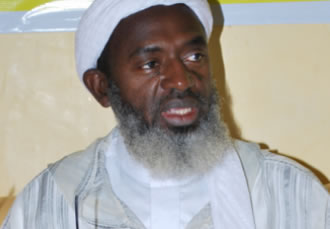

ABUJA, Nigeria — Ahmad Gumi, the Kaduna-based Islamic cleric who has long drawn national attention for his engagement with bandits in northern Nigeria, has reignited controversy after describing the abduction of schoolchildren as a “lesser evil” when compared with the killing of soldiers.
Speaking in an interview with the British Broadcasting Corporation published on Tuesday, December 9, 2025, Gumi said that while both acts are morally wrong, they do not carry the same weight of severity in his view.
“Saying that kidnapping children is a lesser evil than killing your soldiers — definitely it is lesser,” he said.
“Killing is worse than kidnapping, but they are all evil. Not all evils are of the same power.”
Gumi said his remarks reflected what he described as a moral hierarchy of wrongdoing, rather than an attempt to justify or excuse criminal acts.
Mass abductions of schoolchildren have become one of the most feared security threats in Nigeria over the past decade, with armed groups targeting schools across the north for ransom and leverage.
In the same interview, the cleric challenged the widely held policy position that governments should never negotiate with terrorists or armed groups, arguing that such a stance is not supported by religious texts or by global practice.
“That phrase, ‘we don’t negotiate with terror’, I don’t know where they got it from. It’s not in the Bible. It’s not in the Quran. In fact, it’s not even in practice. Everybody is negotiating with outlaws, non-state actors — everybody,” he said.
“We negotiate for peace and our strategic interests. If negotiation will bring a stoppage to bloodshed, we will do it.”
Gumi has for years been criticised by government officials, security analysts and victims’ groups for what they see as his repeated engagement with bandit groups, which they argue risks legitimising criminal networks responsible for killings, mass kidnappings and village raids.
He rejected those accusations, describing them as detached from the realities of conflict mediation.
“Anybody who thinks that way doesn’t understand the intricacies and what we go through,” he said.
“I go there with the authorities. I don’t go alone. And I go there with the press.”
According to him, his last direct interaction with bandits took place in 2021 as part of an effort to facilitate dialogue between armed groups and state authorities.
He claimed that while some state governments welcomed his involvement, the federal government “wasn’t keen” on his role.
Gumi also called for a stronger military presence in regions worst affected by banditry, but cautioned that the armed forces alone cannot resolve Nigeria’s security crisis.
He said even military commanders recognise the limits of relying solely on force.
“We need a robust army… but even the military is saying our role in this civil unrest, in this criminality, is 95 percent kinetic,” he said.
“The rest is the government, the politics, and the locals. The military cannot do everything.”
In explaining his understanding of the motivations behind banditry, Gumi described many of the armed groups as Fulani herdsmen engaged in what he termed an “existential war” connected to cattle ownership, inheritance and access to land.
“They are fighting an existential war. Their life revolves around cattle… They’ll tell you, ‘This cow I inherited from my grandfather’,” he said.
“They are mostly Fulani herdsmen, not the Fulani town — we have to differentiate between the two.”
His comments come at a time of renewed public outrage over attacks on schools and the killing of security personnel in several northern states.
In recent months, soldiers have also suffered deadly ambushes in anti-banditry operations, intensifying debates over whether negotiation, military escalation or a combination of both offers the best path forward.
Reaction to Gumi’s remarks was swift on social media, where many Nigerians expressed anger at what they viewed as a dangerous minimisation of the trauma inflicted on abducted children and their families.
Others defended his broader argument that dialogue remains an unavoidable tool in conflicts involving non-state armed groups.
Nigeria’s federal authorities have repeatedly insisted that their official policy prioritises military pressure, although past hostage releases have often been accompanied by quiet пеgotiations that officials rarely acknowledge publicly.