
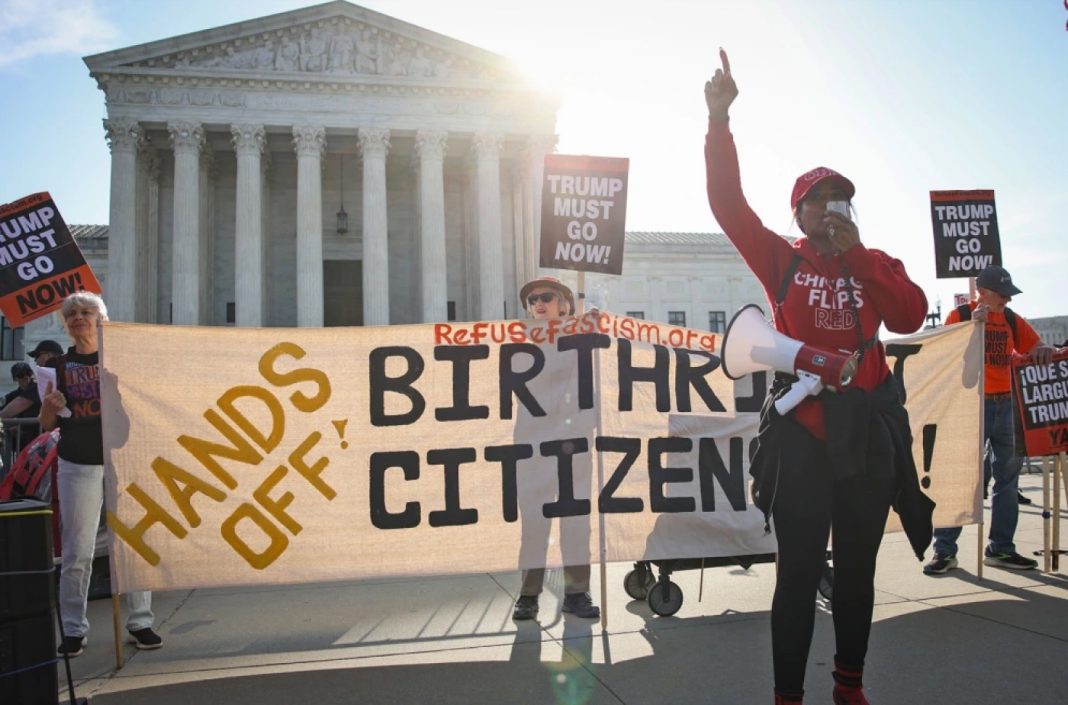

WASHINGTON, United States — The Supreme Court of the United States signalled scepticism on Wednesday, April 1, 2026, over an executive order by Donald Trump seeking to limit birthright citizenship, as justices from across the ideological spectrum questioned the legal basis of the proposal.
The order, introduced at the start of Mr Trump’s second term, would restrict citizenship at birth to children with at least one parent who is a United States citizen or a lawful permanent resident.
It would exclude children born to temporary visitors or individuals without legal immigration status.
Justices Probe Constitutional Basis
During oral arguments, several justices challenged the administration’s interpretation of the citizenship clause of the 14th Amendment, which states that all persons born in the United States and “subject to the jurisdiction thereof” are citizens.
Chief Justice John Roberts questioned whether changing circumstances could justify altering the clause’s long-standing interpretation. “It’s a new world. It’s the same Constitution,” he said.
Justice Neil Gorsuch also raised concerns about the government’s argument, noting that historical interpretations of jurisdiction did not depend on legal immigration status.
“If somebody showed up here in 1868 and established domicile, that was perfectly fine,” he said.
Justice Elena Kagan said the administration appeared to rely on “pretty obscure sources” and added, “The text of the clause, I think, does not support you.”
Justice Clarence Thomas asked government lawyers to clarify how their argument addressed the historical purpose of the amendment, which was adopted after the Civil War to grant citizenship to formerly enslaved people.
Justice Samuel Alito expressed a more sympathetic view, suggesting that the clause’s language could be applied to circumstances not anticipated at the time of its adoption, including modern immigration patterns.
Executive Order Blocked
The executive order has been blocked by lower courts and has not taken effect. Legal experts have widely suggested that the administration faces a difficult path in defending the measure.
The administration’s legal argument centres on the phrase “subject to the jurisdiction thereof,” asserting that it implies a requirement of political allegiance to the United States.
Opponents, including the American Civil Liberties Union, argue that the amendment’s language and historical interpretation clearly support citizenship for nearly all individuals born on U.S. soil.
Broader Legal and Social Implications
The court also examined whether the executive order could conflict with existing federal immigration law, potentially allowing a ruling without directly addressing the constitutional question.
If implemented, the policy could affect thousands of children born in the United States each year.
Mr Trump attended the arguments in person, an unusual step for a sitting president, but left before proceedings concluded.
The case marks a significant legal challenge to one of the most established principles of American constitutional law, with a ruling expected in the coming months.