

ZURICH, Switzerland — FIFA lawyers found that Democratic Republic of Congo goalkeeper Lionel Mpasi had not completed the required process to represent the country, but Nigeria’s protest was rejected on procedural grounds and no sporting sanction was imposed.
The findings, contained in internal FIFA documents reviewed by Le Monde and The New York Times, have renewed scrutiny of how DR Congo remained in the 2026 World Cup qualifying process despite questions over Mpasi’s eligibility.
Mpasi played the full 120 minutes when DR Congo eliminated Nigeria on penalties in the African playoff final in Rabat, Morocco, on November 16, 2025.
Nigeria later challenged the eligibility of Congolese players, but FIFA said the complaint was inadmissible and that no proper appeal followed.
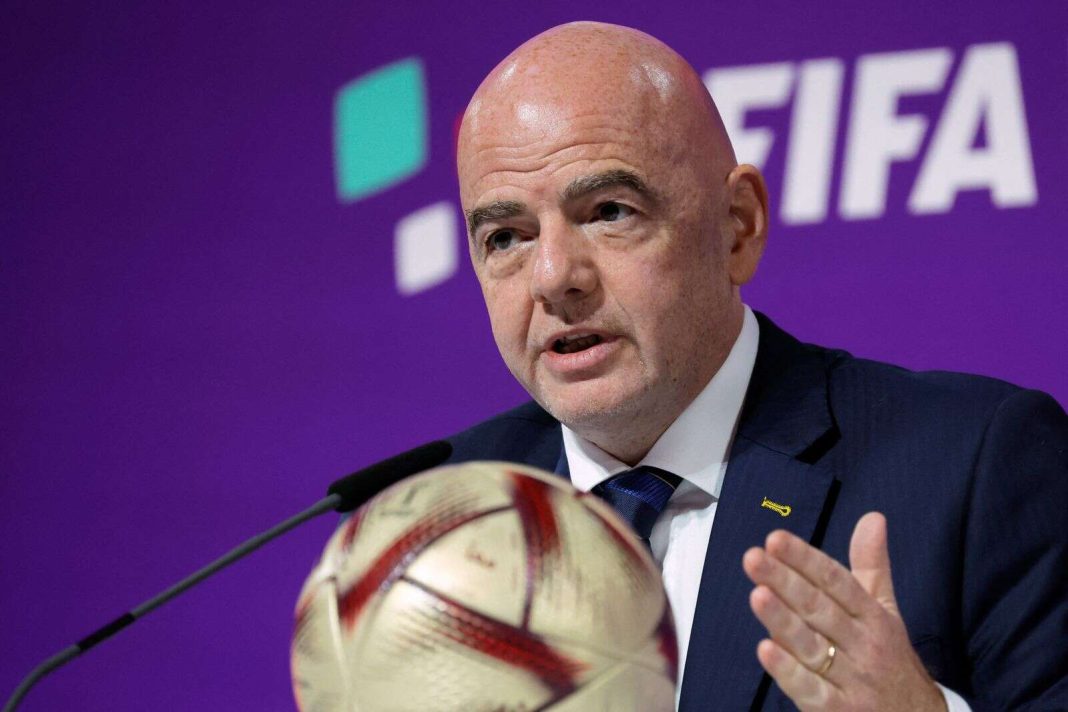
The governing body has rejected suggestions that FIFA President Gianni Infantino interfered in the disciplinary process.

FIFA Lawyers Found Mpasi’s Switch Was Incomplete
Mpasi was born in France and represented the country at youth level, including in competitive matches.
DR Congo began the process of changing his international association in 2021, but FIFA lawyers later concluded that the switch had never been formally completed.
That meant the Congolese federation had not obtained the authorisation required before fielding him.
Mpasi nevertheless made his DR Congo debut in 2022 and appeared in multiple matches during the qualification campaign for the 2026 World Cup.
According to Le Monde, FIFA lawyers examined his status on March 9 and 10, shortly before DR Congo was due to face Jamaica for a place at the tournament.
Their internal assessment concluded that Mpasi was ineligible.
The Associated Press reported that the documents showed he had appeared in five qualifiers without formal approval to represent DR Congo.
Nigeria’s Protest Was Dismissed
The Nigeria Football Federation said it raised eligibility concerns after losing the African playoff final.
According to Le Monde, the NFF said it submitted its complaint on November 28, 2025.
FIFA, however, said the relevant protest was received only in March and failed to meet procedural and timing requirements.
“We can confirm that the FIFA Disciplinary Committee dealt with a protest filed by the Nigeria Football Federation (NFF) in this respect,” FIFA spokesman Bryan Swanson said.
“Following a procedure, the protest was declared inadmissible by this FIFA body.”
FIFA said the ruling was communicated to the NFF in early March and became final because no proper appeal was lodged.
The governing body said its judicial bodies operate independently and decide cases under the applicable rules.
FIFA Had Power to Act Independently
The internal documents show that FIFA could have opened disciplinary proceedings even if Nigeria’s complaint was procedurally defective.
Its rules allow the disciplinary committee to act on its own authority where an ineligible player has been fielded.
According to Le Monde, FIFA lawyers identified several possible responses, including a fine, suspension, match forfeiture, a future points deduction, or replacing DR Congo with Nigeria in the intercontinental playoff against Jamaica.
None of those measures was imposed before the playoff.
DR Congo went on to beat Jamaica and qualify for the World Cup for the first time since 1974.
Nigeria Was Not Automatically Entitled to a World Cup Place
The documents do not show that Nigeria would automatically have qualified for the tournament.
If FIFA had overturned only Nigeria’s playoff defeat to DR Congo, one option was for the Super Eagles to replace DR Congo in the intercontinental playoff against Jamaica.
Nigeria would still have needed to win that match.
A broader review could also have affected other teams.
Mpasi appeared in several earlier qualifiers, and Le Monde reported that FIFA lawyers concluded that forfeiting all affected results could have changed the African standings enough for Burkina Faso to advance instead.
Jamaica was also directly affected because Mpasi later played against it in the intercontinental playoff.

Mosengo-Omba Relationship Draws Scrutiny
The case has also focused attention on the relationship between Infantino and Véron Mosengo-Omba, who became president of the Congolese Football Federation in May.
Mosengo-Omba and Infantino studied law together at the University of Fribourg in Switzerland and later worked in international football administration.
Mosengo-Omba served at UEFA, became director of FIFA’s member associations division, later became general secretary of the Confederation of African Football, and worked on Infantino’s successful 2016 FIFA presidential campaign.
Le Monde reported that Infantino supported Mosengo-Omba’s rise in football administration and raised questions about whether that relationship influenced the handling of the eligibility case.
The newspaper did not establish that Infantino ordered officials to protect DR Congo.
FIFA has denied any such interference.
“FIFA strongly rejects any suggestion that the FIFA President would interfere with these processes,” the organisation said.
Mosengo-Omba did not respond to Le Monde’s questions, according to the newspaper.
Those allegations have not been independently proved.
Similar Eligibility Cases Have Led to Forfeits
The absence of a sanction has drawn further attention because FIFA has imposed match forfeits in previous cases involving ineligible players.
During qualification for the 2018 World Cup, Bolivia forfeited matches after fielding an ineligible player.
South Africa was also punished during the 2026 qualifying campaign after using Teboho Mokoena while he was suspended.
The internal FIFA review reportedly acknowledged that similar cases had often resulted in forfeitures.
Nigerian Officials Consider Next Steps
The disclosures have prompted renewed criticism in Nigeria.
Former NFF president Ibrahim Musa Gusau said FIFA had failed to explain what it knew about Mpasi’s status.
“They just kept quiet, and they can’t tell anyone because they know it’s going to be a serious crisis for them,” Gusau said.
The Guardian reported that Nigerian sports officials were considering whether to seek compensation for losses linked to missing the World Cup.
“Nothing has been decided yet, but we will seriously consider seeking compensation from FIFA for all of the economic losses this has cost Nigeria,” an unnamed National Sports Commission official said.
The Jamaica Football Federation has also called for player-eligibility disputes to be handled consistently and transparently.
FIFA has not announced any move to reopen the qualifying results.
Its position remains that Nigeria’s protest was inadmissible and that no valid appeal followed.
The newly disclosed documents nevertheless show that FIFA lawyers themselves concluded before DR Congo’s final qualifying match that Mpasi had not completed the process required to represent the country.