
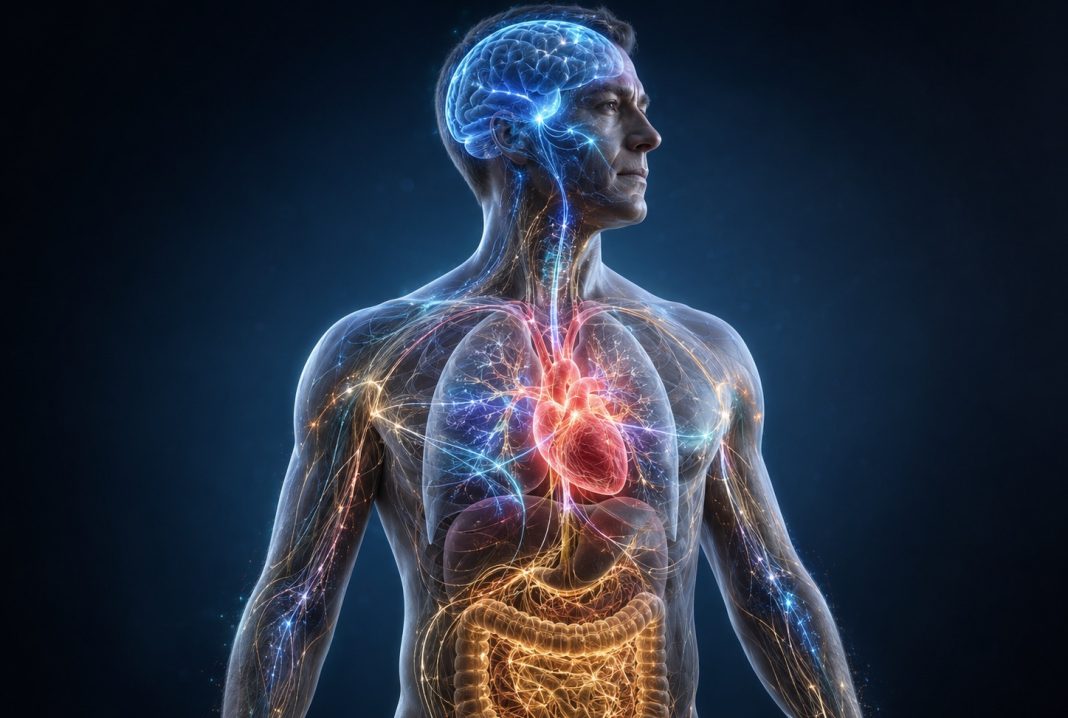

For centuries, the body was often imagined as a biological monarchy. The brain sat on the throne, issuing commands to obedient organs below. The heart pumped, the gut digested and the lungs drew breath. Intelligence belonged to the head.
Modern physiology presents a more interesting picture.
The brain remains the primary organ of conscious thought, memory and deliberate decision-making. But it is not the body’s only centre of information processing. The gut contains an extensive nervous system capable of organising digestion locally. The heart has neural circuits that continually adjust its performance. Hormones, immune cells and microbes carry messages between organs. Even the sleeping brain depends on fluid pathways that help remove metabolic waste.
ALSO READ: The 12 Best Foods for Brain Health and Why They Work
RELATED: Déjà Vu Explained: 10 Things to Know About the Brain’s Strangest Memory Glitch
The human body is less like a machine controlled by a single executive and more like a federation: specialised systems managing local conditions while remaining in constant conversation with the whole.
Intelligence Without Conscious Thought
Calling these systems “intelligent” requires care. A heart does not reason about love, and the gut does not make decisions in the way the cerebral cortex does. Yet intelligence can have a broader biological meaning: the ability to detect change, process information and produce an adaptive response.
By that definition, the body is filled with local intelligence.
Blood vessels widen or narrow in response to chemical signals. Immune cells distinguish threats from healthy tissue, although imperfectly. The pancreas monitors blood glucose and adjusts its hormonal output. The kidneys continuously alter the balance of water, salts and acids in the bloodstream.
Most of this happens without conscious instruction. Were the brain required to supervise every heartbeat, digestive contraction and immune reaction, conscious life would be impossible. Biology solves the problem through distributed control.
The Gut’s Nervous System
Embedded in the walls of the digestive tract is the enteric nervous system, a vast network containing hundreds of millions of neurons. Estimates vary, and the popular claim that it definitively contains more neurons than the spinal cord is not well established. What is beyond dispute is its extraordinary complexity.
The enteric nervous system senses the chemical and physical conditions inside the gut. It coordinates the muscular contractions that move food, regulates secretions, influences blood flow and communicates with immune and endocrine cells. It can carry out many digestive reflexes even when direct communication with the brain is interrupted.
This autonomy explains why it is sometimes called the “second brain”. The phrase is evocative, but it should not be taken literally. The gut does not think. It runs a sophisticated local control system that exchanges information with the brain through nerves, hormones, immune signals and microbial products.
That conversation can affect appetite, pain, stress responses and aspects of mood. However, much of the most dramatic research on the microbiome and behaviour comes from animal studies. Scientists are still working out which findings reliably translate to human beings. The gut–brain connection is real, but it is not evidence that a particular food, probiotic or “detox” programme can treat a psychiatric condition. Research on the microbiota–gut–brain axis
The Heart Is More Than a Pump
The heart also has a local nervous system. Clusters of neurons in and around it monitor conditions, communicate with one another and help adjust heart rate, electrical conduction and the strength of contraction from one beat to the next.
These circuits operate within a larger hierarchy. The heart receives signals from the brain and autonomic nervous system, but it can also make rapid local adjustments. Researchers sometimes describe this network as the heart’s “little brain”, although that label can invite exaggeration. There is no credible evidence that the heart thinks, stores a person’s memories or independently experiences emotions.
It is nevertheless more than a mechanical pump. The heart is also an endocrine organ. It releases natriuretic peptides, hormones that help regulate blood pressure, blood volume and the balance of salt and water. Its rhythm also carries information back to the brain, contributing to the bodily sensations that accompany fear, excitement, calm and exertion. Review of the intrinsic cardiac nervous system
This two-way communication may help explain why emotions feel physical. Anxiety can produce a racing heart, but a forceful or irregular heartbeat can also intensify the sensation that something is wrong. The brain interprets the body even as it regulates it.

The Brain’s Night-Time Maintenance System
The brain has no conventional lymphatic vessels running through its tissue in the way many other organs do. Instead, cerebrospinal fluid moves along spaces associated with blood vessels, exchanging with fluid between brain cells and helping transport metabolic waste towards drainage routes. Researchers call this the glymphatic system.
Landmark experiments in animals found that this fluid exchange and waste clearance increased during sleep. The findings created the popular image of the brain “washing itself” overnight. That metaphor captures something important, but the science is more complicated than a nightly rinse cycle.
Researchers continue to debate precisely how fluid moves through the human brain, how strongly sleep controls the process and what role impaired clearance may play in Alzheimer’s disease. Recent human evidence supports the possibility that normal sleep assists the removal of proteins associated with neurodegeneration, but the field is still developing. The original sleep-clearance study and recent human research
The practical conclusion is reassuringly ordinary. Consistent, adequate sleep supports memory, metabolism, immune function and cardiovascular health, regardless of whether scientists have mapped every glymphatic pathway. No supplement or elaborate cleansing ritual can substitute for it.
Breath: A Bridge Between Choice and Autopilot
Most autonomic functions cannot be controlled directly. A person cannot simply instruct the kidneys to filter more slowly or order the stomach to accelerate digestion. Breathing is different.
Respiration is automatic, yet it can also be altered voluntarily. This makes the breath an unusual bridge between conscious choice and involuntary physiology.
Slow, comfortable breathing changes pressure inside the chest and influences the relationship among respiration, heart rhythm, blood pressure and autonomic signalling. A large systematic review found that voluntary slow breathing generally increases measures of vagally mediated heart-rate variability during and after practice. That does not mean every deep breath “resets” the nervous system, but it does show that breathing patterns can influence physiological regulation within minutes. Systematic review and meta-analysis
Ancient South Asian practices placed unusual emphasis on breath long before researchers could measure these mechanisms. Ayurveda, situated within the broader Hindu intellectual tradition, also described the body as a collection of interacting functions rather than inert parts. Its concepts should not be treated as scientific structures discovered ahead of time: doshas and subdoshas are not anatomical organs or measurable neural networks. Still, the tradition’s attention to rhythm, breath, digestion and bodily awareness reflects questions that physiology continues to investigate in a different language.

Awareness Can Influence the Body, but It Does Not Command It
The scientific term for sensing the internal body is interoception. It includes awareness of heartbeat, breathing, hunger, fullness, temperature, pain and tension.
Interoception helps the brain estimate what the body needs. Those signals contribute to emotion and behaviour: a hollow stomach can sharpen irritability, shallow breathing can accompany alarm, and exhaustion can make an ordinary problem seem overwhelming.
Attention may affect this system indirectly. Noticing a clenched abdomen may prompt someone to release it. Observing rapid breathing may lead to slower breaths. Recognising persistent fatigue may encourage rest or medical attention. Through such feedback, awareness can change behaviour and autonomic activity.
But attention is not a remote control. Thinking about the heart does not cure cardiovascular disease. Focusing on the abdomen cannot correct a serious digestive disorder. No state of consciousness can guarantee that the brain clears amyloid proteins efficiently.
The useful idea is participation, not mastery. We can influence some conditions under which the body regulates itself, but we do not consciously direct its thousands of hidden processes.

A Five-Minute Body Check-In
A simple practice can make bodily signals easier to notice without assigning them mystical meaning.
Sit comfortably and allow your breathing to settle. Spend one minute noticing the breath without trying to deepen it. Then observe sensations in the chest: rhythm, pressure, warmth or tension. Move attention to the abdomen and notice hunger, fullness, movement or discomfort. Finally, widen attention to the entire body, including areas that feel neutral.
If it remains comfortable, breathe slightly more slowly for several minutes, avoiding exaggerated inhalations. Stop if you feel dizzy or short of breath.
This exercise is not a treatment or diagnostic test. Its value lies in recognising patterns. You may discover that stress appears first in your jaw, that eating hurriedly worsens discomfort or that inadequate sleep leaves the body agitated long before the mind acknowledges fatigue.
The Wisdom of a Distributed Body
The most important discovery is not that every organ secretly possesses a mind. It is that life depends on countless systems detecting, communicating and adapting at once.
The gut regulates its local environment while exchanging signals with the brain. The heart modifies its rhythm while responding to neural, hormonal and mechanical information. The sleeping brain participates in fluid movements that may be essential to its long-term maintenance. Breath gives conscious attention a limited but meaningful point of entry into these networks.
The body is neither a machine awaiting orders nor a collection of independent intelligences. It is a conversation—continuous, decentralised and extraordinarily precise. Learning to hear that conversation cannot give us total control. It may, however, help us live with greater respect for the sophisticated biology already keeping us alive.