

ITHACA, New York — Cornell University has suspended all parties and social gatherings at fraternity houses for the remainder of the 2026–27 academic year.
The ban is in response to mounting outrage over allegations that a female student was drugged and sexually assaulted by several fraternity members in 2024.
The Ivy League university announced the sweeping restrictions on Tuesday, October 13, alongside plans to involve New York State Police in investigating campus sexual assault complaints and strengthen institutional support for survivors.
Cornell President Michael I. Kotlikoff said the measures would take effect immediately, with any fraternity violating the restrictions facing emergency suspension.
The decision follows weeks of student demonstrations, faculty criticism, and public scrutiny of the university’s handling of allegations brought by a former student identified in court documents as Jane Doe.
The woman filed a lawsuit in September alleging that she was coerced into consuming drugs and sexually assaulted by multiple members of the Chi Phi fraternity during an October 2024 gathering.
Seven former fraternity members are among the defendants.
The men have denied wrongdoing, and none has been criminally charged.
The lawsuit has renewed questions about the university’s disciplinary procedures, its handling of sexual misconduct allegations, and why an initial criminal investigation ended without prosecution.
In his announcement to the Cornell community, Kotlikoff acknowledged the university’s shortcomings and expressed regret over the woman’s experience.
“I am deeply sorry for the harm Jane Doe suffered in 2024,” he said.
He also acknowledged that women at Cornell continued to question whether they were safe on campus, describing the new restrictions as part of a broader effort to change the university’s culture.

Fraternity Social Life Suspended
Under the new directive, all parties and social events at houses affiliated with Cornell’s Interfraternity Council are prohibited until the conclusion of the current academic year in 2027.
The council represents more than 20 active fraternities at the university.
Cornell has adopted a zero-tolerance policy, meaning any chapter hosting a prohibited event will face immediate emergency suspension.
University administrators said the restrictions would create an opportunity to examine the role of fraternities and determine whether they can continue operating safely.
The review will address not only sexual misconduct but also the broader social environment surrounding fraternity life, including alcohol consumption, recreational drug use, and student behaviour.
Cornell also plans to work with students and faculty members to develop alternative social activities that do not depend on fraternity houses.
The announcement did not establish whether the prohibition extends to fraternity-organised events at off-campus locations.
The restrictions represent one of the university’s most extensive recent interventions in fraternity social life.
In 2022, Cornell temporarily suspended fraternity parties after reports that students had been drugged and a woman sexually assaulted at fraternity-affiliated housing.
The university also introduced tighter fraternity safety measures following the 2019 death of freshman Antonio Tsialas, whose body was found in a gorge after he attended a fraternity event.
Those earlier episodes had already raised concerns about the effectiveness of university oversight of fraternity activities.

Allegations Dating Back to 2024
The controversy centres on events alleged to have occurred during the night of October 19 and the early hours of October 20, 2024, at Cornell’s Chi Phi fraternity house.
According to the civil lawsuit, Jane Doe attended a gathering where fraternity members pressured her to consume drugs and alcohol.
She alleges that she was subsequently sexually assaulted by multiple men while in an impaired condition.
The complaint also describes Snapchat messages allegedly circulated among fraternity members portraying her as sexually available to other men without her knowledge or consent.
The allegations, which have not been established in criminal proceedings, prompted an internal university investigation under Title IX, the federal law governing sex discrimination in educational institutions.

Cornell subsequently closed the Chi Phi chapter and disciplined several students, including expulsions and suspensions.
However, its disciplinary decisions did not result in criminal charges.
Attorneys representing the accused men have disputed the allegations, with some maintaining that any sexual activity was consensual and others denying involvement.
The lawsuit names Cornell, the fraternity, the woman’s sorority, Tri Delta, seven former Chi Phi members, and other defendants.
It alleges that institutional failures contributed to the circumstances surrounding the alleged assault and the university’s subsequent response.

Criminal Investigation Reopened
The handling of the original police investigation has become a central part of the controversy.
Jane Doe reported the alleged assault to Cornell University Police in November 2024.
Campus investigators gathered evidence and referred information to Tompkins County District Attorney Matthew Van Houten, whose office decided not to prosecute.
Van Houten subsequently maintained that the information presented to prosecutors did not establish that a crime had occurred.
However, the woman’s lawyer, Thomas Giuffra, has challenged the circumstances surrounding that decision.
He told the Associated Press that his client had been given the impression that the investigation remained active when prosecutors had already decided against pursuing charges.
Giuffra also questioned whether prosecutors had reviewed all relevant evidence, including statements about physical violence and messages allegedly exchanged among fraternity members.

The case returned to public attention following the filing of the September lawsuit.
Van Houten announced that he would reopen the investigation, but New York Governor Kathy Hochul subsequently removed the local prosecutor from the case.
Hochul appointed New York Attorney General Letitia James as special prosecutor, transferring responsibility for the criminal investigation to her office.
James is now overseeing the reopened inquiry.
Separately, Cornell announced on Tuesday that it would work with New York State Police to provide experienced investigators trained to handle sexual assault cases.
The state police personnel will be able to interview survivors seeking criminal investigations and prepare reports for the appropriate law enforcement authorities.
The arrangement is intended to provide an investigative process independent of Cornell’s own police department, whose handling of the original allegations has attracted criticism.

Independent Review Led by Sally Yates
Cornell’s Board of Trustees has also commissioned an independent examination of the university’s sexual misconduct policies and institutional response.
The review is being led by Sally Yates, a former United States deputy attorney general, through the law firm King & Spalding.
Her mandate includes examining how Cornell receives and investigates sexual assault complaints, supports complainants, conducts disciplinary proceedings, works with law enforcement, and oversees fraternity organisations.
The review will also examine the university’s response to Jane Doe’s allegations.
Cornell’s trustees have said they intend to share findings and recommendations with the university community.
However, the scope of any eventual public disclosure remains uncertain.
A Reuters analysis published on Tuesday noted that universities commissioning investigations through law firms sometimes face competing pressures involving transparency, confidentiality, potential litigation, and attorney-client privilege.
The board has not established a public deadline for completion of the review.
Students and Faculty Demand Accountability
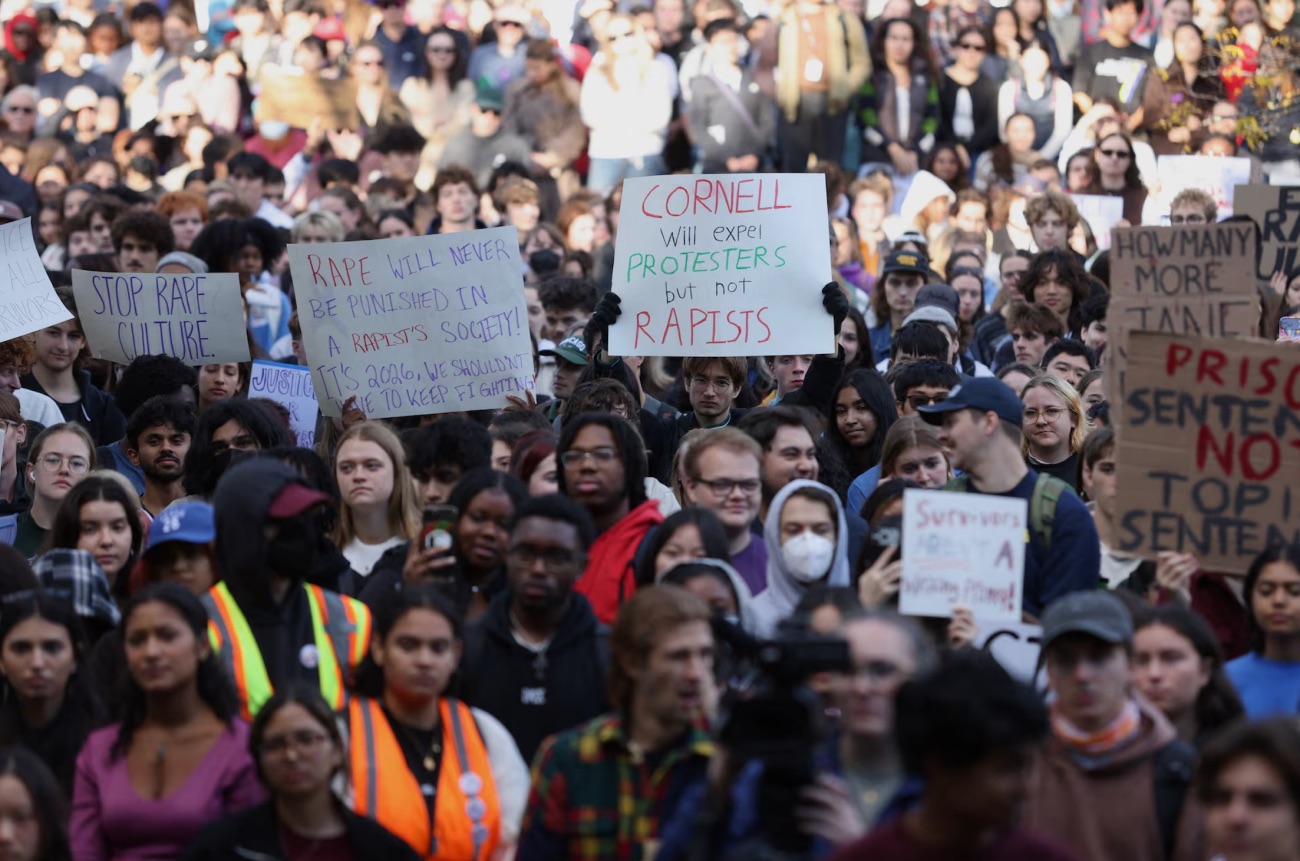
The restrictions come after a series of protests organised by Cornell students and supporters demanding greater accountability for sexual violence.
Thousands of students and community members participated in a rally on October 5, while demonstrators organised a sit-in at Toni Morrison Dining Hall on October 7.
Some protesters called for stronger sanctions against students found responsible for sexual misconduct, improved reporting procedures, and greater independence in investigations.
Faculty members have also questioned the administration’s response.
Cornell’s Faculty Senate is scheduled to consider a proposed resolution expressing no confidence in the university leadership’s handling of sexual assault on Wednesday, October 14.
Paul Ortiz, a Cornell professor of labour history and a leading sponsor of the resolution, welcomed the new restrictions but criticised the timing.
He told the Associated Press that the measures had followed sustained student protests, intense news coverage, and pressure from survivors and faculty members.
Ortiz said numerous students, alumni, and university employees had approached supporters of the resolution with accounts of sexual misconduct and concerns about institutional responses.
The proposed no-confidence resolution represents a significant test of confidence in Kotlikoff’s leadership, although it does not itself constitute a decision to remove him.
The controversy has also reached beyond the campus.
On October 8, hundreds of demonstrators gathered in New York City under the banner of an emerging movement against sexual violence, drawing attention to the Cornell allegations and broader concerns about accountability.

Survivor’s Lawyer Welcomes Changes but Says They Came Too Late
Giuffra said the measures announced by Cornell represented progress but could not undo what his client had experienced.
In comments to NBC News, he said Jane Doe had pursued litigation partly to improve how the university responds to allegations of abuse.
He welcomed the new initiatives but said they had come too late to protect her.
The lawyer expressed hope that the changes would prevent similar experiences among future students.
The Cornell president has also announced plans to increase staffing at the university’s Office of Civil Rights, appoint a dedicated case manager to assist students reporting sexual misconduct, and expand prevention education and victim advocacy services.
The proposed support arrangements will help complainants navigate academic accommodations, housing arrangements, financial aid, and other university processes while their cases are reviewed.
Kotlikoff has said the university must address the prevalence of excessive drinking and drug use, as well as the responsibility of students to intervene when they witness potentially dangerous situations.
He acknowledged that sexual violence is not confined to fraternities and that any lasting institutional reform must extend beyond restricting fraternity social events.
For Cornell, the immediate challenge is implementing the new restrictions while the criminal investigation, civil litigation, faculty scrutiny, and independent institutional review continue.
Whether the university ultimately restores fraternity social events will depend on the outcome of its broader examination of campus safety and fraternity life.




