
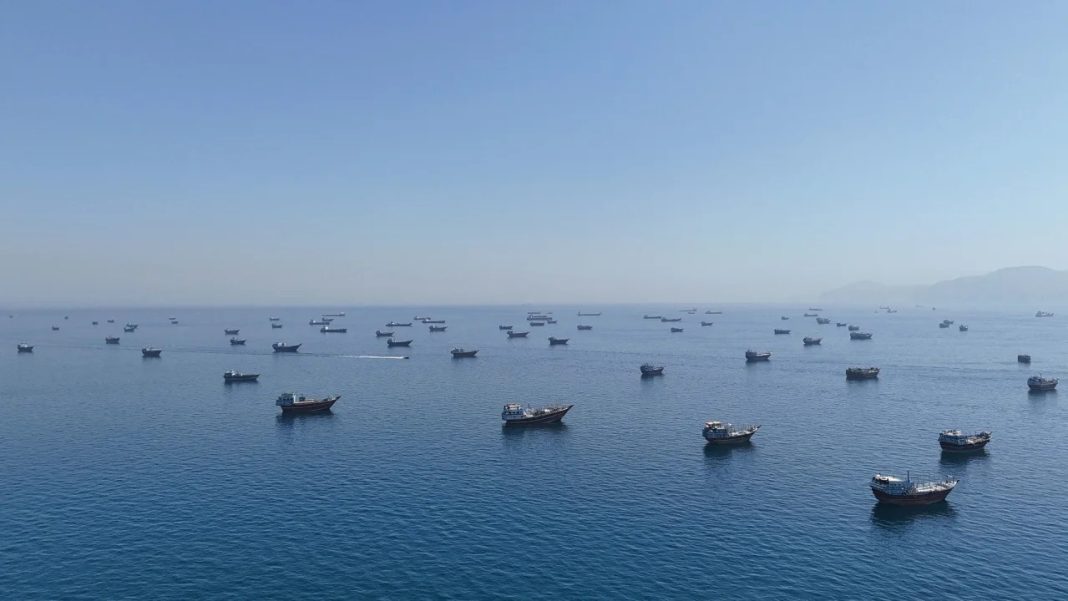

DUBAI, United Arab Emirates — Commercial traffic through the Strait of Hormuz has begun to increase after the United States and Iran moved to reduce tensions over one of the world’s most important maritime corridors.
Still, the two governments offered conflicting accounts of whether Tehran had agreed to admit nuclear monitors.
At least two dozen commercial vessels passed through the strait over a 24-hour period, according to MarineTraffic data cited on Tuesday, June 23, 2026.
The figure marked a steady rise in movement through the waterway, though shipping remained below levels recorded before the war.
The increase followed an agreement by Iran and the United States to establish a communication channel for the strait.
Iran’s top negotiator said the hotline was intended to “prevent and resolve any misunderstandings” with countries whose vessels transit the chokepoint.
The Strait of Hormuz is a critical passage for oil and commercial shipping from the Gulf.
Any prolonged disruption there can unsettle energy markets and raise costs for exporters and importers across the region.
Dispute Over Nuclear Access
The improvement in maritime traffic came as Washington and Tehran disagreed publicly over nuclear monitoring.
Vice President JD Vance said Iran had agreed to allow nuclear monitors into the country as part of discussions with the United States. Iran denied that it had made any new commitment.
President Donald Trump said his administration’s priority was preventing Iran from acquiring a nuclear weapon, even if a prolonged conflict carried economic consequences.
The dispute over monitoring underscored the uncertainty surrounding the emerging arrangement between the two countries.
The United States has presented the talks as progress toward a broader deal, while Iran has pushed back against claims that it has accepted new nuclear obligations.
Rubio Heads to the Gulf
Secretary of State Marco Rubio is expected to visit the Gulf region as the Trump administration seeks support for the preliminary agreement with Iran.
Rubio is scheduled to travel to the United Arab Emirates, Kuwait and Bahrain, three countries with direct security and economic interests in the stability of the Gulf and the Strait of Hormuz.
In Bahrain, he is also expected to meet with the Gulf Cooperation Council, which includes Saudi Arabia, Qatar and Oman.
The discussions are expected to include the handling of shipping through the strait and wider concerns about the terms of the U.S.-Iran arrangement.
One point of concern is Iran’s expected role, alongside Oman, in oversight connected to commercial traffic through the Strait of Hormuz.
Another is that the interim arrangement does not address Iran’s missile programme, an issue several Gulf states consider central to their security.
The agreement also includes a proposed $300 billion reconstruction fund for Iran.
Trump has committed Gulf funding to the initiative, though there has been no clear indication that Gulf governments have formally agreed to finance it.
Saudi Arabia has said it has “no details” about the proposal, while Qatar has expressed interest without announcing a formal commitment.
Lebanon Talks Resume
Separate U.S.-mediated talks are also expected to begin over fighting in Lebanon between Israel and Hezbollah, the Iran-backed group.
Hezbollah is not included in the talks and has denounced them.
A U.S. official said Washington had also established a “monitoring mechanism” for the ceasefire, after repeated violations threatened to complicate wider negotiations with Iran.
The fighting in Lebanon remains a point of tension in the broader diplomatic effort.
Iran has sought to link regional de-escalation to the wider discussions, while Israel has maintained that its security concerns in Lebanon must be handled separately.
For now, the renewed movement through the Strait of Hormuz offers a limited sign of relief for shipping and energy markets.
But the competing accounts from Washington and Tehran over nuclear access suggest that major issues remain unresolved.