
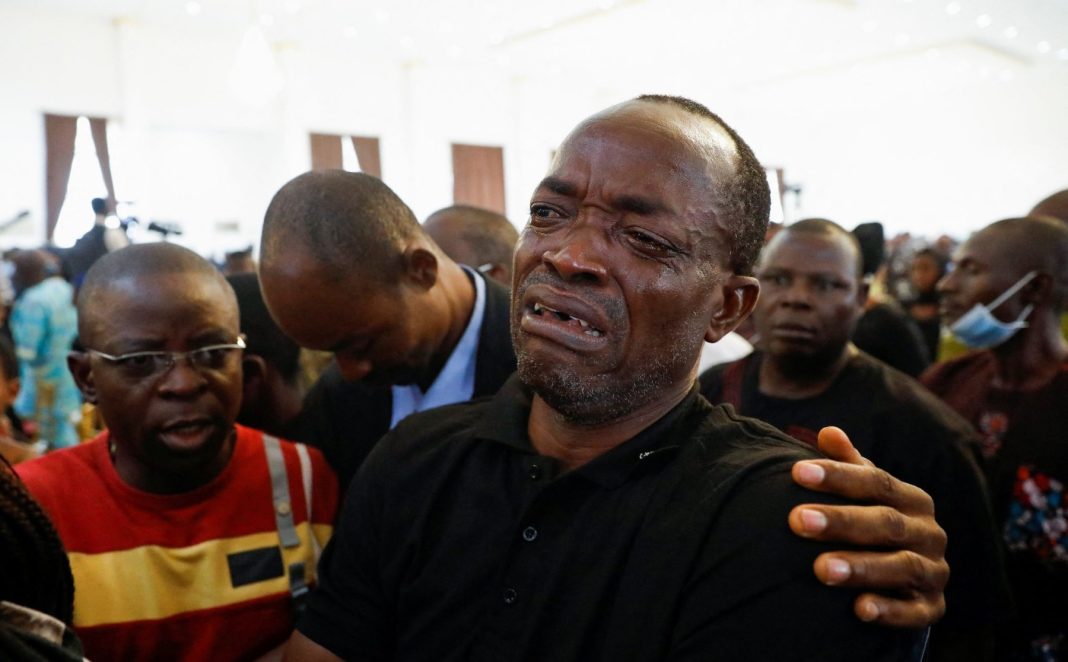

ENUGU, Nigeria — At least 7,500 Christians have been killed across Africa since the beginning of 2026, with more than 1,000 churches attacked, destroyed, or burned, according to a new report by the International Society for Civil Liberties and Rule of Law (Intersociety), a Nigerian human rights organisation.
The report, released in Enugu on Tuesday, October 13, identifies Nigeria as the country with the largest reported death toll, estimating that between 3,426 and 4,300 Christians were killed between January 1 and October 10.
The Democratic Republic of Congo accounted for an estimated 2,000 deaths, while at least 1,100 others were reported across several African countries.
Intersociety also recorded approximately 3,395 Christian abductions in Nigeria and estimated that the country accounted for about 42 per cent of the attacks on churches across the continent.
The findings, compiled from community accounts, survivor testimonies, eyewitness reports, media coverage, and information from research organisations, depict a widening pattern of violence affecting Christian communities across parts of sub-Saharan Africa.
The continental death toll and church destruction figures have not been independently verified.
The report also contains discrepancies between some of its estimates, underscoring the difficulties of establishing reliable casualty figures in regions affected by prolonged conflict and insecurity.
Nigeria Accounts for Largest Share of Reported Killings
According to Intersociety, Nigeria recorded at least 343 Christian deaths and 202 abductions in the 40 days between September 1 and October 10.
The organisation said 10 churches were destroyed during that period, eight pastors were abducted, and two pastors were killed.
Plateau State accounted for 130 of the reported deaths, while Adamawa recorded 64.
Other incidents were documented in Benue, Bauchi, Kaduna, Taraba, Kogi, Kwara, Sokoto, Imo, and Abia states.
In Adamawa, the organisation reported attacks attributed to Boko Haram militants against more than a dozen Christian communities in Gombi and Hong local government areas between early September and October 8.
It alleged that at least 40 Christians were killed, 50 people abducted, and three churches destroyed during those attacks.
Some of the violence has been independently reported.
On September 7, suspected Boko Haram militants attacked Nzangula village in Gombi Local Government Area, killing 12 residents and burning a church belonging to the Church of the Brethren in Nigeria, according to Punch.
The local government chairman, Markus Ishaya, confirmed the deaths and said a woman had been abducted.
In Southern Kaduna, Intersociety reported that at least 20 Christians were killed and 50 abducted during the 40-day period.
The organisation also alleged that hundreds of Christians abducted in previous years remained in captivity in forest camps around Rijana, although the precise number and current status of the captives could not be independently established.
More Than 1,000 Churches Reportedly Attacked
Beyond the deaths and kidnappings, the report identified the destruction of places of worship as a major feature of the violence.
Intersociety estimated that more than 1,000 churches were attacked, destroyed, or burned across Africa during the first nine months and 10 days of 2026.
Nigeria accounted for approximately 42 per cent of the incidents, suggesting that more than 400 church buildings were affected.
The organisation attributed many of the attacks in Nigeria to Boko Haram, the Islamic State West Africa Province (ISWAP), and armed militant networks operating in areas affected by longstanding conflicts involving farming and pastoral communities.
The destruction has consequences extending beyond religious worship. In many rural communities, churches also operate schools, clinics, food distribution centres, and other essential services.
A separate development in Benue State on Tuesday illustrated the impact of insecurity on religious institutions.
The Catholic Diocese of Gboko ordered the temporary closure of four institutions in Ihugh, Vandeikya Local Government Area, and the withdrawal of priests and other pastoral personnel following repeated attacks on church properties.
The affected institutions include St Winifred Girls Secondary School, St Winifred Nursery and Primary School, St Thomas Hospital, and St Winifred Parish.
In a decree dated October 12, Bishop William Avenya cited repeated incidents of arson, burglary, and destruction, including the burning of students’ hostels on several occasions between October 2025 and October 11, 2026.
The closures demonstrate how insecurity can disrupt education, healthcare, and religious life even when an attack does not produce fatalities.
Congo Records Estimated 2,000 Christian Deaths
Outside Nigeria, the Democratic Republic of Congo recorded the second-highest estimated toll, with at least 2,000 Christians reportedly killed between January and October 10.
Intersociety attributed many of the attacks to the Allied Democratic Forces (ADF), a militant organisation with roots in Uganda that pledged allegiance to the Islamic State group in 2019.
The group has operated for years in eastern Congo, particularly in North Kivu and Ituri provinces, where its fighters have attacked villages, religious gatherings, and civilian settlements.
In May, the Associated Press reported that at least 40 people had been killed in attacks attributed to the ADF in communities near the Uganda border.
Another attack in August killed at least 13 people in Banana École, near Mambasa, according to local civil society representatives cited by the news agency.
The ADF has also been linked to attacks on churches and Christian worshippers, including a deadly assault on a Catholic gathering in Komanda in July 2025.
Congo’s conflict, however, involves numerous armed organisations with differing political, territorial, and economic objectives. Not every civilian death in the country’s wars can be attributed to religious persecution.
Intersociety also documented reported attacks in Mozambique, particularly in Cabo Delgado, where an Islamist insurgency has displaced large numbers of civilians and disrupted communities for years.
The organisation identified further incidents affecting Christians in Sudan, South Sudan, Burkina Faso, Ethiopia, Kenya, and Uganda.
It estimated that these countries, together with other affected African states outside Nigeria and Congo, accounted for at least 1,100 Christian deaths during the reporting period.
Independent Research Reveals Extensive Violence
Although Intersociety’s continental estimates remain unverified, other organisations have independently documented large numbers of Christian deaths in Nigeria.
A September report by the United States-based humanitarian organisation Equipping the Persecuted recorded at least 4,216 Christians killed in Nigeria between January 1 and September 8, 2026.
Its report, Crisis in the Middle Belt: Religious Persecution and Security Failure in Nigeria, said the figures were compiled from eyewitness accounts, survivor testimony, community records, and field investigations.
The organisation described its count as a documented minimum and estimated that more than 600 predominantly Christian communities had been destroyed or abandoned.
Intersociety acknowledged the difference between its own tally of 3,426 Nigerian Christian deaths through October 10 and Equipping the Persecuted’s higher count covering an earlier end date.
It used the difference to establish an estimated Nigerian range of 3,426 to 4,300 deaths. The underlying incident records were not provided in the news account of the latest report, making it difficult to determine how extensively the two organisations’ figures overlap.
Intersociety also described 4,300 deaths as representing 65 per cent of its continental total of 7,500, although the figure is approximately 57 per cent. The discrepancy was not explained.
Separate research by the Observatory for Religious Freedom in Africa (ORFA) provides a longer-term picture.
In a study published in June 2026, ORFA documented 79,323 deaths associated with violence in Nigeria between October 2019 and September 2025, including 42,033 civilian fatalities.
Among those civilians, it identified 22,835 Christians and 10,519 Muslims, while the religious identities of 8,495 victims could not be established.
The study concluded that Christian communities had suffered disproportionately from attacks by armed groups in several parts of the country.
It also documented substantial Muslim casualties, showing that religiously identified victims of Nigeria’s violence are not exclusively Christian.
The Christian persecution organisation Open Doors, meanwhile, reported that 3,490 Christians were killed in Nigeria because of their faith during its October 2024 to September 2025 reporting period, accounting for nearly three-quarters of the 4,849 such deaths it recorded worldwide.
Its 2026 World Watch List ranked Nigeria seventh among countries where Christians face the most severe persecution.
The reporting periods and methodologies used by these organisations differ, meaning their totals cannot be directly combined or treated as interchangeable.
Rights Group Accuses Security Agencies of Complicity
Intersociety accused sections of Nigeria’s security establishment of failing to protect Christian communities and, in some cases, shielding suspected perpetrators.
The organisation alleged that security personnel had sometimes misrepresented attacks, blamed victims, or failed to take appropriate action against armed groups.
The allegations were not accompanied by independently verified evidence establishing institutional complicity across the security services.
Nigeria’s federal government has repeatedly rejected accusations that the country operates a policy of religious persecution.
In February 2026, Information Minister Mohammed Idris said Nigeria had no state policy permitting religious violence or discriminatory attacks.
The government has maintained that its security challenges arise from overlapping threats involving terrorism, organised crime, banditry, and communal conflict, and that Christians and Muslims have both suffered serious losses.
The African Union has also cautioned against characterising all the violence in Nigeria as genocide against Christians.
The distinction remains a major source of disagreement between the Nigerian government, religious freedom advocates, and organisations documenting attacks on Christian communities.
What is established, however, is that armed groups have carried out repeated attacks on Christian settlements and places of worship, while many predominantly Muslim communities have also experienced massacres, abductions, and displacement.
Growing Pressure for Protection and Accountability
The latest figures add to demands for stronger security measures, more reliable documentation of attacks, and accountability for perpetrators.
Research organisations have called for better protection of vulnerable communities, independent investigations of attacks, the prosecution of those responsible, and the safe return of displaced residents.
Intersociety’s report was signed by Emeka Umeagbalasi, its lead researcher; Chidinma Evangeline Udegbunam, head of campaigns and publicity; Obianuju Joy Igboeli, head of civil liberties and rule of law; and Samuel Kamanyaoku, head of field data collection.
While the precise continental toll remains uncertain, the findings reinforce a broader pattern documented by humanitarian organisations: deadly attacks, kidnappings, and the destruction of religious institutions continue to threaten civilian populations across several African countries.
For affected communities, the consequences extend beyond the immediate casualties, encompassing the loss of homes, livelihoods, schools, healthcare facilities, and places of worship.




