
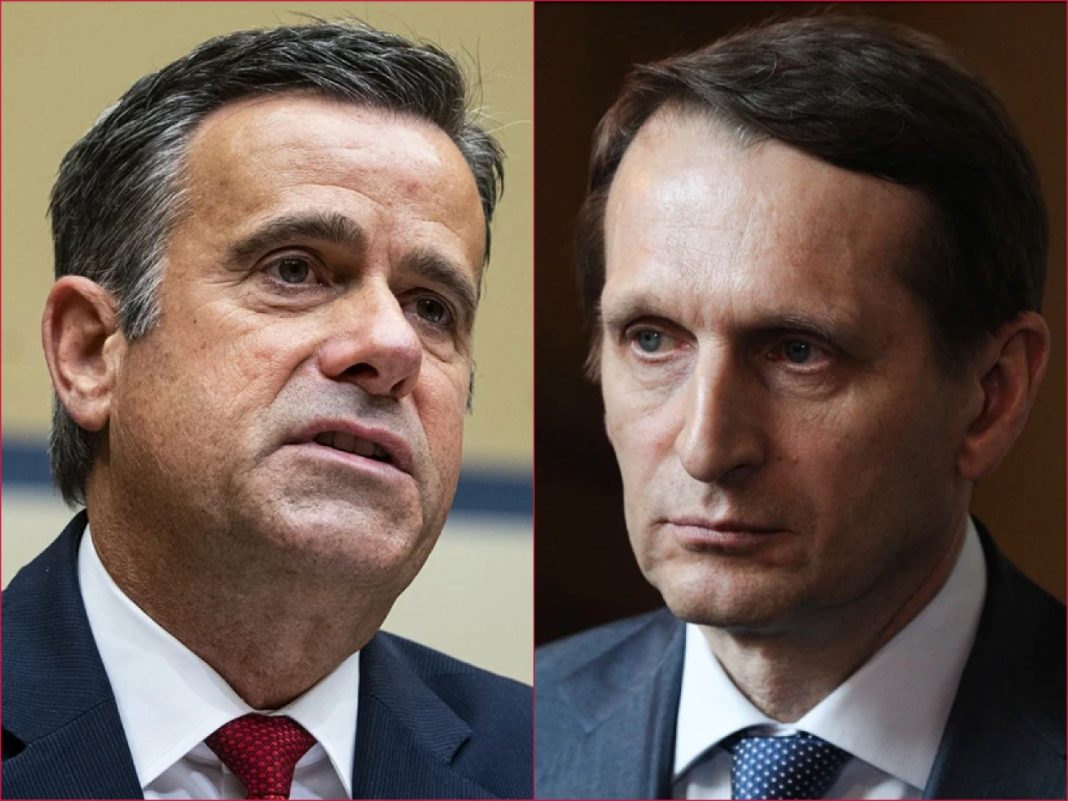

WASHINGTON, United States — CIA Director John Ratcliffe asked Russia not to provide intelligence to Iran during an unannounced meeting in Moscow this week, according to people familiar with the discussions.
Ratcliffe raised the matter with Sergey Naryshkin, the director of Russia’s Foreign Intelligence Service, during talks on Tuesday, August 25, 2026, that covered several security issues, NBC News reported.
The request came amid continuing American concern that Moscow could give Tehran information about United States military assets in the Middle East.
Neither the White House nor the Central Intelligence Agency has publicly confirmed the substance of the conversation.
Moscow Describes Talks as Routine
Naryshkin confirmed on Thursday that he had met Ratcliffe, describing their encounter as a “working-level meeting” involving sensitive matters within the responsibilities of the two intelligence agencies.
He told Russian state media that there was “nothing unusual” about the meeting. Naryshkin did not identify the subjects discussed or say whether he had given Ratcliffe any assurances concerning Iran.
Dmitry Peskov, the Kremlin spokesman, said Ratcliffe did not meet President Vladimir Putin. He added that Putin had been briefed on the discussions.
Peskov said contacts between intelligence agencies could continue during difficult periods in relations between the countries.
He cautioned, however, that it was too soon to determine whether Ratcliffe’s visit would help move bilateral ties out of what he called a “profound crisis”.
President Donald Trump also sought to minimise the significance of the trip.
He initially described it as “sort of semi-routine” and said it might contribute to efforts to end Russia’s war in Ukraine.
When asked whether Ratcliffe had travelled to discuss possible Russian action against NATO or sanctions connected to Iran, Trump replied, “None of the above.”
Trump later said Ratcliffe had not been sent to deliver a particular message and argued that meetings between the two intelligence chiefs occurred periodically.
“There was no message and there was nothing unusual,” Trump told Axios, according to Reuters.
Reports Cite Concerns Over Iran and NATO
Trump’s account differed from several reports about the meeting.
Two people familiar with the discussions told Reuters that Ratcliffe raised the possibility of a Russian operation against a NATO country.
One of the sources said Russia’s support for Iran was also discussed.
The Wall Street Journal reported that Ratcliffe warned Moscow against attacking a NATO member, while Politico said Estonia, Latvia and Lithuania were a particular focus of the talks.
The Washington Post separately reported that recent classified American intelligence indicated that the Kremlin viewed the United States as weakened by its war with Iran and saw an opportunity to intensify action against American interests and allies in Europe.
The assessment preceded Ratcliffe’s visit, according to two people familiar with it.
Trump rejected those concerns publicly.
“He’s not going to attack a NATO territory,” Trump said of Putin during remarks at the White House.
The Kremlin has also denied that Russia intends to attack a NATO member.
Peskov characterised reports suggesting otherwise as unfounded alarmism.
Western intelligence agencies have monitored suspected Russian sabotage, cyberoperations and other activity in Europe that remains below the threshold of conventional war.
Reuters reported that officials had examined the possibility of a false-flag operation in which a Ukrainian drone could be used to attack an eastern or northern European country while concealing Russian involvement.
No government has publicly presented evidence that such an operation has been authorised.
Earlier Claims of Russian Support for Iran
Questions about Russian intelligence assistance to Iran arose soon after the United States and Israel began their war with Tehran in February.
In March, The Washington Post reported that Russia had passed Iran information about the locations of American warships and aircraft in the Middle East.
The report cited three officials familiar with United States intelligence.
The Associated Press subsequently reported that Moscow had supplied information that could help Iran locate American military assets.
Officials said there was no evidence that Russia was directing how Tehran used the information.
Russia denied sharing such intelligence during a March telephone call between Trump and Putin, according to Steve Witkoff, the president’s special envoy.
“Yesterday on the call with the president, the Russians said that they have not been sharing,” Witkoff said at the time.
Russia and Iran signed a comprehensive strategic partnership agreement in January 2025. Iran had previously supplied Russia with Shahed drones and licensed their production for use during the war in Ukraine.
Ratcliffe’s journey was the first publicly known visit to Moscow by a CIA director since William Burns travelled there in November 2021. Burns went to warn Russian leaders against invading Ukraine, which Russia did three months later.
American officials informed Ukraine that a senior delegation would be visiting Moscow and requested a temporary suspension of strikes on the Russian capital and some nearby areas, according to officials cited by the Associated Press and CBS News.