
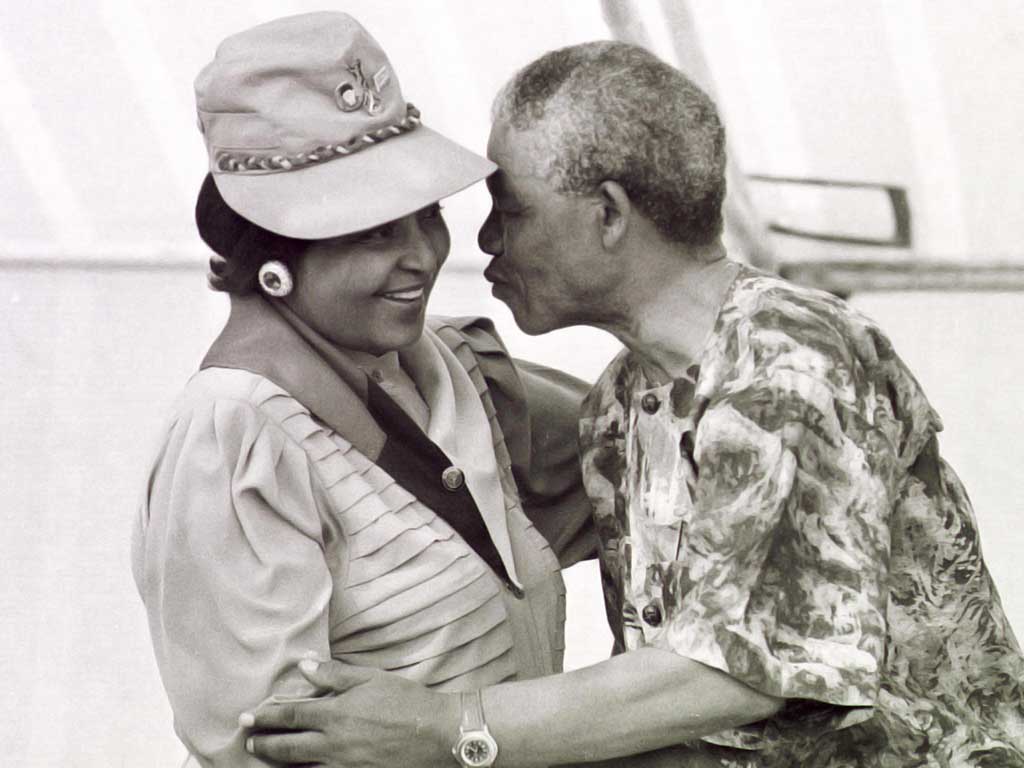

JOHANNESBURG, South Africa — Nelson Mandela told a Johannesburg court that his marriage to Winnie Madikizela-Mandela had left him profoundly lonely after his release from prison, bringing to public attention the breakdown of a relationship that had endured nearly three decades of separation under apartheid.
During divorce proceedings on Monday, March 18, 1996, Mandela disclosed that he and his wife had not resumed a normal marital relationship after his return home in 1990.
“I was the loneliest man,” he told the court.
The testimony marked a public departure from the couple’s earlier image as partners reunited after years of imprisonment, political persecution, and family separation.
Their marriage had survived Mandela’s 27 years in prison, but they separated in 1992, barely two years after his release. Their divorce was finalised four years later.
In Knowing Mandela: A Personal Portrait, journalist John Carlin, who covered South Africa during the transition from apartheid, described the couple’s relationship through interviews with Mandela, members of his family, and people who knew them.
His account included allegations of extramarital relationships, the controversy surrounding Winnie’s criminal conviction, and the personal difficulties that accompanied Mandela’s return to family life.
A Marriage Interrupted by 27 Years in Prison
Mandela married Winnie in 1958, when he was already an established figure in the struggle against apartheid.
Their relationship developed while he was increasingly occupied with political activities, leaving the couple relatively little time together before his imprisonment.
They had two daughters, Zenani and Zindzi.
Mandela’s incarceration placed Winnie under intense scrutiny from the apartheid authorities, who subjected her to repeated arrests, detention, restrictions on her movements, and separation from her children.
She spent more than a year in solitary confinement and was subsequently banished from her home in Soweto.
Despite the restrictions, she remained publicly associated with the campaign for her husband’s release.
During his imprisonment, Mandela maintained contact with Winnie through letters and occasional visits.
His correspondence included expressions of affection and descriptions of his longing to be reunited with his wife.
The couple’s lengthy separation also shaped Winnie’s experience of marriage and motherhood.
In an interview with Carlin shortly before Mandela’s release, Winnie reflected on the absence of ordinary family life during their marriage.
“I have never lived with Mandela,” she said.
She explained that she had never experienced the routine of sharing a home and family meals with her husband and children.
Even before his imprisonment, Mandela’s political commitments had frequently kept him away from home.
The Reunion Before Mandela’s Release
In late January 1990, Carlin visited Winnie’s home in Diepkloof Extension, Soweto, hoping to interview her ahead of her husband’s anticipated release.
He was admitted by Zindzi, then 29, who was preparing breakfast in the kitchen.
While waiting for Winnie, Carlin observed family photographs and greeting cards displayed in her study.
He recognised Mandela’s handwriting on a Christmas card and a birthday card, both of which contained expressions of affection for his wife.
“Darling, I love you. Madiba,” one of the cards read.
Carlin described Winnie as expressing excitement about her husband’s approaching freedom and the prospect of rebuilding their relationship.
Mandela was released from prison on February 11, 1990, and the couple appeared together before cheering supporters.
Yet the years they had spent apart had left them with little experience of living together as husband and wife.
According to Carlin’s account, the difficulties surrounding their reunion became increasingly apparent during the following two years.
Winnie’s Affair With Dali Mpofu
One of the central issues in the breakdown of the marriage was Winnie’s relationship with Dali Mpofu, a lawyer associated with the African National Congress.
Carlin reported that the relationship began before Mandela’s release and continued after he returned home.
The affair subsequently became public through a letter Winnie had written to Mpofu, which was published in the South African press.
In the letter, she accused Mpofu of betraying her by maintaining a relationship with another woman, with whom he had a child.
The correspondence also referred to difficulties in Winnie’s marriage and her dissatisfaction with Mpofu’s conduct.
Carlin recounted an incident in which Winnie travelled to the United States on ANC business with Mpofu despite Mandela’s objections.
According to a friend of Mandela who spoke to the journalist, Mandela telephoned Winnie’s hotel room in New York, where Mpofu answered the call.
The account described the incident as one of several developments that contributed to the deterioration of the marriage.
In his subsequent divorce proceedings, Mandela publicly identified the affair as a reason for seeking to end the relationship.
According to contemporaneous reporting by The Washington Post, Mandela told the court that the published correspondence had confirmed his wife’s involvement with another man.
The Criminal Case That Preceded Their Separation
The couple’s marital difficulties developed alongside the criminal proceedings against Winnie over the abduction and assault of four young men in Soweto.
One of the victims, 14-year-old Stompie Seipei, was subsequently murdered by a member of the Mandela United Football Club, a group associated with Winnie’s security entourage.
In May 1991, Winnie was convicted of kidnapping and being an accessory after the fact to assault.
She received a six-year prison sentence, which was later reduced on appeal to a suspended sentence and a fine.
She was not convicted of Seipei’s murder.
Mandela publicly supported his wife during the proceedings and accompanied her to court.
The case attracted considerable attention as the ANC and the South African government were engaged in negotiations over the country’s political future.
According to Carlin, Mandela’s associates were reluctant to confront him about his wife’s conduct during the period following his release.
The journalist also reported that two senior government officials later told him that they had encouraged judicial leniency towards Winnie because of concerns about the effect her imprisonment might have on Mandela’s participation in the political negotiations.
That account was attributed to the officials by Carlin and does not establish that Mandela requested or knew of any such intervention.
Mandela Announces Their Separation
In April 1992, Mandela convened a press conference at the ANC headquarters in Johannesburg to announce that he and Winnie had agreed to separate.
He began by acknowledging the support she had given him during his years in prison and her contribution to the anti-apartheid struggle.
“My love for her remains undiminished,” he told journalists.
He then announced that the couple had decided to live apart, attributing the decision to differences that had developed between them.
Mandela declined to discuss the details of their marital problems.
At the end of the announcement, he appealed to journalists to recognise the personal difficulty of the occasion and brought the press conference to a close.
The separation followed 34 years of marriage.
Family Tensions Become Visible at Daughter’s Wedding
Carlin also described tensions between Nelson and Winnie at their daughter Zindzi’s wedding, which took place several months after the separation.
The ceremony and reception were attended by relatives, friends, and prominent figures associated with the ANC.
Mandela participated in the formal proceedings, including the wedding cake ceremony and a speech marking his daughter’s marriage.
According to Carlin, however, Mandela and Winnie had little interaction during the reception.
Helen Suzman, the former South African parliamentarian and a friend of Mandela, was among the guests.
She later told Carlin that she had passed Mandela a note encouraging him to smile.
Carlin’s account also described an uncomfortable encounter involving Winnie, a former romantic partner, and a woman associated with Mpofu.
The journalist presented the wedding as another occasion on which the couple’s private disagreements became apparent to people close to the family.
Mandela Tells Divorce Court He Will Not Reconcile
By the time the divorce proceedings reached the Rand Supreme Court in Johannesburg in March 1996, Mandela had become president of South Africa.
The proceedings brought details of the marriage into the public record.
Mandela told the court that he had hoped to rebuild his family life following his release from prison but had been unable to establish the relationship he wanted with his wife.
He said they had not shared a conventional marital relationship during the two years they lived together after his imprisonment.
He also told the court that he had attempted to resolve their differences privately.
According to contemporary accounts of the proceedings, Mandela rejected Winnie’s proposal that a traditional elder intervene to help them reconcile.
He said that no intervention would persuade him to continue the marriage.
Winnie, who opposed the divorce, sought a postponement after dismissing her legal representatives. The court rejected the request and granted Mandela a divorce on March 19, 1996.
Their marriage had lasted 38 years.
A Family Life Mandela Had Hoped to Rebuild
In his account of the marriage, Carlin interviewed Amina Cachalia, a longtime friend of Mandela who had known him before his relationship with Winnie began.
Cachalia said Mandela had looked forward to resuming family life with his wife and children following his release from prison.
She described the prospect of living together again as one of his principal personal wishes.
The difficulties of the marriage were also discussed by people close to Mandela in the documentary The Long Walk of Nelson Mandela, produced for PBS’s Frontline.
The documentary included interviews with Cachalia, Mandela’s biographers, and other associates who described the couple’s attempts to adjust to life together after his imprisonment.
Their accounts provided differing perspectives on the circumstances of the separation, while documenting the personal and political pressures surrounding the marriage.
Two years after his divorce from Winnie, Mandela married Graça Machel, the widow of former Mozambican President Samora Machel, on his 80th birthday in 1998.
His marriage to Winnie nevertheless remained closely associated with the history of South Africa’s struggle against apartheid, a period during which the couple had spent most of their married lives apart.