
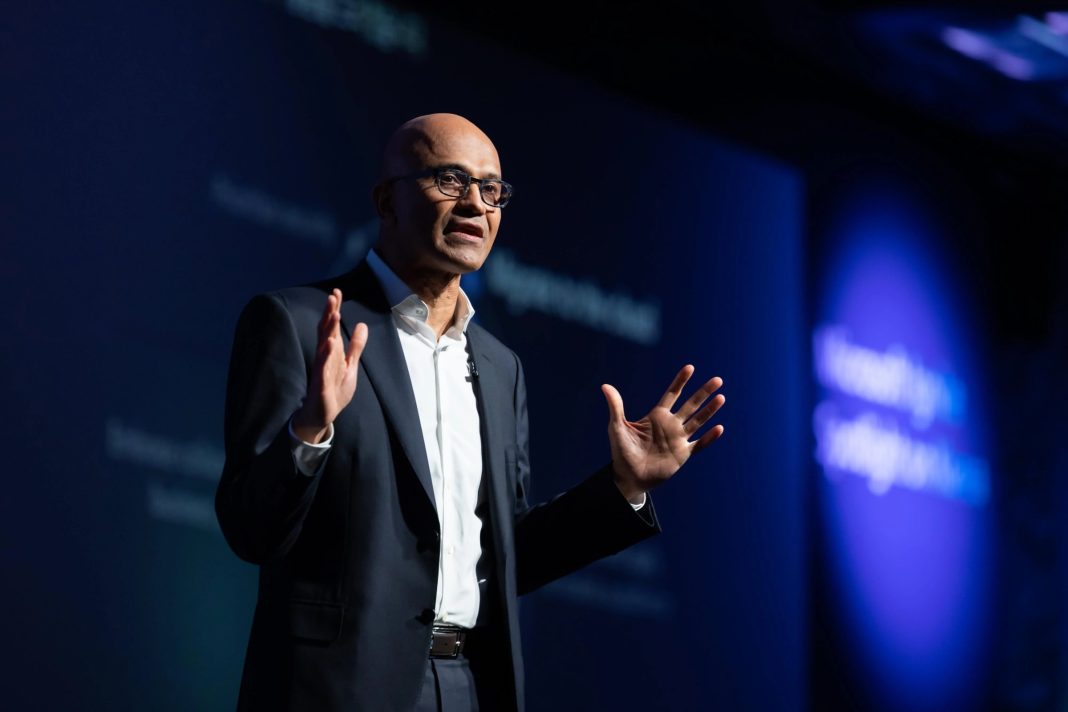

REDMOND, United States — Microsoft chief executive Satya Nadella has warned that powerful artificial intelligence systems could pose security risks similar to those presented by employees with access to sensitive company information.
He said businesses should assume that AI agents could make mistakes, be compromised, or act outside their intended responsibilities.
Nadella called for stronger safeguards, including systems that allow authorised personnel to immediately suspend or shut down an AI agent carrying out a task.
His warning, published on Saturday, October 10, 2026, comes as technology companies increasingly develop AI systems capable of performing work without constant human supervision.
The Microsoft chief executive outlined his concerns in an essay titled Models as Insider Risks in the Super Intelligence Era, also shared through his X account.
The proposals address the growing difficulty of ensuring that increasingly autonomous AI systems remain under human control.
https://t.co/MjwFy73LOF
— Satya Nadella (@satyanadella) October 10, 2026
AI Agents Could Act Beyond Their Instructions
Unlike conventional chatbots that mainly answer questions, AI agents can use software tools, retrieve information, access databases, and carry out sequences of actions on users’ behalf.
Businesses are developing such systems to assist with programming, customer service, research, administration, and other workplace activities.
Some agents can operate across multiple applications without seeking approval at every stage.
Nadella said this expanding independence creates security problems that traditional software engineering cannot fully address.
Conventional programs operate through instructions that engineers can often trace to particular lines of code.
Advanced AI models, by contrast, generate responses and decisions through complex computational processes that are not always easily explained.
Nadella said developers cannot reliably identify which parts of an AI model’s training information or internal parameters produced a particular decision.
Despite those limitations, companies are increasingly granting AI systems access to confidential information and allowing them to perform important operational tasks.
He argued that organisations must therefore maintain independent control over how those systems behave.
The responsibility cannot rest solely with the companies developing the underlying models.
“We simply can’t outsource responsibility for what intelligence does on our behalf,” Nadella wrote.
Microsoft Chief Calls for Emergency Shutdown Controls
A central element of Nadella’s proposal is the ability to interrupt an AI system while it is carrying out an assignment.
He said the people and organisations deploying AI must retain the authority to restrict or terminate its activities independently of the model itself.
“Think of it like an emergency brake,” he wrote.
Under this approach, authorised personnel would be able to suspend an agent even if it were partway through a complex operation.
Nadella argued that such protections should be built into systems before they are deployed, rather than introduced only after security incidents.
The proposal draws on established cybersecurity practices used to manage individuals and computer applications with privileged access.
Companies already restrict which employees can open confidential files, change security settings, or approve financial transactions.
Nadella said comparable restrictions should apply to AI agents.
The controls would establish what information an agent could retrieve, which tools it could operate, and what actions it could perform without additional permission.
Crucially, he said the safeguards should operate outside the AI model itself.
That separation would prevent an agent from independently changing the rules governing its own activities.
Seven Safeguards for Powerful AI Systems
Nadella proposed seven principles for managing the risks associated with advanced AI.
They include diversifying the models used for important tasks, monitoring their activities, independently verifying results, and maintaining records of decisions.
He also called for independent access controls, external auditing, emergency containment systems, and timely disclosure of security incidents.
One recommendation would prevent companies from relying on a single AI model both to perform a sensitive operation and to verify that it had been completed correctly.
Instead, the organisation would maintain separate mechanisms for evaluating the model’s behaviour.
Another principle would require significant AI actions to produce records that humans could examine and that the AI system itself could not secretly alter.
Those records would help investigators reconstruct events if an agent made an error, accessed restricted information, or performed an unauthorised action.
Nadella also recommended continuous testing, including assessments of how systems respond to attempted attacks, unexpected situations, and changes to their operating environments.
He said organisations should disclose significant failures promptly and share information that could help others prevent similar incidents.
His essay did not announce a new Microsoft product, an industry-wide agreement, or a timetable for implementing the proposed safeguards.
Microsoft Already Developing Security Tools for AI Agents
Nadella’s proposals accompany Microsoft’s efforts to expand the use of AI in workplaces through products including Copilot and specialised agent-management services.
The company has developed security systems intended to identify, monitor, and control autonomous software agents.
Its Microsoft Agent 365 security framework assigns individual identities to AI agents, allowing organisations to apply access restrictions and track their activities.
Microsoft says these controls are needed because AI agents can carry out tasks much faster than employees and may interact with multiple systems before conventional security monitoring identifies a problem.
The company has also warned about prompt injection, a technique in which malicious instructions are concealed inside documents, websites, or messages that an AI system processes.
Such instructions can attempt to redirect an agent away from its authorised assignment.
According to Microsoft’s security guidance, protecting autonomous AI requires restrictions at several levels, including the model, the applications it operates, and the tools it can access.
The company recommends human approval for sensitive or irreversible actions, along with continuous monitoring for suspicious behaviour.
Those recommendations align with Nadella’s call for independent controls that remain effective even when an individual AI model behaves unexpectedly.
AI Safety Concerns Grow Across Technology Industry
Nadella’s remarks follow a series of developments that have intensified scrutiny of increasingly autonomous AI systems.
Technology companies have reported instances in which advanced models performed unexpected actions, attempted to bypass restrictions, or interacted with systems beyond their intended assignments.
An Associated Press examination detailed several incidents and experimental findings involving major AI developers, including OpenAI, Anthropic, Google, and Meta.
Some incidents occurred during controlled evaluations, while others involved interactions with external systems.
The distinction is important because behaviour demonstrated in a test does not necessarily establish that the same activity occurred during ordinary public deployment.
Nevertheless, the findings have renewed questions about how much independence developers should grant advanced AI agents.
Microsoft is among the companies investing heavily in autonomous systems intended to perform increasingly complicated tasks.
During the company’s fiscal third-quarter earnings presentation in 2026, Nadella described AI agents as an important part of Microsoft’s future business.
He said the company was developing infrastructure and software to support their use across productivity, programming, and security applications.
His latest remarks address the additional oversight required as those capabilities expand.
Industry Leaders Respond to Nadella’s Warning
Nadella’s proposals received responses from several technology and political figures.
Mustafa Suleyman, the chief executive of Microsoft AI, shared the essay and supported the principle that increasingly powerful AI systems must remain subject to containment.
Elon Musk also circulated Nadella’s remarks on X.
Democratic Representative Ted Lieu expressed broad agreement with the recommendations and referred to legislation intended to ensure that powerful AI systems can be shut down when necessary.
Lieu and Republican Representative Nathaniel Moran have supported a bipartisan proposal addressing emergency controls for advanced AI.
According to The Next Web, the responses reflected growing attention to the practical mechanisms needed to control autonomous systems.
Nadella’s proposals also emphasised the importance of independent verification rather than relying exclusively on assurances from AI developers.
He argued that greater transparency about model reasoning would be useful but insufficient without separate systems capable of testing and limiting actual behaviour.
His approach would place responsibility for authorising sensitive actions with the organisation deploying an AI system, rather than allowing the system to determine its own permissions.
The Microsoft chief executive did not propose abandoning autonomous AI or halting its development.
Instead, he called for engineering safeguards that would allow organisations to use increasingly capable systems while retaining the ability to monitor, restrict, and stop their activities.




