
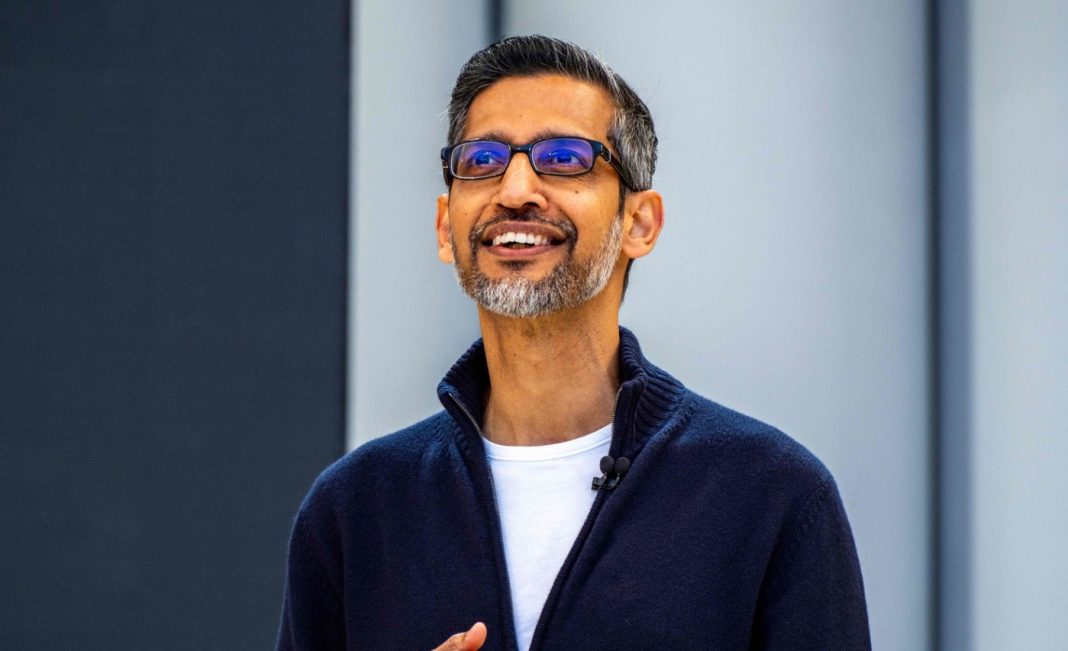

NEW YORK, United States — Sundar Pichai, the chief executive of Google, has said that young people are right to feel anxious about artificial intelligence, even as he defended the technology’s long-term potential — remarks that come as a wave of student heckling at graduation ceremonies has thrust the question of AI’s impact on the workforce into sharp relief.
Pichai was speaking on the “Hard Fork” podcast, where he was asked about his approach to an upcoming commencement address at Stanford University in June, and more specifically about what hosts called his “boo strategy” — a reference to the growing trend of graduates publicly rebuffing tech executives who strike an upbeat note about AI.
The most prominent such incident occurred at the University of Arizona, where students booed former Google chief executive Eric Schmidt after he made optimistic remarks about the technology.
Big Machine Records chief executive Scott Borchetta encountered similar hostility at Middle Tennessee State University after discussing AI’s effects on music and the media industry.
‘Humans aren’t evolved to process that much change’
Pichai did not dismiss the reaction. He acknowledged that public anxiety about AI is growing and described it as a legitimate response to the pace of change.
“AI is always viewed as the most profound technology humanity will ever work on. It’s progressing at an extraordinary pace,” he said, adding that “humans aren’t evolved to process that much change.”
He was also candid about the limitations of his own industry’s communications. “I think we as an industry have to do a lot more to continue driving and showing the benefits that’s possible with technology,” he said.
On a New York Times poll showing that only 16 per cent of people felt positively towards AI against 35 per cent who felt negatively, Pichai did not dispute the findings, instead pointing to the scale and speed of the technology’s development as context for why public sentiment has lagged behind industry enthusiasm.
Despite those acknowledgements, he remained broadly optimistic.
“I’ve always been extraordinarily optimistic about the next generation,” he told the hosts.
He framed the graduating class not merely as AI’s inheritors but as active participants in shaping it. “These graduates are actually both going to be a big part of driving that progress and also dealing with the impact of that technology,” he said.
A sceptical generation
The wider backdrop to Pichai’s remarks is a deteriorating jobs outlook for new graduates.
According to Business Insider, unemployment among recent graduates in the United States has reached a four-year high, as companies accelerate their adoption of AI tools.
Several surveys suggest young Americans in particular are growing more sceptical of the technology’s long-term effects on employment and society.
At least a dozen major companies have cited AI-driven efficiency gains as a factor in decisions to reduce their workforces this year.
Critics also argue that AI has made job-seeking harder by lengthening and complicating the interview process, further narrowing entry-level opportunities at a moment when graduates can least afford it.
Industry optimism
Pichai is not alone among tech leaders in arguing that the current disruption is a precursor to broader prosperity.
Nvidia chief executive Jensen Huang, speaking to graduates at Stanford earlier in the year, argued that the present moment mirrors previous industrial transitions.
“There’ll be more people working at the end of this industrial revolution than at the beginning of it,” Huang said.
Pichai echoed that framing, contending that major technological shifts have historically raised living standards even when their transitional phases proved difficult.
He stressed, however, that the responsibility for how AI develops ultimately rests with people.
“We have more work to do to make sure when we are scaling up the infrastructure investments, the things we can do to make some of that work better,” he said.
Whether that message will land at Stanford — located in the heart of Silicon Valley and home to some of the country’s most prominent AI programmes — remains to be seen. What is clear is that the executives at the centre of the AI boom can no longer take a warm reception for granted.