


OSLO, Norway — Navanethem “Navi” Pillay, the South African jurist and former United Nations human rights chief whose career has spanned the fight against apartheid, international war-crimes tribunals, and investigations into conflicts from Rwanda to Gaza, has won the 2026 Nobel Peace Prize.
The Norwegian Nobel Committee awarded Pillay the prize on Friday for her lifelong efforts to promote peace and international law and strengthen institutions that hold perpetrators of genocide, crimes against humanity, and war crimes accountable.
Pillay, 85, is a former judge of the International Criminal Court and former president of the International Criminal Tribunal for Rwanda.
She served as United Nations High Commissioner for Human Rights from 2008 to 2014 and is currently an ad hoc judge at the International Court of Justice.
BREAKING NEWS
The Norwegian Nobel Committee has decided to award the 2026 #NobelPeacePrize to Navanethem “Navi” Pillay for her efforts to promote peace and international law.#NobelPrize https://t.co/97vurspw6z
— The Nobel Prize (@NobelPrize) October 9, 2026
The committee said she was being honoured “for her efforts to promote peace and international law”.
Jørgen Watne Frydnes, chair of the Norwegian Nobel Committee, said Pillay’s work “is a source of hope and inspiration to all those who seek to bring about a more peaceful world”.
The announcement on Friday, October 9, 2026, ended weeks of speculation over a field that had included 287 nominated individuals and organisations.
The prize is worth 12 million Swedish kronor, about $1.2 million, and will be formally presented in Oslo on December 10, the anniversary of Alfred Nobel’s death.
From Apartheid South Africa to International Justice
Pillay was born in Durban in 1941 into a family of Indian Tamil descent and came of age under South Africa’s apartheid system.
She encountered racial and gender discrimination early in her legal career, when white-controlled law firms were unwilling to employ a non-white woman lawyer.
In 1967, she opened her own legal practice in Natal, becoming the first non-white woman to do so there.
She spent much of the next three decades representing political prisoners and anti-apartheid activists and challenging abuses inside South African prisons.
After apartheid ended, Nelson Mandela appointed her to South Africa’s High Court in 1995, making her the first non-white woman to serve as a High Court judge in the country.
The United Nations says Pillay later served as a judge at the International Criminal Tribunal for Rwanda, eventually becoming its president.
Her work there placed her at the centre of one of the most important developments in international criminal law.
Pillay sat on the tribunal panel in the landmark prosecution of Jean-Paul Akayesu, a former Rwandan mayor convicted for his role in the 1994 genocide.
The judgment was the first by an international tribunal to recognise that rape and sexual violence could constitute acts of genocide when committed with the intent to destroy a protected group.
That principle subsequently became an important part of international criminal law.
Warmest congratulations to my dear friend and former UN Human Rights Chief Navi Pillay on the Nobel Peace Prize! She has shown what courage, integrity and an unwavering belief in human rights and the law can achieve.
Thank you, Navi, for inspiring us all.
— Volker Türk (@volker_turk) October 9, 2026
Nobel Committee Praises Her ‘Courage and Integrity’
The Nobel Committee said a “common thread” could be traced through Pillay’s career, from representing people persecuted under apartheid to her work in international tribunals dealing with some of the world’s gravest crimes.
It credited her with helping broaden both the reach and practical effect of international law.
Pillay became a judge at the newly established International Criminal Court in The Hague in 2003.
Five years later, she was appointed U.N. High Commissioner for Human Rights, a position she held until 2014.
During her tenure, she frequently challenged governments over human-rights violations, including abuses in Syria, Sri Lanka, North Korea, and other conflicts.
The Nobel Committee said her career demonstrated “exceptional courage and integrity” in seeking to ensure that genocide, crimes against humanity, and war crimes were investigated and prosecuted.
Reuters reported that the committee described Pillay as possessing an “unwavering moral compass” at a time when international legal institutions face growing pressure.
Gaza Inquiry Drew International Attention
More recently, Pillay chaired the U.N. Independent International Commission of Inquiry on the Occupied Palestinian Territory, including East Jerusalem, and Israel.
In September 2025, the commission concluded that Israel had committed genocide against Palestinians in Gaza and said senior Israeli officials bore responsibility for incitement and other acts.
Israel rejected the report, calling its findings false and accusing the commission of bias.
The commission’s conclusion is not a judicial ruling.
The International Court of Justice is separately considering South Africa’s case accusing Israel of violating the Genocide Convention and has not issued a final judgment on whether genocide occurred.
Pillay has rejected accusations that her commission was biased.
Her role in the Gaza investigation has made her a prominent and controversial figure in debates over the application of international law to the Israel-Gaza war.
The Norwegian Nobel Committee presented Friday’s prize more broadly, emphasising Pillay’s decades-long career rather than any single investigation.
Serving on Myanmar Genocide Case
Pillay is also serving as an ad hoc judge at the International Court of Justice in proceedings brought by The Gambia against Myanmar.
The case concerns allegations that Myanmar violated the Genocide Convention in its treatment of the Rohingya Muslim minority.
Her appointment adds another chapter to a career that has taken her through national courts, international criminal tribunals, the United Nations, and the world’s highest court for disputes between states.
Pillay was also a co-founder of Equality Now, an international organisation advocating for the rights of women and girls.
Prize Comes as International Courts Face Pressure
The Nobel Committee’s decision comes at a difficult moment for institutions established to enforce international law.
The International Criminal Court has faced sustained criticism and sanctions from the United States over investigations involving Israel and U.S. interests.
The court has also issued arrest warrants involving major international conflicts, including warrants for Russian President Vladimir Putin over Ukraine and Israeli Prime Minister Benjamin Netanyahu over the Gaza war.
Russia and Israel reject the ICC’s actions against their leaders. Neither Russia nor the United States is a member of the court, while Israel is also not a member.
The Associated Press said the committee’s selection of Pillay amounted to a strong endorsement of international legal institutions at a time when their authority is increasingly being challenged.
Frydnes said international law should not be regarded as an abstract principle but as a means of resolving disputes peacefully and holding individuals responsible for grave crimes.
“Being a lawyer and a judge, I still want to verify this information.”
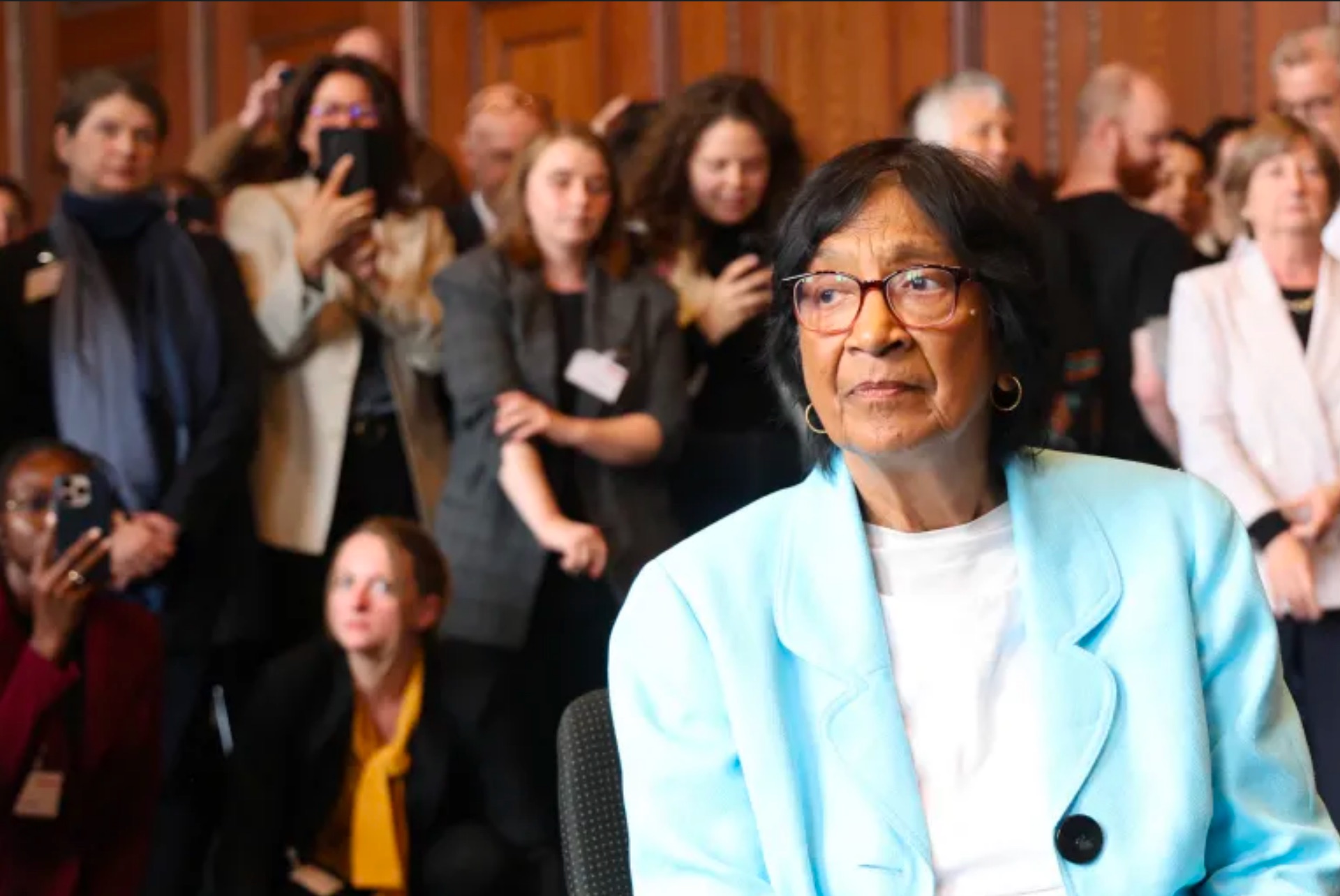
Navi Pillay – newly awarded peace laureate – didn’t yet believe she had actually been awarded a Nobel Prize, standing in the courtroom where the Nuremberg trials took place. She told the room, “I think it’s very appropriate that I’m with friends and colleagues, all of whom support human rights.”
Join us in congratulating our 2026 Nobel Peace Prize laureate!
— The Nobel Prize (@NobelPrize) October 9, 2026
U.N. Welcomes Award
The United Nations human rights office welcomed Pillay’s selection.
Spokeswoman Shabia Mantoo described the former high commissioner as a steadfast defender of human rights and said the award should encourage those continuing that work around the world.
The office said Pillay had spent decades advocating for victims who might otherwise have gone unheard.
Pillay succeeds Venezuelan opposition leader María Corina Machado, who received the 2025 Nobel Peace Prize for her campaign for democratic rights and free elections in Venezuela.
The 2026 award marks the 125th anniversary of the Nobel Peace Prize.
The Norwegian Nobel Committee does not disclose its shortlist or confirm individual nominations, and its deliberations remain secret for 50 years.
Among figures publicly proposed or discussed before Friday’s announcement were U.S. President Donald Trump, Canadian Prime Minister Mark Carney, humanitarian groups operating in Sudan, international courts, and the International Space Station partnership.
Ultimately, the committee chose a lawyer and judge whose career has rested on the proposition that lasting peace depends in part on enforceable rules.
For Pillay, that work began under apartheid and eventually carried her to some of the most consequential international courts of the modern era.