
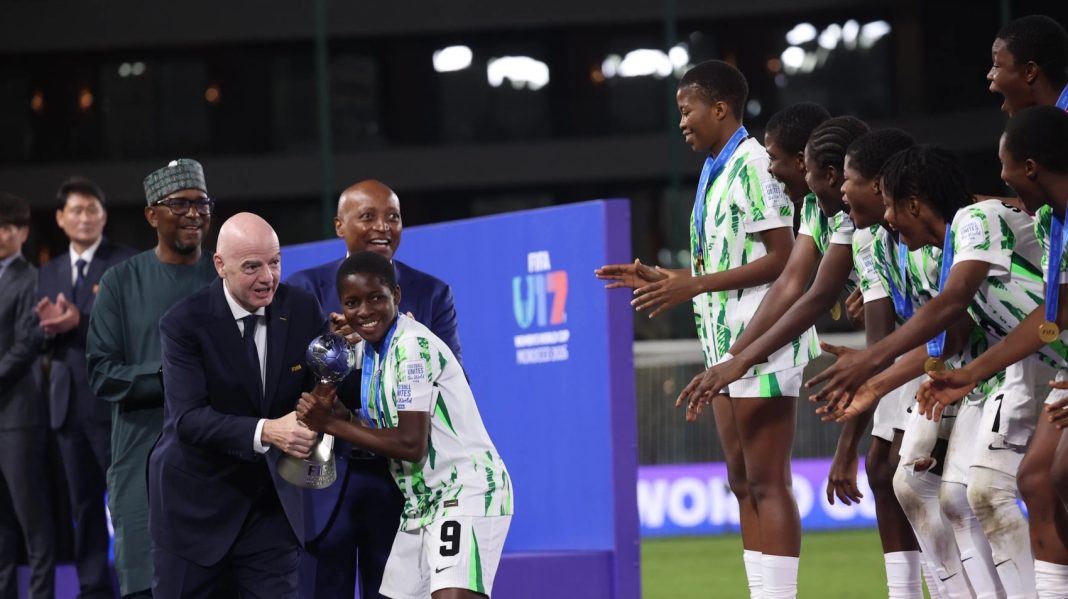

RABAT, Morocco — Nigeria’s Flamingos have won the FIFA Under-17 Women’s World Cup for the first time, defeating Japan 2-1 in a historic final in Morocco.
The victory makes Nigeria the first African country to win the competition. It is also the first FIFA world title won by an African women’s national team at any age level.
Awawu Bashiru and Oluebube Umejiaku scored for Nigeria in the final at the Mohammed VI Football Complex in Rabat on Saturday, November 7, 2026.
Japan pulled a goal back through Fuki Ito but could not prevent Nigeria from lifting the trophy.
The result marks a new achievement for Nigerian women’s football. It also surpasses the country’s previous best performance at the tournament, a third-place finish in 2022.
Bashiru and Umejiaku Secure Historic Victory
Nigeria started the match strongly, creating several opportunities against a Japanese side that had entered the final unbeaten.
The Flamingos came close to scoring when Umejiaku headed against the crossbar after Japan goalkeeper Kou Kadowaki failed to gather a free kick.
Nigeria eventually broke the deadlock in the 39th minute.
Bashiru sent a looping effort towards goal, and Kadowaki was unable to hold the ball as it slipped through her hands and crossed the line.
The goal gave Nigeria a 1-0 lead at half-time.
Two minutes after the restart, Umejiaku doubled the advantage.
She received a long pass from Esther Stephen, raced beyond the Japanese defence, and lifted the ball over the advancing goalkeeper.
Japan responded by increasing its attacking pressure.
Nigeria goalkeeper Jane Ijirigho survived a dangerous moment when an attempted clearance fell to Wara Shimizu, whose effort went over the crossbar.
Japan finally scored in the 80th minute.
Substitute Anri Ito headed a corner back into the penalty area, allowing Fuki Ito to volley into the net.
The goal reduced Nigeria’s lead to 2-1 and set up a tense finish.
But the Flamingos held firm through the final minutes and five minutes of added time.
The final whistle confirmed Nigeria as world champions.
According to FIFA’s official match report, Umejiaku was named Player of the Match.
Umejiaku Wins Golden Ball
Nigeria’s victory was followed by another major individual honour.
Umejiaku, 16, received the Golden Ball as the outstanding player of the tournament.
The forward scored four goals during the competition, including the winner against Japan.
Her performances helped Nigeria recover from an opening defeat and advance through the knockout stages.
The FIFA awards announcement confirmed that Umejiaku had won the tournament’s highest individual prize.
American forward Maddie DiMaria collected the Golden Boot after scoring 12 goals.
North Korea’s Kim Son-gyong received the Golden Glove as the tournament’s outstanding goalkeeper.
Japan received the Fair Play Trophy.
From Opening Defeat to World Champions
Nigeria’s route to the title began with a setback.
The Flamingos lost their opening group match 2-1 to Poland, leaving them under pressure to recover.
But the team, coached by Akeem Busari, responded with six consecutive victories.
Nigeria defeated Puerto Rico and defending champions North Korea to advance from the group stage.
The Flamingos then beat Mexico 2-1 in the round of 16.
A late penalty from Azeezat Oduntan secured a 1-0 quarter-final victory over Venezuela.
Nigeria faced Brazil in the semi-finals and produced one of its strongest performances of the tournament.
Queen Joseph opened the scoring before Bashiru struck twice to give Nigeria a 3-1 victory.
The result sent the Flamingos into their first Under-17 Women’s World Cup final.
Japan, meanwhile, reached the final after defeating defending champions North Korea in a penalty shootout.
The final brought together a Japanese team seeking its second title and a Nigerian side attempting to become Africa’s first winner.
Nigeria emerged victorious.
FIFA President Congratulates Nigeria
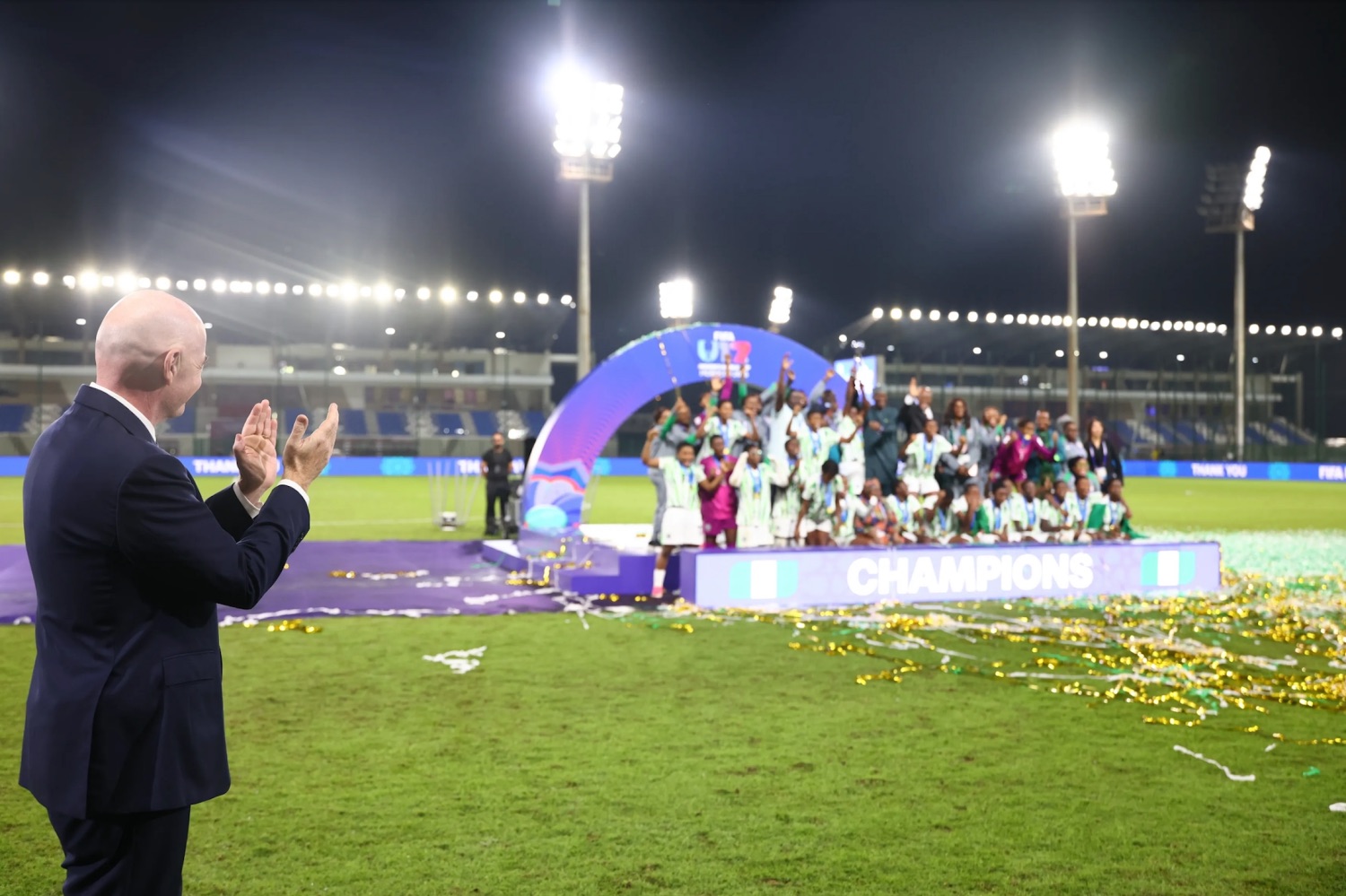
FIFA President Gianni Infantino congratulated Nigeria after the final.
He described the achievement as an important moment for African women’s football.
“First African team to ever win a (FIFA) Women’s U-17 World Cup — so many congratulations to Nigeria. Well deserved in the final,” Infantino said.
In a statement published by FIFA, he also congratulated Japan, North Korea, and hosts Morocco for their contributions to the competition.
North Korea finished third after defeating Brazil 6-0 in the third-place match.
The 2026 edition was the 10th staging of the Under-17 Women’s World Cup, which began in 2008.
Tinubu Celebrates World Cup Victory
President Bola Tinubu congratulated the Flamingos, describing their achievement as a proud moment for Nigeria.
In a statement issued by his Special Adviser on Information and Strategy, Bayo Onanuga, Tinubu praised the players for their determination throughout the tournament.
“What wonderful news to return home to! Our young girls have conquered the world and given Nigerians everywhere another reason to celebrate our great country,” the president said.
He recalled that the team had promised to win the trophy after defeating Brazil in the semi-finals.
Tinubu also commended Bashiru and Umejiaku for scoring the goals that secured the championship.
“Today, Nigeria celebrates you. You have written your names in gold, and your country is immensely proud of you,” he said.
The president congratulated the coaching staff, the Nigeria Football Federation, and the National Sports Commission.
He also pledged continued support for grassroots sports development and opportunities for young female athletes.
Nigeria Adds Women’s Crown to Men’s U-17 Success
The triumph gives Nigeria a distinction no other African country has achieved.
Nigeria has now won FIFA Under-17 World Cup titles in both men’s and women’s football.
The Golden Eaglets won the men’s competition five times, in 1985, 1993, 2007, 2013, and 2015.
The Flamingos have now added the women’s title.
For Nigerian football, the victory ends an 18-year wait since the women’s Under-17 tournament was introduced in 2008.
It also represents the first time an African women’s national team has won a FIFA World Cup trophy.
The Flamingos leave Morocco as world champions, having recovered from defeat in their opening match to win the next six and secure the most significant title in their history.