


Until recently, I didn’t know about gamification or game-based learning. I am not an educationist. I am a philosopher and a scholar of religion interested in education, especially educational reform in Nigeria. I believe the school system can change and should change; the way that children learn and are taught can be transformed.
I have been looking for ways to foster critical thinking and philosophy for children(p4c) in primary and secondary schools. I have operationalised critical thinking as questionstorm. Questionstorm makes generating questions not just an expression of curiosity and inquisitiveness, but also a measure of intelligence. For me, questionstorm and diverstorm drive inquiry-based learning. I have written books and designed some P4C charts for elementary schools.
But these initiatives do not suffice. I have been looking for ways to make critical thinking and philosophy for children fun, entertaining, and attractive. It occurred to me that I could introduce some game elements into the process. I can make students think critically through playing. But I was reluctant to do so. Why? At home, I discourage my children from devoting so much time to playing video games or watching cartoons. On some occasions, I have punished them. I have seized their tablets or collected phones that they used to play games. So how do I tell my children that I am encouraging games without being a hypocrite?
After some searching, researching, and reflection, I embraced the idea. I decided to gamify questionstorm. I realised that gaming can be effective in teaching and learning. Playing games is not necessarily a waste of time. Gaming is a form of pedagogy. Before materialising the idea, I went online and read about gamification, or game-based learning. It was mind-blowing. What I found was eye-opening and inspiring.
Several authors have noted that children can learn through playing, not only through working. Introducing game elements could enhance motivation, engagement, and learning.
One author noted: “Game-based learning, and gamification, are likely to be the next big growth area in education, gaining more and more formal acceptance as a learning strategy”. I agree. So how do I gamify critical thinking or philosophy for children to enhance inquiry-based learning? Simply put, how do I gamify questionstorm?
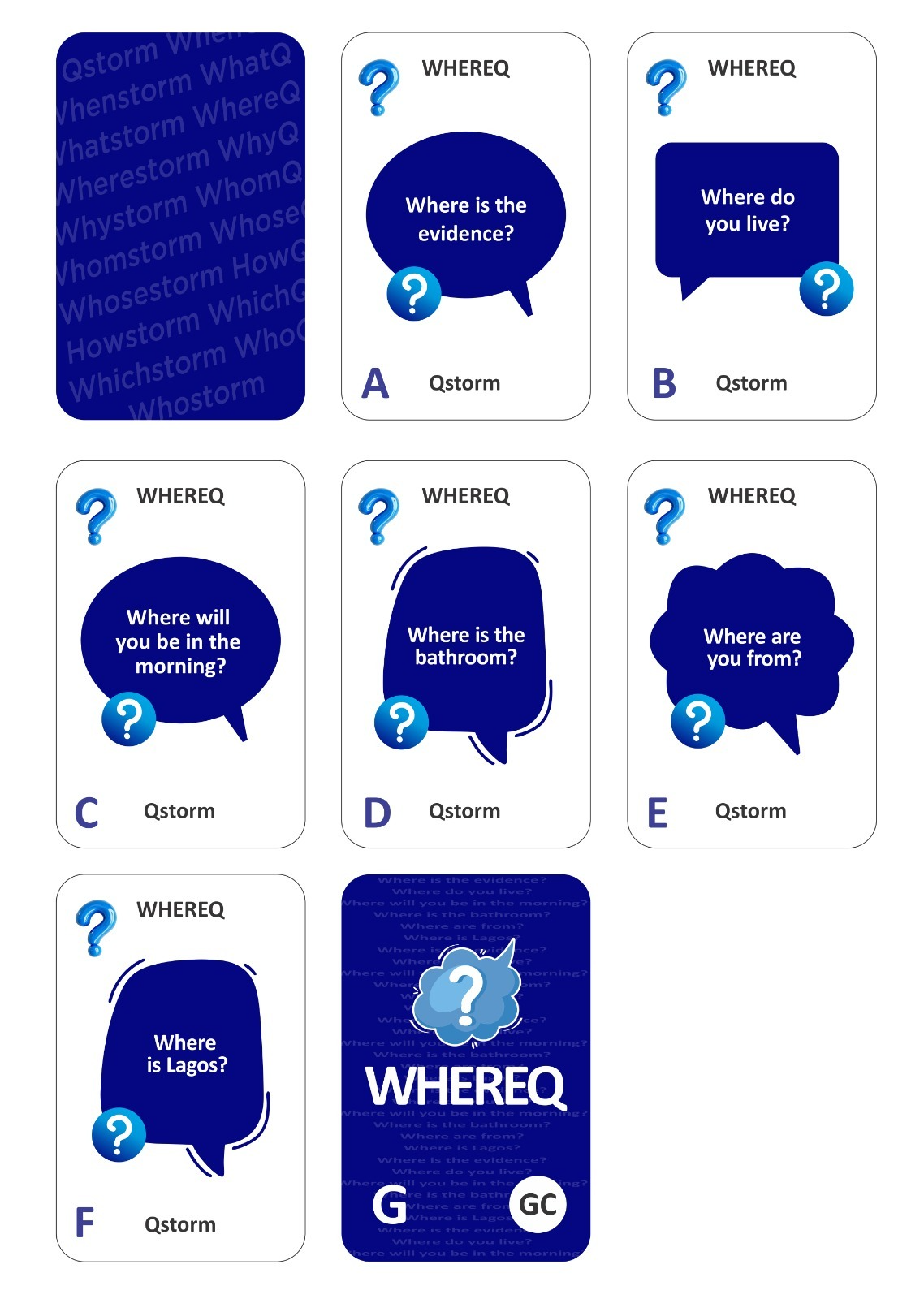
I decided to introduce a card game, some questionstorm cards, or Qstorm cards. I modeled this game after the Whot card game, which is popular in Nigeria. Like the Whot game, the winner is the first to finish their cards.
But unlike Whot games, Qstorm cards are played while thinking in terms of questions. Qstorm cards are question cards. These cards are in three categories: game cards, game changer cards, and end game cards.
Each category necessitates some thinking in terms of questions. Game cards contain questions drawn from 8WH: what, when, which, where, how, who, why, whom, and whose. Each category has six questions. Game-changing cards allow players to switch from one category to another. With end game cards, a player can ask one question that overrules all other questions and all other cards.
With Qstorm cards, students in Nigeria can play games while exercising their critical thinking skills. Students will be motivated to think, inquire, question, and learn through playing.
Leo Igwe, PhD, is a board member of Humanists International and the Humanist Association of Nigeria. He directs the Advocacy for Alleged Witches and Critical Thinking Social Empowerment Foundation, which promotes critical thinking and philosophy for children in schools. He can be reached by email HERE.
The opinions expressed in this article are solely those of the author.