
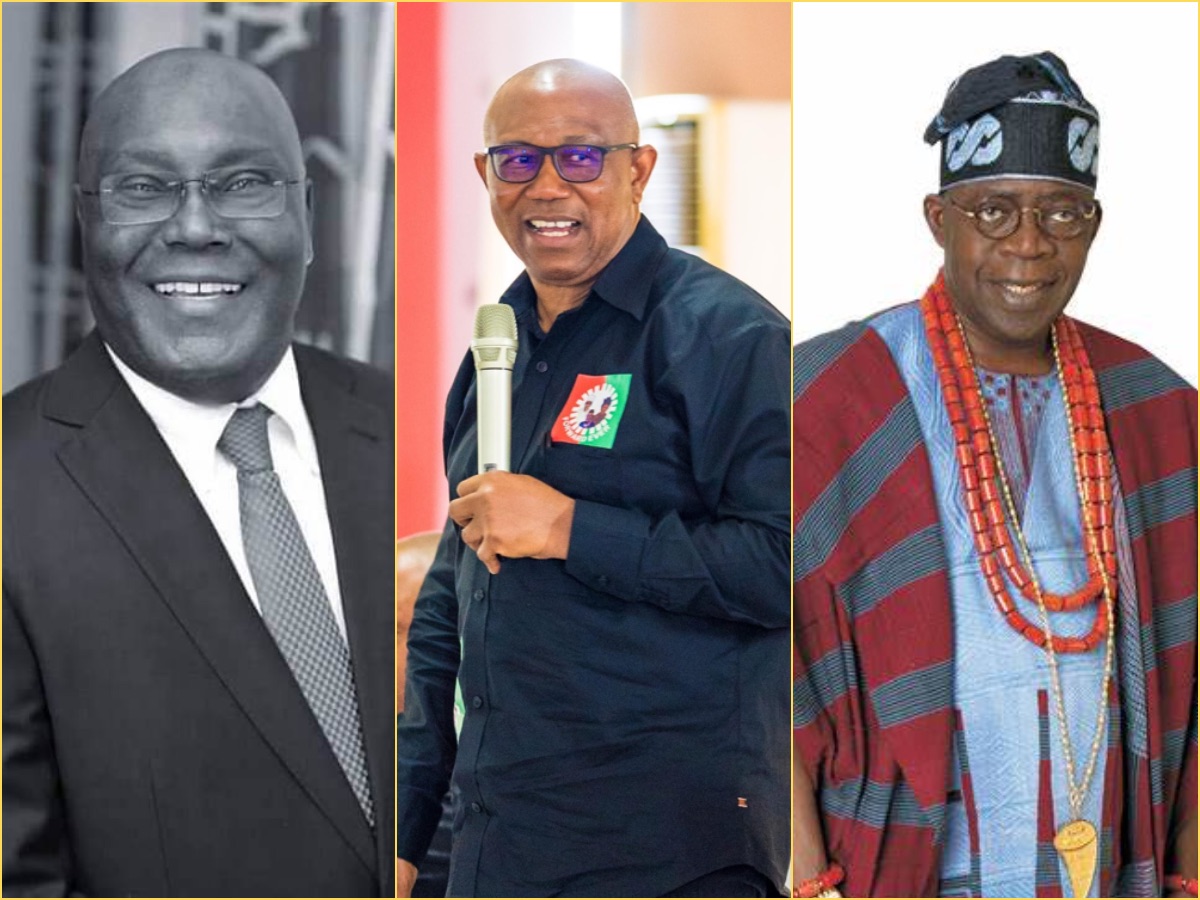

Let us have a brief family meeting. Nothing too serious. Just three Nigerian families gathered around the proverbial village square, comparing notes about our sons.
My Yoruba brothers and sisters, you have brought Bola Ahmed Tinubu. My Fulani brothers and sisters, you have brought Atiku Abubakar. And we, the Igbo, have brought Peter Gregory Obi. Three sons. Three résumés. Three records of public life.
And now, once again, three men are asking Nigerians to entrust one of them with the most important job in the country. So, permit me a mischievous question: My Yoruba and Fulani brothers and sisters, are you as proud of your sons as we are of ours?
Before anyone reaches for the tribal trumpet, that question is precisely the point of this piece. I do not believe Peter Obi should become President of Nigeria because he is Igbo. If that were my argument, this essay would be intellectually bankrupt before the second paragraph.
I am asking something far more uncomfortable. Strip away the tribes. Remove Yoruba, Fulani and Igbo. Remove Lagos, Adamawa and Anambra. For a moment, erase the names and place three anonymous résumés on a table. Call them Candidate A, Candidate B and Candidate C. Then ask yourself: Which record would you entrust to Nigeria? That is the election Nigeria desperately needs.
Let us look at our son, Peter Obi. Peter did not enter public life without a résumé. Before becoming governor, he had established himself in business and corporate Nigeria. His record includes service as chairman or director of several companies and financial institutions, including Fidelity Bank Plc, Guardian Express Mortgage Bank, Future View Securities, and Paymaster Nigeria. He later chaired the Board of Nigeria’s Securities and Exchange Commission.
Then came Anambra State. Obi governed Anambra from 2006 to 2014, surviving impeachment, removal, and extraordinary political turbulence. His governing philosophy became particularly associated with fiscal restraint and investment in education and health. His administration rehabilitated educational infrastructure, provided hundreds of school buses and thousands of computers and printers, and supported upgrades to healthcare facilities.
His fiscal record has sometimes been exaggerated by supporters. The frequently repeated claim that he left Anambra with absolutely “no debt,” for example, is too sweeping: Debt Management Office figures show that Anambra had formal domestic and external debt obligations at the time he left office.
Fine. That is precisely why Nigerians should examine records rather than worship politicians. Correct exaggerations. Remove propaganda. Interrogate every claim. Then look again at the overall record. That is the Peter Obi I am prepared to put on the table.
Now, my brothers, bring your own sons. My Yoruba brothers, bring Bola Tinubu. Bola Ahmed Tinubu has an extensive political record: senator in the aborted Third Republic, governor of Lagos State from 1999 to 2007, one of the country’s most consequential political powerbrokers thereafter, and currently sitting in Aso Rock since May 2023. Those accomplishments belong on his résumé. So does the record of his occupation of Aso Rock (why does occupation rhyme with usurpation?). But that is where the conversation becomes considerably less comfortable.
Nigeria under Bola Tinubu today remains trapped in an extraordinary cost-of-living crisis. Poverty is widespread. Food insecurity remains severe. Insecurity continues to exact an enormous human and economic toll. Millions of Nigerians struggle to translate macroeconomic reform into food on their tables.
The IMF estimated that 63 percent of Nigerians lived below the national poverty line, while about 27 million people faced food insecurity in fall 2025. The World Bank similarly reports widespread poverty, weak job creation, and persistent insecurity.
Yes, there is another side to the economic record. Tinubu’s defenders can point to reforms, higher reserves, improved external accounts, and, more recently, stronger GDP growth. Nigeria’s economy expanded by 4.43 percent year over year in the second quarter of 2026. These facts should not be hidden. But Nigerians should not be asked to confuse improving macroeconomic indicators with the lived experience of a family that cannot afford food.
A reform is ultimately judged not merely by what it does to a spreadsheet in Abuja, but by what it ultimately does to the life of the Nigerian standing in the market with ₦10,000, wondering exactly what he can still buy.
And then there is Tinubu’s American history. Here, accuracy matters. Tinubu was not convicted in the United States of drug trafficking, and it would be false to say he was. But there was a real United States civil asset-forfeiture case. In 1993, $460,000 in an account held in Tinubu’s name was forfeited to the United States under a settlement arising from proceedings in which American authorities alleged that the funds were connected to drug proceeds or to prohibited financial transactions. That is a historical court record, not a campaign slogan.
There is also the extraordinary saga of Chicago State University. Let us be precise, because the documented account is remarkable enough without embellishment. Chicago State University states that Bola Ahmed Tinubu attended the institution and graduated in 1979 with a bachelor’s degree. That is the university’s official position, and any fair account must acknowledge it. But that is hardly the end of the story.
When Atiku Abubakar went to a United States federal court to obtain Tinubu’s academic records for use in his Nigerian election litigation, Tinubu did not simply say, “Here are my records. Examine them.” He intervened in the case, objected to their disclosure, and after a federal magistrate judge ordered Chicago State University to produce the records, sought emergency intervention from the district judge and obtained a temporary stay pending consideration of his objections.
The district court ultimately rejected those objections and ordered the records released. The judge concluded that Tinubu’s privacy interest in his educational records was outweighed by Atiku’s interest in obtaining them, particularly because Tinubu had placed the authenticity of his CSU diploma at issue by submitting a diploma to INEC.
Then came the records, and with them came more questions.
Among the controversies was an academic record tied to Tinubu’s educational history that listed the student’s sex as female. Atiku and Tinubu’s other political opponents seized on this and other discrepancies, raising questions about identity and the records’ provenance. Tinubu’s defenders rejected those conclusions, and Chicago State University has maintained that the Bola Tinubu who attended CSU and graduated in 1979 is the same Bola Tinubu who occupies Aso Rock. So let us not pretend that a U.S. court established that Tinubu impersonated a female student. It did not. But neither should we pretend that the controversy never existed.
More strikingly, when Chicago State University’s registrar was questioned under oath about the diploma Tinubu submitted to INEC, he confirmed that CSU held Tinubu’s underlying academic record but could not authenticate the specific diploma because the university did not have it. Atiku subsequently alleged that the document submitted to INEC was forged. Tinubu’s representatives denied the allegation.
And perhaps that is the larger point. For a man who has held Nigeria’s highest political office, why has something as basic as his biography sparked so many years of litigation, argument, and competing documentation? Who are you? When were you born? Where did you go to school? What certificate did you obtain? What document did you submit to the Nigerian electoral authorities? These should be the most boring questions ever asked of a presidential candidate.
In Bola Tinubu’s case, somehow, the matter became one for lawyers, depositions, subpoenas, federal judges, and international headlines. That, by itself, belongs on the résumé we are asking Nigerians to examine.
And then there is Bola Tinubu’s job performance. For the ordinary Nigerian, the question is brutally simple: Are you better off? Can you feed your family more easily? Can you afford transportation more easily? Is your income worth more? Do you feel safer traveling between Nigerian cities? Can a young graduate reasonably expect employment? Has government become sufficiently accountable? Has public office become less extravagant while citizens are being asked to sacrifice?
These are not Yoruba questions. They are Nigerian questions. And Bola Tinubu must answer them not as somebody’s Yoruba son, but as the occupant of the highest office in the Federal Republic of Nigeria seeking to extend his occupancy.
My Fulani brothers, please bring Atiku, former customs officer, businessman, Vice President of Nigeria for eight years, and perennial presidential candidate, a man who has occupied the commanding heights of Nigerian politics for decades.
Atiku’s defenders can legitimately point to his business career, his role in the Obasanjo administration’s economic reform program, and his long participation in Nigeria’s democratic politics. But his public record also includes longstanding allegations of corruption.
His former boss, President Olusegun Obasanjo, was considerably less charitable. In My Watch, Obasanjo described the man who served as his vice president for eight years as having a “propensity to corruption” and a belief that money could buy his way out of difficulties (Vol. 2, pp. 31–32).
And Obasanjo did not leave the matter at a general indictment of Atiku’s character. He devoted an entire chapter – Chapter 36, appropriately titled “Atiku and US Justice Entanglement” – to corruption allegations surrounding his former vice president. There, among other matters, Obasanjo recounted allegations concerning the Petroleum Technology Development Fund (PTDF), including the alleged misapplication of $20 million intended for the PTDF and another $125 million in funding for the agency in the 2003 fiscal year. He also discussed controversies involving privatization, Malabu Oil, and the William Jefferson affair in the United States.
These were not accusations made by one of Atiku’s presidential opponents on a campaign podium. They were allegations set out in writing by Olusegun Obasanjo – the president under whom Atiku served as vice president for eight years and a man who had observed him from perhaps the closest possible vantage point in government.
To be clear, Obasanjo’s allegations are not judicial findings that Atiku personally embezzled those amounts, and they should not be presented as such. But when Nigerians are once again asked to evaluate the records, character, and stewardship of men seeking the presidency, surely what a former president wrote at such length about the conduct of his own vice president belongs among the evidence Nigerians are entitled to examine, just as they are entitled to interrogate allegations against Tinubu and claims made on Obi’s behalf. So, my Fulani brothers and sisters, there is your son. Put his résumé beside ours.
Now remove their names. This is where my little ethnic provocation ends. The truth is that Peter Obi is not running to become President of Igboland. Bola Tinubu is not running to become President of Yorubaland. Atiku Abubakar is not running to become President of the Fulani. They are running to become President of Nigeria.
Therefore, the question before us cannot be “Where is he from?” It must be “What has he done?” Not “Does he speak my language?” But “Can I trust him with my broken country?” Not “Is he my brother?” But “What happened the last time someone gave him public power and public money?”
That last question should become one of the defining questions of the coming election. Give me your record. Show me what you inherited. Show me what you did with it. Show me what you spent. Show me what you borrowed. Show me what you saved. Show me the schools. Show me the hospitals. Show me the jobs. Show me the roads. Show me your financial dealings. Show me your declarations. Show me the people around you.
Show me whether your family became mysteriously richer while you were in office. Show me what happened to poverty under your watch. Show me what happened to security. Show me what happened to the naira. Show me what happened to the ordinary citizen. Show me your work.
Nigeria has spent too many decades electing ethnic champions and facing national disappointments. The Yoruba market woman pays the same inflation as the Igbo trader. The Fulani farmer kidnapped by bandits does not experience a different insecurity than the Christian farmer attacked elsewhere.
Hunger has no tribe. Unemployment has no tribe. A collapsing naira does not ask whether the money in your pocket belongs to an Igbo man, a Yoruba woman, or a Hausa family before eroding its purchasing power. Bad governance is remarkably detribalized. Our voting should be equally so.
And that is why I began by asking my Yoruba and Fulani brothers whether they are as proud of their sons as we are of ours. Perhaps I should end differently. Do not be proud of Peter Obi because he is Igbo. Do not defend Bola Tinubu because he is Yoruba. Do not vote for Atiku Abubakar because he is Fulani. Indeed, distrust anyone who tells you that the most important qualification for occupying Aso Rock is the accident of where his ancestors happened to come from.
Instead, place all three men beneath the unforgiving light of evidence. Examine their business records. Examine their public records. Examine the allegations against them. Examine their explanations. Examine their successes. Examine their failures. Examine their character. Examine the condition in which they left the institutions entrusted to them. And where claims are disputed, demand evidence rather than forwarding propaganda that flatters your preferred candidate. Then vote according to your own considered judgment about competence, integrity, character, and the future of Nigeria.
If after all of that you choose Tinubu, let it be because you have examined his record and believe in it – not because he is Yoruba. If you choose Atiku, let it be because you have examined his record and believe in it – not because he is Fulani. And if you choose Peter Obi, let it be because you have examined his record and believe in it – not because he is Igbo. That is how we finally defeat the tribal demon that Nigerian politicians have fed us for generations.
So yes, my Yoruba and Fulani brothers and sisters, bring your sons. We will bring ours. But this time, let no one bring a tribe as proof of competence. Bring the résumés. Bring the records. Bring the receipts. And let Nigeria decide.
Vitus Ozoke is a lawyer, human rights activist, and public affairs analyst based in the United States. He writes on politics, governance, and the moral costs of leadership failure in Africa.
The opinions expressed in this article are solely those of the author.