
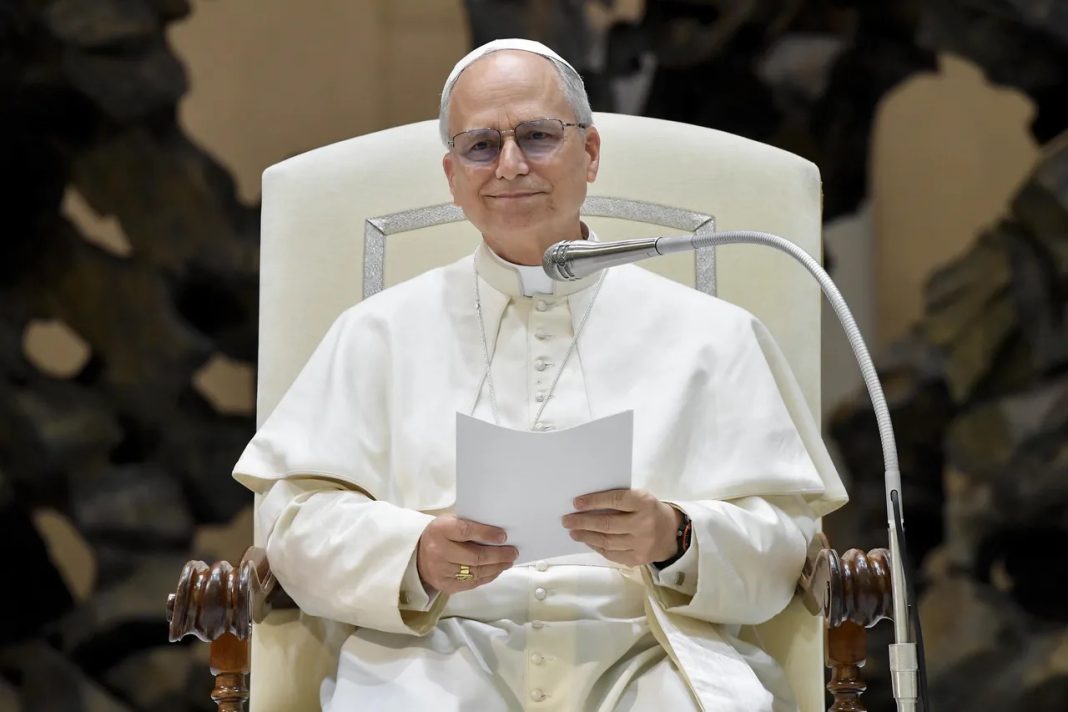

It was the late Pope Benedict XVI, who called Africa, “the spiritual lung of humanity.” Before then, however, his predecessor, Pope St. John Paul II, in his landmark, Post-Synodal Apostolic Exhortation “Ecclesia in Africa”, equally, seemed to have anticipated the seemingly, spiritual and pastoral focus and significance of this week’s Apostolic Visit of Pope Leo XIV to the continent of Africa.
In his “Ecclesia in Africa”, Pope St. John Paul II, exhorts the Christians and Churches of Africa, as follows:
“Today, I urge you to look inside yourselves, look to the riches of your own traditions, look to the faith which we are celebrating in this assembly: Here you will find genuine freedom, here you will find Christ who will lead you to the truth.” – (John Paul II, “Ecclesia in Africa”. no. 48).
This week, Pope Leo XIV, is in Africa, his first apostolic visit to the continent since his election as the Successor to the See of St. Peter, the Apostle, in Rome, on May 8, last year, 2025.
The Pope started the apostolic visit to Africa, with Algeria, the birth place of his spiritual father and origins of his spirituality as Augustinian. The other countries, the Pope is visiting in this his first ever African visit as pope, include, Cameron, Equatorial Guinea, Angola.
In this article, we are reflecting, briefly, on the ‘African significance and takeaways’, of the first stop in this Pope Leo’s African visit, in Algeria’s ancient City of Hippo (which is today’s Algerian hill top City of Annaba (the ancient commercial, and political bustling City of Hippo), and so forth!
Today, April 14, 2026, in Algeria, Pope Leo visits ‘The ancient City of Hippo (today’s City of Annaba) – The Birthday Place & Episcopal See of St Augustine of Hippo, an African-born and raised Church Father and Father of Christian Theology of the Western European Church of Rome’:
Some takeaways
Again, note, that, the ancient and historical City of Hippo, was the Episcopal See of St Augustine, that all times, great African Church Father, the indisputable Father and founder of the Western Theology and Church’s Doctrinal cum Theological foundation of Christianity, since the Patristic era to this day. Lucky enough, till date, all the liturgical texts and history of the Church, refers to him, as ‘ST AUGUSTINE OF HIPPO. Nobody has denied his African roots. His father was a Roman military officer who married, a devout native African woman, (St.) Monica, who was of an African ethnic group, known as Berbera, the original African natives of Carthage and that part of the Maghreb North Africa. It was from his African mother, Monica, that Augustine got his Catholic faith, conversion and priestly vocation later in life. (Cf. Augustine’s “My Confessions.”)
The Rwandan-Ugandan born African theologian, Emmanuel Katongole, in his article about this epochal apostolic visit of Pope Leo to Africa, says that, “The Pope is not travelling to bring hope to Africa, but to find hope in Africa.” That is, that the Pope is travelling to Africa, to find the richness of the Christian hope, that has continued to sustain and guide African Churches and Christians in their daily struggle for survival, in the midst of the historical injustices, Muslims onslaught, Western powers and their African local agents collaborators’ exploitation, failed inherited post-colonial African nation states — the killings, government-sponsored genocides, ethnic-cleansings of some targeted ethnic groups and Christians, etc. As well as, the evils of the continued man-made, political motivated and sponsored African political instability, lopsided governments and leadership of tyranny, dictatorship, corruption, violence and intimidation – all kinds of man’s inhumanity to fellow man.
What kind of the Christian hope, in the midst of all these, that has continued to sustain the Churches and Christians of Africa, as they experience all these things every day and in every part of the continent and beyond? This is the type of Christian hope and faith in Jesus Christ by the African Christians and Churches, that most Africans, believe, Pope Leo XIV, is about to find in Africa as he visits those four representative African countries of Algeria, Cameron, Equatorial Guinea and Angola.
Again, today, Pope Leo XIV, an Augustinian religious professed, priest and pope, visits Hippo, the origins of his Augustinian Spirituality and Identity. What a great reconnection with one’s identity and religious spirituality, as a Successor of St. Peter, and the head of the Church of Rome?
Unfortunately, that previously, vibrant Catholic Church city of St Augustine of Hippo, his Episcopal See of Hippo and the entire, once, vibrant and flourishing Church of Carthage and the entire Maghreb and North Africa, is now an Archeological Site, no more? Why? And what are the lessons, that the Churches and Christians of today’s seemingly, vibrant and booming Churches in sub-Saharan Africa, can learn from what happened to the once, booming and flourishing North African Churches?
With this visit of Pope Leo XVI to the Archeological Site of Hippo, where Augustine was born, raised by his African mother from an African native ethnic group of Berbera, let’s always keep in mind this African origins of Christian theology and doctrine. Because, while these great Fathers of the Church of the Maghreb African, Tertulian, Cyprian of Carthage and Augustine of Hippo, were from that North Western part of North Africa, shaping and giving birth to the Western European Christianity and Church – the Church of Rome, their other equally, great African Church Fathers, counterparts in the Egypt, the Church of Alexandria – the great Patriarchs and theologians, Church Fathers of the Eastern Orthodox Church of Alexandria, Egypt – e.g.: Patriarchs and great Church Fathers, such as St. Athanatius, St. Cyril of Alexandria, and Origine, among others., were also at the same time, reshaping and giving birth to the Christian theology and Doctrine of the Eastern Orthodox Church of the Patriarchate of Constantinople (today’s Istanbul.)
In other words, the now decadent Church of North Africa, was the one that gave birth to Christian theology, Monastic Spirituality and the Consecrated Religious Life Spirituality in the Church, among other contributions of that early church of North Africa to the Universal Church.
In particular, again, their spiritual god-father, St Anthony, Abbot of the Church of Alexandria in Egypt, had at the same time, busy, giving birth through his life and sacrifices, to the Universal Church’s spirituality of monastic life – the Christianity’s Monastic, life as well as the Church’s Spirituality of Religious vocations and vows of Consecrated life – vows of Obedience, Poverty and Celibacy, for the sake of the Gospel and the Kingdom of God, pointing the world’s attention to the other side of life, life after death.
Some of the Causes of the Fall of the Vibrant Churches of North Africa:
More importantly, while the Church leaders in Maghreb North Africa, were busy, celebrating themselves, fraternising with corrupt politicians, royals, etc., and concentrating much of the church life in cities, in royal and episcopal palaces, neglecting, the evangelisation of the interior areas of the vast lands of Numidia, today’s Morocco, Niger Republic, Mali, Burkina Faso, etc.; their counterparts in Egypt, especially, from the time of the Patriarchs Demetrius, and in particular, of the indefatigable, St. Athanatius, as Patriarch of Alexandria, these two patriarchs, Demetrius and Athanatius, made a breakthrough, by moving into the interiors of Egypt, and began to establish new Dioceses everywhere, encouraging, indigenous vocations, translations of the Bible, liturgical texts and other sacred books into African local languages, promoting the indigenisation (inculturation), and establishing monasteries, parish community centres and ‘desert tents kinds of monasteries and parish centres’ all over the place in their domain.
The Coptic Church (Coptic, is another word, for describing non-hellenised Egyptian Christians. Today, it referred to, the non-Arabised or Islamised, Egyptians.
During the time of Arab Muslim invasion and persecution in Egypt, almost all those ‘big and influential’ Church leaders, scholars and Christian politicians in the cities of Alexandria, Cairo, etc., were the first to run away to Constantinople, Athens in Greece, and to Rome, leaving the peasant and other ordinary Christians in the rural and interior areas at the mercy of the Jihadists, invading Arab Muslim forces.
This was the time, those poor, peasant Christians, rose up, began to defend their Christian faith and farmland. Millions of those peasant Christians of Egypt, were massacred, and their Martyrdom remains unparalleled in the entire of the church’s history of Christian martyrdom. Today, the Church in Egypt, Coptic Church, does not follow the traditional Western Gregorian Liturgical Calendar for the beginning of the year. The Coptic Church liturgical Calendar year begins with the Year of the Martyrdom of those Egyptian Christian peasants, that gave their lives to save the ‘remnant’ Christian Church, Coptic Church, that survived that Muslim onslaught and persecution.
Pope Leo in Africa challenges today’s African Churches and Christians, to go back to the African roots of the Church, and ask themselves the uncomfortable question of, “Why are those vibrant Churches of North Africa, the Church of St, Augustine of Hippo, of St Cyprian and Tertulian, of Carthage, are no more? And where is the only Church of the Patriarch of Alexandria (now in with its headquarters in Cairo), Egypt, is the only one that seemed to have survived, and it survived as a minority, in which it has to pay tax every year, to the Islamic Government in Egypt, for it to exist as a Church?
Pope Leo’s visit challenges the Churches and Christians of today’s Africa, to begin to look inward, to look towards Saharah, and look towards Africa’s rich traditions, culture, history, and learn from them, from Africa’ historical memory and experience as a Church and People!
Again, ask themselves, as Churches and Christians of Africa, ‘how come it that those once vibrant, prosperous and flourishing Churches in North Africa, are today, no more? How come it that today they have today, become a mere ‘Archeological Site?’ And that only the Coptic Church in Egypt survived, and survived as a minority. And even the Coptic (Egyptian) Orthodox Church itself, that managed to survive till today, exist only as a minority, has to pay tax for it to exist as a ‘protected’ Church in the all Muslims dominated Egypt? What is the lesson for today’s booming African Churches in Africa, South of the Sahara. That is the one billion dollars question?
Lessons from The Ethiopian Orthodox Church Survival Mechanism:
Corollary, Christians and Churches of Africa today, especially, today’s booming and vibrant Churches and Christians in Africa, South of the Sahara, should ask themselves, whether they are prepared not to allow the same experience of the once vibrant Churches of North Africa, happen to their own vibrant churches in sub-Saharan Africa today? What are those things that the Churches and Christians in Sub-Africa are doing today, to prevent the same Islamic onslaught and internal betrayal, that caused the fall of the Churches of North Africa, not to happen to their own churches in Africa, South of the Sahara?
In other words, the Churches and Christians of Africa, today, must learn and ask themselves the hard question, as African Churches and Christians:
– how come it that only in Ethiopia has the Church survived from that early period to the present day?
And, don’t forget, that the Church in Ethiopia was integral part of the Patriarchate of Alexandria, in Egypt, even throughout the period the Arab Muslim world have overrun the entire North Africa and taken control of the entire central Sahara Northeastern and Central African routes, that the Church in Ethiopia were using to travel to Constantinople and Alexandria in Egypt, to ask for a new Patriarch, for Episcopal Ordination, for their Church in Ethiopia. But the game began to change, with the Arab Muslims onslaught and conquering of the entire North Africa and the Trans-Saharan Routes. The Church in Ethiopia could no longer travel to Alexandria in Egypt to ask for the Ordination of a new bishop for Ethiopia.
Conclusion
For over 800 years, the Church in Ethiopia was an isolated church, without Bishops. The question is, how did the church in Ethiopia survive, and today, it no longer sees itself as a daughter church of Alexandria in Egypt, but as a sister church to the church in Egypt and the rest of the world?
The survival mechanism applied by both the Orthodox Church in Egypt – today’s Egyptian Coptic Orthodox Church, and their sister Church in Ethiopia, the Ethiopian Orthodox Church, is what the today’s African Churches and Christians must learn and imbibe with, if they don’t want what happened to the once vibrant, flourishing, but now, the decadent North African Church of Magreb North Africa and the historical Church of Nubia (today’s Sudan), to happen to them.
This is the greatest pastoral and spiritual challenge, of Pope Leo XIV travelling to Africa at a time like this!
A Stitch in Time Saves Nine!
Francis Anekwe Oborji is a Roman Catholic Priest. He lives in Rome where he is a Professor of missiology (mission theology) in a Pontifical University. He runs a column on The Trent. He can be reached by email HERE.
The opinions expressed in this article are solely those of the author.