
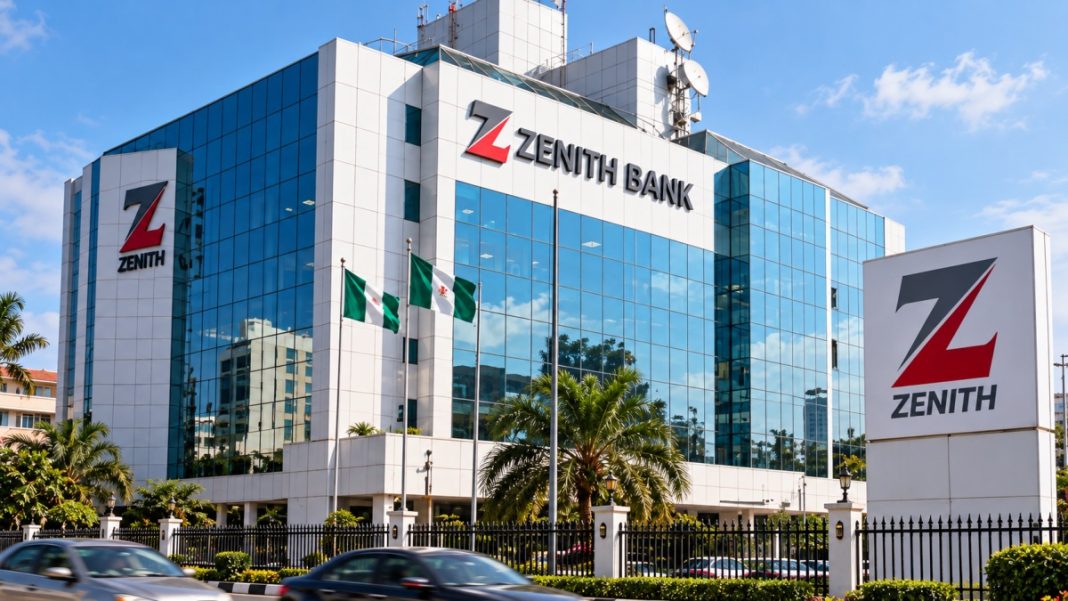

LAGOS, Nigeria — Zenith Bank Plc recorded 171 cases of fraud and forgery in the first six months of 2026, resulting in losses of ₦376 million, according to its latest financial statements.
The bank also disclosed more than 1,600 unresolved customer complaints involving claims worth ₦67.2 billion.
The disclosures, contained in the bank’s audited interim financial report for the period ended June 30, highlight continuing concerns about financial fraud and customer protection in Nigeria’s banking industry, even as the country’s largest lenders expand their digital operations.
Zenith Bank, one of Nigeria’s biggest commercial banks, reported that the fraud losses had been recognised in its operating expenses.
“During the period, a total of 171 fraud cases were reported, which resulted in actual loss of N376 million to the Bank,” the directors said in the financial report published on the Nigerian Exchange.
The bank said it had complied with its obligation to submit monthly reports on fraud and forgeries to the Central Bank of Nigeria (CBN), as required under Section 24 of the Banks and Other Financial Institutions Act 2020.
The financial statements did not provide a detailed breakdown of the 171 cases by transaction channel, identify the perpetrators, or specify how much money was involved in unsuccessful attempts.
They also did not establish whether the incidents primarily involved employees, external fraudsters, compromised customer accounts, or other forms of financial misconduct.
More Than 1,600 Customer Complaints Remain Unresolved
Separately, Zenith Bank disclosed that it received 7,914 customer complaints during the first half of 2026 and resolved 6,780 cases.
With 499 complaints carried forward from the end of 2025, the bank had 1,633 unresolved complaints as of June 30.
The outstanding cases involved customer claims totalling ₦67.21 billion.
That figure was lower than the ₦92.77 billion associated with unresolved complaints at the end of December 2025, although the number of outstanding complaints increased substantially.
The bank’s financial disclosures showed that complaints received during the six-month period involved claims of approximately ₦12.11 billion, while the cases resolved represented claims totalling ₦37.66 billion.
Zenith Bank also reported refunds of ₦4.01 billion in connection with resolved complaints.
The distinctions are important because the ₦67.21 billion in unresolved customer claims does not represent confirmed fraud losses.
Customer complaints may involve disputed transactions, service failures, unauthorised debits, or other banking issues, and the existence of a claim does not establish that the bank is liable for the full amount.
The bank’s report did not establish how many of the complaints were related specifically to fraud.
Its comparative figures also require care: the customer complaints table compares June 30, 2026, with December 31, 2025, rather than with the corresponding six-month period of the previous year.
The disclosure nevertheless indicates a growing backlog of unresolved cases, with outstanding complaints rising from 499 at the end of 2025 to 1,633 six months later.
Profit Declines Despite Higher Pre-Tax Earnings
The fraud disclosures accompanied a mixed financial performance for Zenith Bank, which is led by Group Managing Director and Chief Executive Officer Adaora Umeoji.
The lender reported a profit before tax of ₦637.60 billion for the first half of 2026, compared with ₦625.63 billion during the corresponding period of 2025, representing an increase of approximately 1.9 per cent.
However, profit after tax declined by about 19.1 per cent, falling from ₦532.18 billion to ₦430.76 billion.
The decline was accompanied by a sharp increase in taxation.
Zenith Bank’s tax expense rose to ₦206.84 billion, more than double the ₦93.45 billion recorded during the first six months of 2025.
Gross earnings also fell by approximately 24.6 per cent, declining from ₦2.52 trillion to ₦1.90 trillion.
The figures indicate that the bank maintained substantial profitability despite weaker revenue and a considerably heavier tax burden.
Its financial position continued to expand in other areas.
According to a separate analysis of the interim accounts published by Punch, Zenith Bank’s total assets increased to ₦32.65 trillion by June 30, up from ₦31.46 trillion at the end of 2025.
Loans and advances rose to approximately ₦12.05 trillion, while customer deposits increased to ₦26.35 trillion.
The bank also proposed an interim dividend of ₦1.50 per share, compared with ₦1.25 per share for the corresponding period of 2025.
Fraud Remains a Major Challenge for Nigerian Banks
Zenith Bank’s disclosure comes amid continuing efforts by regulators and financial institutions to combat fraud across Nigeria’s rapidly expanding electronic payments system.
The growing use of mobile banking applications, internet banking, point-of-sale terminals, and other digital services has made financial transactions more accessible, but it has also created additional opportunities for criminals.
According to a January 2026 research brief by the National Institute for Legislative and Democratic Studies, Nigerian banks and other financial institutions lost ₦25.85 billion to electronic payment fraud in 2025.
The amount represented a decline of approximately 51 per cent from the ₦52.26 billion recorded in 2024, based on data presented by the Nigeria Inter-Bank Settlement System (NIBSS).
The research also identified approximately 67,515 reported fraud cases in 2025, continuing a broader decline in the number of incidents.
However, the researchers warned that fraud was becoming increasingly sophisticated, involving account compromises, phishing, social engineering, insider collusion, and other technologically enabled methods.
They also raised concerns about underreporting and the need for stronger cooperation between financial institutions, regulators, and law enforcement agencies.
The broader scale of the problem was illustrated by another CBN disclosure in June.
According to the central bank’s Nigeria Payments System Vision 2028 document, banks and their customers lost a combined ₦134.48 billion to fraudulent transactions between 2020 and 2025.
The figures covered multiple channels, including automated teller machines, mobile applications, internet banking, point-of-sale terminals, cheques, and over-the-counter transactions.
The central bank’s findings suggested that although fraud losses declined significantly in 2025, the financial threat remained substantial.
These industry-wide figures are not directly comparable with Zenith Bank’s ₦376 million loss because they cover different institutions, reporting periods, and categories of fraud.
Regulators Push for Stronger Fraud Prevention
Fraud prevention has become an increasingly important part of banking supervision in Nigeria as regulators seek to protect customers and maintain confidence in the country’s financial system.
The CBN requires financial institutions to report fraud incidents and maintain internal procedures for detecting suspicious transactions, managing operational risks, and addressing customer complaints.
The Financial Institutions Training Centre (FITC), which publishes periodic reports on fraud in Nigerian banks, has repeatedly emphasised the need for stronger internal controls and more effective monitoring of electronic transactions.
Its second-quarter 2025 report identified computer and web-based platforms, mobile banking, and point-of-sale terminals among the most frequently affected channels.
The organisation also highlighted the role of staff-related fraud and recommended stronger employee supervision, transaction monitoring, and cybersecurity safeguards.
For customers, the effectiveness of these measures depends not only on preventing unauthorised transactions but also on how quickly banks investigate complaints, resolve disputes, and return funds when reimbursement is warranted.
In its latest accounts, Zenith Bank said it was investing in information technology, fraud detection, and cybersecurity systems to protect digital banking channels and strengthen customer confidence.
The disclosure of 171 fraud cases and ₦376 million in losses provides a measure of the financial damage recorded during the first half of the year.




