
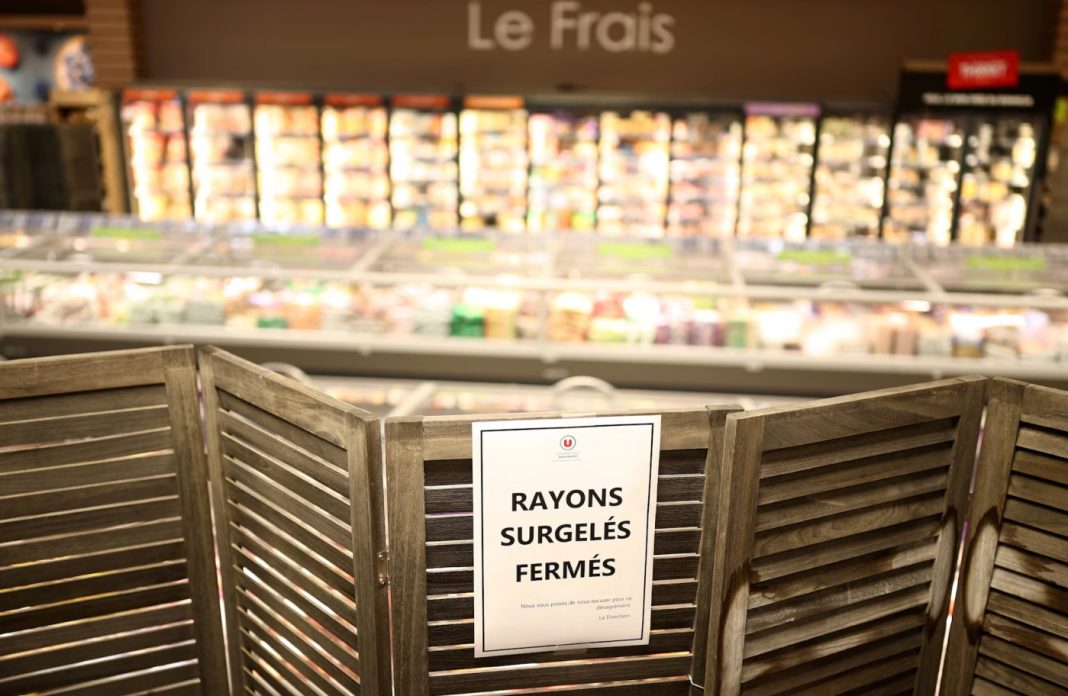

PARIS, France — Hackers remotely raised the temperatures of refrigerators and freezers in hundreds of French supermarkets to as high as 50 degrees Celsius, spoiling large quantities of food and causing losses estimated at millions of euros.
The cyberattack, which began on Sunday night and was discovered on Monday, October 12, 2026, affected several of France’s largest supermarket chains, including Intermarché, Coopérative U, Carrefour, Monoprix, and E. Leclerc.
French prosecutors said the attacks also caused fires, prompting a criminal investigation into how hackers gained access to the computerised systems controlling refrigeration equipment.
At some Intermarché stores, refrigeration units remained at elevated temperatures for approximately six hours, forcing employees to discard fresh and frozen food to prevent health risks.
The government has ordered an investigation by France’s National Cybersecurity Agency, known as ANSSI, amid concerns that similar systems in other European countries may also have been compromised.
Hundreds of Supermarkets Affected
Intermarché and its Netto discount supermarket chain were among the hardest hit.
According to Agence France-Presse, at least 300 outlets belonging to the two brands were targeted, alongside more than 100 stores operated by Coopérative U.
Carrefour separately confirmed that 80 of its supermarkets had been affected, while Monoprix said approximately 5 per cent of its stores experienced disruptions.
E. Leclerc also acknowledged problems at several branches, w hich it attributed to a cyberattack involving one of its refrigeration equipment suppliers.
The full number of affected stores has not been established.
At an Intermarché supermarket in central Paris, employees were seen disposing of large quantities of thawed frozen food.
A witness described workers loading shopping trolleys with damaged stock before transferring the products into an outdoor waste container.
Some containers of ice cream had melted, spilling their contents onto the street.
Intermarché said affected stores had removed compromised fresh and frozen products from sale because of food safety concerns.
The company has not disclosed the total value of its losses.
Although reports have estimated the damage across the industry at several million euros, retailers and investigators have yet to publish a consolidated financial assessment.
Hackers Manipulated Refrigeration Software
The attackers reportedly gained access to software used to monitor and control commercial refrigeration systems.
Rather than simply shutting off electricity to the appliances, they remotely activated the equipment’s defrosting functions, causing temperatures to rise.
Defrosting is a normal function in refrigeration equipment, but forcing systems to remain in that mode can prevent them from maintaining temperatures needed for food storage.
French broadcaster BFMTV reported that hackers manipulated the settings to create prolonged defrosting cycles.
Some units reached 50 degrees Celsius, far above the temperatures required to preserve meat, fish, dairy products, and other perishable goods.
A source familiar with the investigation told Reuters that the incident involved vulnerabilities in refrigeration control software supplied by the Danish manufacturer Danfoss.
The company acknowledged reports of incidents involving its equipment in France.
Danfoss said affected systems included older products that no longer receive regular security updates, as well as equipment operating with outdated firmware.
The company identified its AK-SM800 and AK-SC355 refrigeration control systems among the affected products.
It said it had previously advised customers to install available security updates and replace obsolete equipment.
Investigators have not established how the attackers initially gained access to the affected systems.
Supermarket Executive Calls Attack Unprecedented
Dominique Schelcher, chief executive of Coopérative U, condemned the disruption and said the company was working with technical specialists to restore operations.
In a statement posted on X, Schelcher described the attack as unprecedented.
“Targeting equipment essential to the preservation of fresh products and to the food supply of the French people is of extreme gravity and is unprecedented,” he wrote.
He said the company’s employees and refrigeration specialists were working to restore the affected equipment.
Je confirme qu’une cyberattaque touche depuis cette nuit les installations de production de froid de plusieurs magasins de notre réseau @CooperativeU.
Nos équipes sont pleinement mobilisées, en lien avec les frigoristes, pour rétablir la situation au plus vite. Une enquête devra permettre de faire toute la lumière sur cette attaque.
S’attaquer à des équipements essentiels à la conservation des produits frais et à l’approvisionnement alimentaire des Français est d’une extrême gravité et est inédit. C’est inacceptable.— Dominique Schelcher (@schelcher) October 12, 2026
The Paris prosecutor’s office confirmed that investigators were examining reports of destroyed food and fires associated with the attacks.
The investigation will seek to identify affected businesses, establish the extent of the damage, and determine who was responsible.
The authorities have not identified any suspects or attributed the operation to a particular country or organisation.
France Investigates Possible Attacks Beyond Its Borders
Prime Minister Sébastien Lecornu instructed ANSSI to investigate the breach and assess whether other French businesses could be vulnerable.
A person familiar with the government’s response told Reuters that French officials were coordinating with cybersecurity authorities elsewhere in Europe.
Félix Aimé, a senior cyber threat intelligence analyst at Sekoia Threat Detection and Research, said similar incidents had affected Spain, Portugal, Poland, Germany, and Belgium.
The extent of those reported incidents and whether they were part of the same operation had not been independently established.
The attack also coincided with a separate cybersecurity incident involving Dutch supermarket operator Ahold Delhaize, which operates the Albert Heijn chain.
The company took several computer systems offline as a precaution, disrupting online grocery orders and deliveries.
However, Ahold Delhaize said there was no reason to conclude that its technical problems were connected to the attacks in France.
Cyberattack Raises Concerns About Food Supply Systems
The incident has drawn attention to the use of internet-connected technology in refrigeration equipment and other systems essential to food distribution.
Commercial supermarkets often rely on centralised controllers that allow technicians to monitor and adjust temperatures remotely.
Those systems can help maintain equipment across multiple locations but may also be vulnerable if security weaknesses are exploited.
Antoine Hautin, a cybersecurity specialist at consultancy Almond, told AFP that refrigeration equipment once operated largely in isolation but is increasingly connected through sensors and remote monitoring platforms.
The European retail industry has also expressed concern.
Christel Delberghe, director-general of the European retail association EuroCommerce, said the disruption demonstrated the importance of protecting supply chains against cyber threats.
European Commissioner for Agriculture and Food Christophe Hansen condemned the targeting of equipment used to preserve food.
The incident follows earlier warnings about vulnerabilities in commercial refrigeration control systems, including research published by cybersecurity companies examining Danfoss equipment.
French authorities are continuing to investigate the attacks as supermarkets calculate their losses, dispose of damaged goods, and work to restore normal refrigeration operations.




