
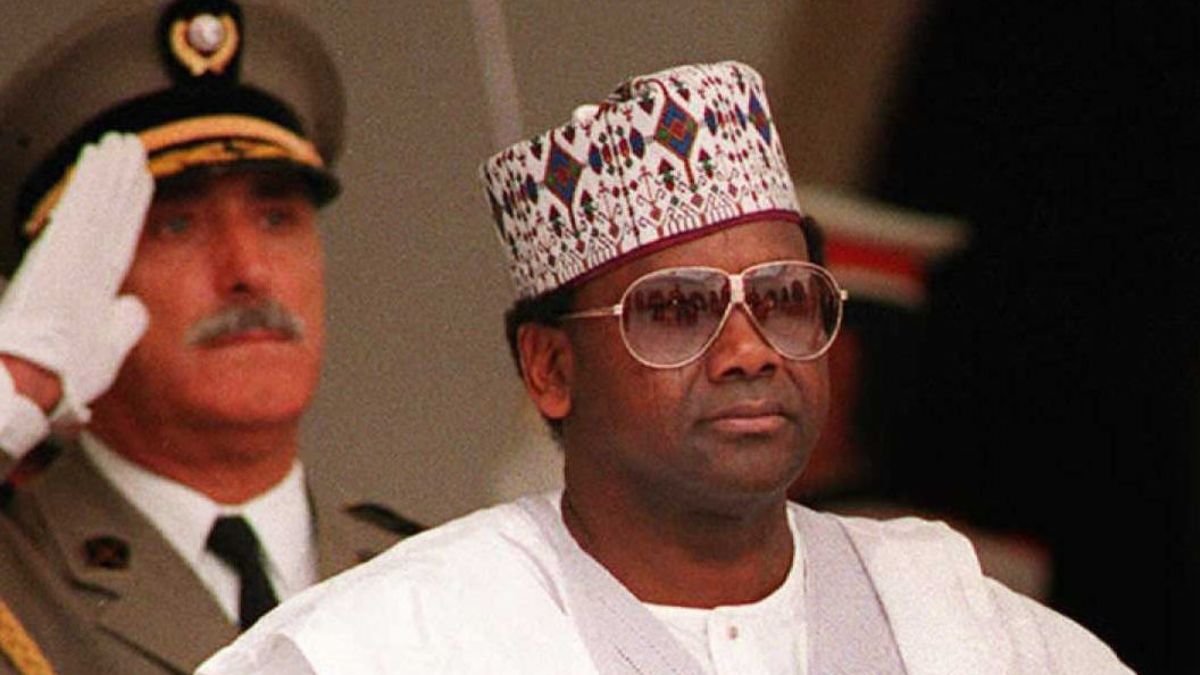

ABUJA, Nigeria — A retired Nigerian security official has offered a detailed account of the final hours of Gen. Sani Abacha, saying a young pharmacist who was with the military ruler when he died insisted that she had not harmed him.
Dennis Amachree, a former assistant director of the State Security Service, said he personally questioned the woman in Lagos after Abacha was found unresponsive at the Aso Rock Guest House in Abuja.
“The first thing she said to me was: ‘I did not kill him, he died on top of me,’” Amachree wrote.
The account appears in his newly released 348-page book, DSS @40: My Journey Behind the Shield. Amachree presents it as an effort to resolve decades of speculation about the circumstances surrounding Abacha’s death.
His version has not been independently corroborated in the material available to The Trent. It relies principally on what he said the unnamed woman told him during an interrogation and on information received by security officials immediately after Abacha died.
Abacha, Nigeria’s seventh military head of state, died at the age of 54 on Monday, June 8, 1998. He had ruled the country since taking power in November 1993.
A Death Followed by Decades of Speculation
Conflicting explanations emerged almost immediately after Abacha’s death.
Some accounts attributed it to natural causes. Others alleged poisoning, foreign intelligence involvement, a compromised handshake, a poisoned apple or the presence of women brought into the presidential residence.
Amachree rejected those versions and said the account provided by the pharmacist offered the clearest explanation of what happened.
“The lady pharmacist’s account, on whom Abacha apparently had a coitus-induced cardiac arrest, remains the true position, and puts an end to the conspiracy theories and half-truths that have gone viral,” he wrote.
Amachree was serving as assistant director of operations and intelligence at the Lagos State SSS Command when Abacha died. The agency later became known as the Department of State Services.
He described alternative versions of the death as misleading.
“Any other narrative is an act of deceit and a disservice to our countrymen and women,” he wrote.
The retired officer said the woman left Abuja for Lagos shortly after witnessing Abacha’s death. Security officials later located her at an address in Ogudu, Lagos, and took her to his office for questioning.
Amachree’s Account of the Final Hours
In Chapter 17 of the book, titled The Months of Death: A Turning Point in Nigerian History, Amachree sets out his version of the events inside the presidential residence.
He wrote that Abacha had spent part of the period before his death receiving visitors and dignitaries. These included representatives of Yasser Arafat, then leader of the Palestine Liberation Organisation.
Amachree also referred to the visit of Pope John Paul II, who travelled to Nigeria and appealed for the release of political detainees. He described the Pope as the last major visitor received by Abacha.
The retired officer said that at about 2.40 a.m., after senior military officer Jeremiah Useni had left, a woman described as Abacha’s girlfriend arrived at the Aso Rock Guest House from the Nicon Noga Hilton Hotel.
She was accompanied by her younger sister, an unnamed pharmacist who was in Abuja for a professional conference.
“At approximately 2.40 am, shortly after Gen. Useni left, Abacha’s girlfriend, an Igbo lady (name withheld), arrived at the Aso Rock Guest House from the Nicon Nogs Hilton Hotel,” Amachree wrote. “With her was her younger sister, a pharmacist who was in Abuja for a conference. The Head of State had just bought his girlfriend a new SUV, and they decided to stop by to say hello to ‘Oga.’”
According to Amachree, Abacha became interested in the younger woman. Her sister subsequently returned to the hotel, leaving the pharmacist with the head of state.
“Abacha was taken with the younger sister, and after a short while, the girlfriend returned to the hotel, leaving the pharmacist alone with the Head of State,” he wrote. “At about 4.05 am, as they were getting intimate, the pharmacist realized Abacha had stopped moving. She called out to him, but he was unresponsive and stiff. She checked his pulse; there was none.”
Amachree said the woman panicked, dressed and left the guest house without informing the guard that Abacha appeared to have died.
“In a state of panic, she quickly dressed and left the guest house, telling the soldier in guard duty that ‘Oga’ had asked for a car to take her back to her hotel,” he wrote. “The soldier, unaware of the gravity of the situation, promptly arranged for her transportation.”
The woman returned to the hotel and informed her sister, according to the account. She was then driven to the airport to board an early Okada Airline flight to Lagos.
“She returned to the Hilton, and after telling her sister what had happened, was quickly driven to the Abuja Airport to catch the 7.am Okada Airline flight to Lagos,” Amachree wrote.
Security Officers Search for Abacha’s Last Guest
Amachree said members of Abacha’s security team initially did not understand what had happened inside the guest house.
Maj. Hamza Al-Mustapha, Abacha’s chief security officer, was informed at about 5 a.m. that the head of state was unstable, according to the book.
Al-Mustapha asked who had most recently been with Abacha and was told about the pharmacist. Security officers were sent to the hotel, but she had already left for Lagos.
“This is the window Major Al-Mustapha missed,” Amachree wrote. “When he was finally informed of Abacha’s instability at 5 am, he asked who had been with the General. He was told about the girlfriend’s younger sister, whom they had just dropped off at the Hilton.”
He added: “The State Security Service (SSS) was immediately informed and went to the Hilton to arrest the girlfriend, but the pharmacist they urgently needed was already on her way to Lagos.”
Amachree said he received a call at about 8 a.m. the following day from the director of operations at the SSS national headquarters.
“At approximately 8 am on June 9, 1998, as the Assistant Director of Operations and Intelligence at the Lagos State SSS Command, I received a call from the Director of Operations at SSS National Headquarters,” he wrote. “He informed me of Abacha’s death and ordered me to send operatives to an address in Ogudu, Lagos, to arrest a young pharmacist.”
Amachree said his officers found the woman and brought her in for questioning.
“My team located and brought her to my office. I interrogated her myself,” he wrote. “The first thing she said to me was: ‘I did not kill him, he died on top of me.’ After her detailed account, I called the Director in Abuja, and she was immediately flown back.”
Amachree did not identify the woman or disclose the full contents of the statement he said she provided.
He wrote that reports of Abacha’s death later generated stories about imported women, poison and assassination plots.
“Later that day, the news broke, and the media, with their ‘fertile imagination,’ began to spin takes of imported Indian girls and poisoned apples,” he wrote.
Disputing 6 Competing Accounts
A substantial part of Amachree’s account is devoted to challenging explanations previously offered by journalists, former officials, military officers and politicians.
He addressed a report attributed to David Orr of The Irish Times, which cited an unnamed diplomat who suggested that dissatisfied military officers had poisoned Abacha.
“A journalist’s account cited an unnamed diplomat claiming Abacha was poisoned by a small group of disaffected military officers,” Amachree wrote. “While dramatic, this narrative was contradicted by a Nigerian newspaper report citing autopsy results that ruled out poisoning.”
He also examined an account associated with Susan Rice, a former United States national security adviser.
“The former US National Security Advisor’s account, while condescending, echoed the widespread rumour that Abacha died in the company of prostitutes, possibly due to Viagra use,” Amachree wrote. “This version, while popular, lacks concrete evidence and is dismissed by those close to the late Head of State.”
Amachree then turned to Al-Mustapha, whose proximity to Abacha has made his statements central to public debate over the death.
“As Abacha’s Chief Security Officer, his account is often considered a key source, though it contains notable inconsistencies,” he wrote. “He claimed Abacha’s health collapsed after a handshake with a security guard of a visiting dignitary. This version, while exonerating the ‘poisoned apple’ theory, differs significantly from other timelines and accounts.”
Al-Mustapha has maintained that Abacha’s health deteriorated after he shook hands with a foreign security operative attached to Arafat’s delegation.
According to the version recounted by Amachree, Al-Mustapha said a doctor stabilised Abacha at about 6 p.m. and that the military ruler continued to receive visitors.
Amachree said the former chief security officer’s chronology did not fully account for the period immediately before Abacha was discovered unresponsive.
He wrote that Al-Mustapha “missed the one and half window after Gen. Useni’s departure that provides the key to the mystery.”
Amachree also challenged aspects of Useni’s account.
“A close friend of Abacha, Useni’s narrative provides a different timeline of events, contradicting Al-Mustapha’s account regarding the final hours,” he wrote. “He supported the official story of death by natural causes, citing autopsy results from multiple countries.”
Another explanation came from Brig. Gen. Oviemo Ovadje, a medical officer who suggested that Abacha had experienced long-term health problems.
“His account offers a different perspective, suggesting Abacha’s death was a result of long-term health issues exacerbated by poor medical management, including the use of steroids,” Amachree wrote.
He also dismissed claims circulated by Femi Fani-Kayode, a former aviation minister, who had alleged that the Central Intelligence Agency was involved in a plot built around a poisoned handshake.
“While lacking evidence, this narrative highlights the deep-seated public distrust and willingness to believe external forces are pulling the strings,” Amachree wrote.
The retired officer said stories involving imported Indian women, poisoned fruit and foreign intelligence services had complicated attempts to establish a reliable historical record.
“Many accounts were published, but few were based on verifiable facts,” he wrote. “These range from fictional stories of a poisoned apple from disaffected soldiers, to more sensational claims involving foreign intelligence agencies.”
Abacha’s Rule and the June 12 Crisis
Abacha took power during the political crisis that followed the annulment of the June 12, 1993 presidential election.
Moshood Abiola was widely regarded as the winner of the election, but the military government led by Gen. Ibrahim Babangida annulled the result.
Amid protests and national outrage, Babangida stepped aside and installed an unelected Interim National Government headed by Ernest Shonekan. Abacha remained in the administration as defence minister.
The arrangement failed to gain broad public acceptance. Less than three months later, Abacha forced Shonekan out and assumed control of the government.
Amachree described the five-and-a-half years of Abacha’s rule as a period of severe authoritarian repression.
“Abacha’s five and half year rule was a period of extreme authoritarianism and brutal repression,” he wrote, adding that the government was accused of arbitrary detention, torture, human rights violations and extrajudicial killings.
The author said the number of political prisoners held during the period was reported to have surpassed the number detained throughout British colonial rule.
Abacha’s government held Abiola in custody after he declared himself president on the strength of the annulled election.
Abacha died less than a month before Abiola. The detained politician died on July 7, 1998, while meeting Nigerian and American officials.
The two deaths transformed Nigeria’s political direction and accelerated the process that eventually returned the country to civilian government.
The Attempt to Remain in Power
Before his death, Abacha had advanced a plan that would have allowed him to exchange military authority for an ostensibly civilian presidency.
Five registered political parties adopted him as their sole presidential candidate.
The parties participated in a transition programme controlled by the military government while supporting Abacha’s proposed continuation in office.
Bola Ige, a former governor of Oyo State and prominent opposition figure, famously described the parties as “five fingers of a leprous hand.”
Abacha died before the self-succession plan could be completed.
Amachree Says Falsehood Obscured the Record
Amachree said he included the account in his memoir because he believed people with direct knowledge had failed to provide an accurate public record.
“As a security professional who was in the thick of it, I feel compelled to set the record straight and provide the true narrative for posterity,” he wrote.
He described the controversy surrounding the death as part of a wider Nigerian problem involving secrecy, misinformation and the absence of accountability.
“The confusion surrounding Abacha’s death is a microcosm of a larger problem in Nigeria: a leadership culture steeped in falsehood and a lack of accountability,” he wrote.
He added that “the deliberate suppression of facts and the promotion of misinformation by those who should be held to a higher standard have kept the country in a retrogressive circle.”
Amachree questioned why senior military officers, political figures and close presidential aides had allowed contradictory stories to circulate.
He asked who supplied the media with the accounts that later became embedded in public discussion and why those in a position to clarify events had not done so.
“While the truth may be suppressed temporarily, the forces of human curiosity and investigative inquiry will ultimately bring it to light,” he wrote.
Amachree also used Abacha’s death to reflect on the limits of political authority and personal security.
“Abacha, a military dictator who surrounded himself with a seemingly impenetrable security detail, thought he was invincible,” he wrote. “Yet, in the end, death kept it’s appointment with him, rendering his concentric rings of security useless.”
“His story is a poignant reminder that power is transient and that no amount of security can shield a leader from their ultimate fate.”