
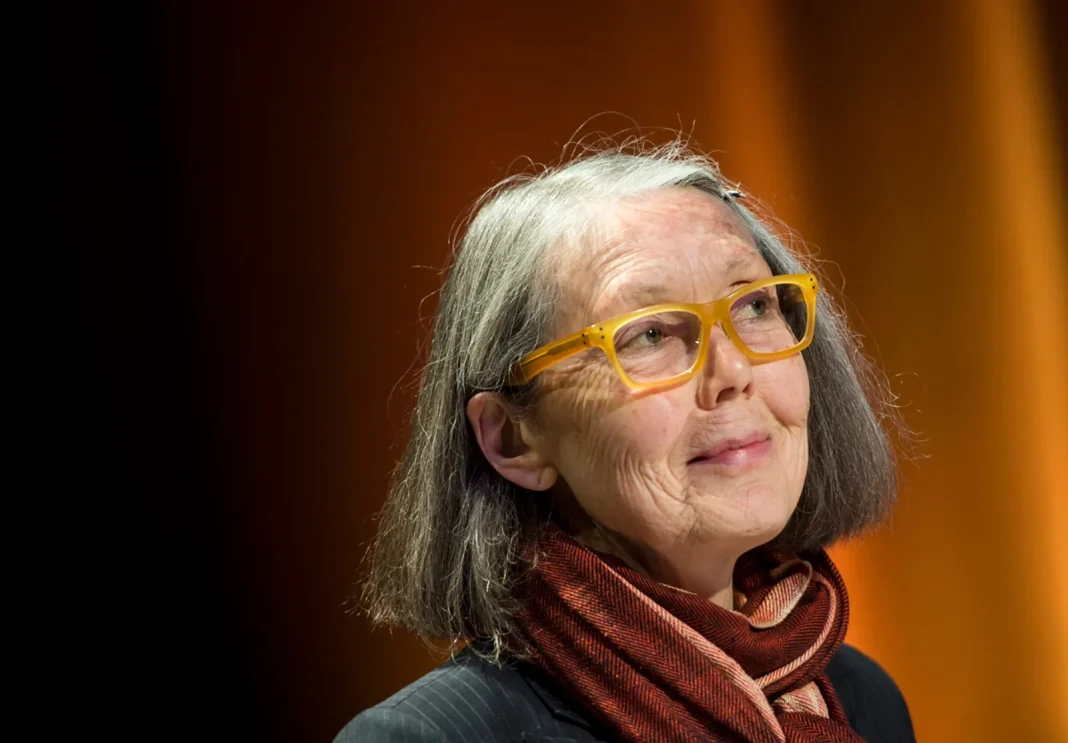

STOCKHOLM, Sweden — Canadian poet, essayist, and classical scholar Anne Carson has won the 2026 Nobel Prize in Literature.
The Swedish Academy honoured the 76-year-old writer for her contributions to contemporary literature, particularly her unconventional use of poetry, prose, translation, and ancient Greek mythology.
The prize was announced in Stockholm on Thursday, October 8, 2026.
Carson, whose books include Autobiography of Red, The Beauty of the Husband, and Nox, was in Iceland when she received news of the award.
The prize carries a cash award of 12 million Swedish kronor, approximately $1.2 million.
According to the Swedish Academy’s official announcement, Carson was selected for a body of work that combines classical scholarship with experimentation in literary form.
The Canadian writer becomes the 19th woman to receive the Nobel Prize in Literature since the award was established in 1901.
Nobel Committee Praises Literary Innovation
In announcing the award, the Swedish Academy praised Carson’s ability to draw on ancient literary traditions while creating new forms of expression.
The committee said her writings explored the relationship between language, literature, and human experience through combinations of verse, storytelling, essays, and translation.
Ingrid Carlberg, the academy’s permanent secretary, announced the decision at a ceremony in Stockholm.
Anders Olsson, chairman of the Nobel Committee for Literature, presented the academy’s assessment of Carson’s work.
He highlighted her ability to combine different literary traditions and move between poetry, scholarship, and other artistic forms.
The academy’s biographical assessment described her translations of ancient Greek literature as important contributions in their own right.
It also identified her interest in the origins and changing meanings of words as a central feature of her writing.
Carson’s books often place classical figures and stories in contemporary settings, exploring themes of love, grief, abandonment, memory, and identity.
Carson Reacts With Surprise
Carson was staying in Iceland when the Swedish Academy contacted her about the award.
Carlberg told reporters that the writer appeared surprised by the announcement.
During their brief conversation, Carson explained that she was in Iceland, where she was “listening to the wind”.
Speaking afterwards to Icelandic public broadcaster RÚV, Carson reacted with characteristic humour.
“Crazy, I think they’re all crazy,” she said, according to Reuters.
She also joked about the commercial impact the award might have on her books.
“I’ll get a sticker on the front of my book,” she said.
The writer has maintained a relatively private life despite decades of international literary recognition.
She holds Canadian and Icelandic citizenship and has spent considerable time living in Iceland.
A Career Shaped by Ancient Greek Literature
Born in Toronto in 1950, Carson developed an interest in classical literature while attending school.
She later studied at the University of Toronto, where she completed a doctorate in classics in 1981.
Her academic career included teaching at universities in Canada and the United States, including McGill University, Princeton University, and the University of Michigan.
She established her literary reputation with Eros the Bittersweet, published in 1986.
The book examines desire and longing through ancient Greek poetry and philosophy, particularly the writings of Sappho.
Carson subsequently expanded her literary approach, producing books that combined academic analysis with personal reflection and imaginative storytelling.
Her 1998 book Autobiography of Red, one of her most widely recognised works, reinterprets the ancient Greek myth of Geryon, a red-winged monster killed by Heracles.
In Carson’s version, Geryon becomes a young man confronting emotional vulnerability, sexuality, and love.
The book was followed by Red Doc>, published in 2013, which revisits the characters later in their lives.
Another major work, The Beauty of the Husband, appeared in 2001.
Subtitled A Fictional Essay in 29 Tangos, it examines a troubled marriage through poetry, narrative, and references to the English Romantic poet John Keats.
The collection won the T. S. Eliot Prize.
Carson has also translated classical Greek literature, including works by Sappho, Sophocles, and Euripides.
Her 2002 book If Not, Winter presents surviving fragments of Sappho’s poetry in translation.
Personal Loss and Experimental Writing
One of Carson’s most personal works is Nox, published in 2010 after her brother Michael’s death.
Rather than presenting the material as a conventional book, Carson produced a collection of photographs, letters, illustrations, and written fragments arranged in an accordion-fold format.
The work combines memories of her brother with her translation of a poem by the Roman writer Catullus, who also wrote about the death of a sibling.
The Swedish Academy highlighted Nox as an example of Carson’s willingness to explore the physical presentation of literature.
Her other experimental publications include Float, released in 2016 as a collection of separate booklets that readers can approach in different sequences.
Her 2024 collection, Wrong Norma, combines prose, poetry, and illustrations.
Carson has also worked with musicians, dancers, theatre directors, and visual artists, extending her writing beyond conventional literary publication.
According to the Associated Press, her collaborations have included projects involving musicians Laurie Anderson and Lou Reed.
Canada Celebrates Literary Honour
Carson’s selection was welcomed by literary institutions and political leaders in Canada.
Prime Minister Mark Carney praised the writer’s achievement, describing her work as an important contribution to international literature.
He acknowledged her distinctive approach to classical texts and her influence on contemporary writing.
The University of Toronto, where Carson received three academic degrees, also celebrated her achievement.
University President Melanie Woodin congratulated the writer and recognised her contributions to literature and classical scholarship.
Carson becomes the third Canadian-born recipient of the Nobel Prize in Literature.
The previous recipients were Saul Bellow, who won in 1976, and Alice Munro, who received the award in 2013.
Bellow was born in Canada but became an American citizen and was widely associated with American literature.
Munro, whose work focused largely on short fiction, was the first Canadian woman to receive the prize.
Carson’s selection also follows several years in which the Swedish Academy has recognised writers whose work explores unconventional literary forms.
The 2025 prize went to Hungarian novelist László Krasznahorkai, while South Korean author Han Kang received the award in 2024.
Nobel Ceremony Scheduled for December
Carson will formally receive the Nobel Prize in Literature at a ceremony in Stockholm on December 10.
The annual ceremony marks the anniversary of Alfred Nobel’s death, the Swedish inventor whose fortune established the prizes.
The Nobel Prize in Literature has been awarded since 1901 and recognises writers selected by the Swedish Academy.
Carson has previously received several major literary honours, including a MacArthur Fellowship in 2000 and Spain’s Princess of Asturias Award for Literature in 2020.
Her Nobel recognition follows more than four decades of writing, translation, teaching, and artistic collaboration.
The award places her among the recipients of one of the world’s most prestigious literary distinctions.




