

Peptide signaling networks remain a central theme in modern biochemical investigation. These molecular messengers orchestrate communication across cellular environments, influencing processes ranging from metabolic regulation to cellular differentiation. Among these signaling molecules, insulin-like growth factors have attracted sustained interest due to their participation in complex regulatory systems that influence cellular growth, repair, and adaptation. One synthetic analogue that has generated considerable discussion in experimental literature is IGF-1 LR3, a modified form of insulin-like growth factor-1 engineered to possess altered receptor interactions and prolonged activity.
IGF-1 LR3, commonly described as Long Arg3 IGF-1, represents a recombinant peptide analogue derived from the endogenous insulin-like growth factor-1 sequence. Through structural modifications that include the substitution of arginine at position three and the extension of the peptide chain by thirteen amino acids at the N-terminus, this molecule is believed to exhibit distinct biochemical characteristics when compared with native IGF-1. These structural adaptations have led researchers to explore how the peptide might interact with receptor systems, binding proteins, and intracellular signaling pathways in ways that differ from the naturally occurring growth factor.
Structural Characteristics and Molecular Design
The foundation of IGF-1 LR3 lies within the broader insulin-like growth factor family, which shares evolutionary and structural similarities with insulin. Native IGF-1 consists of a 70-amino-acid peptide that may interact primarily with the insulin-like growth factor-1 receptor, a transmembrane tyrosine kinase receptor involved in growth signaling pathways. IGF-1 LR3 differs from this native structure through two principal modifications: the replacement of glutamic acid with arginine at position three, and the addition of a 13-amino-acid extension at the N-terminal region.
These structural adjustments were originally engineered in order to modify the peptide’s interactions with insulin-like growth factor binding proteins. Under typical physiological circumstances, IGF-binding proteins regulate the distribution and availability of growth factors within the organism by sequestering them and controlling receptor accessibility.
Interaction with the IGF-1 Receptor Signaling Network
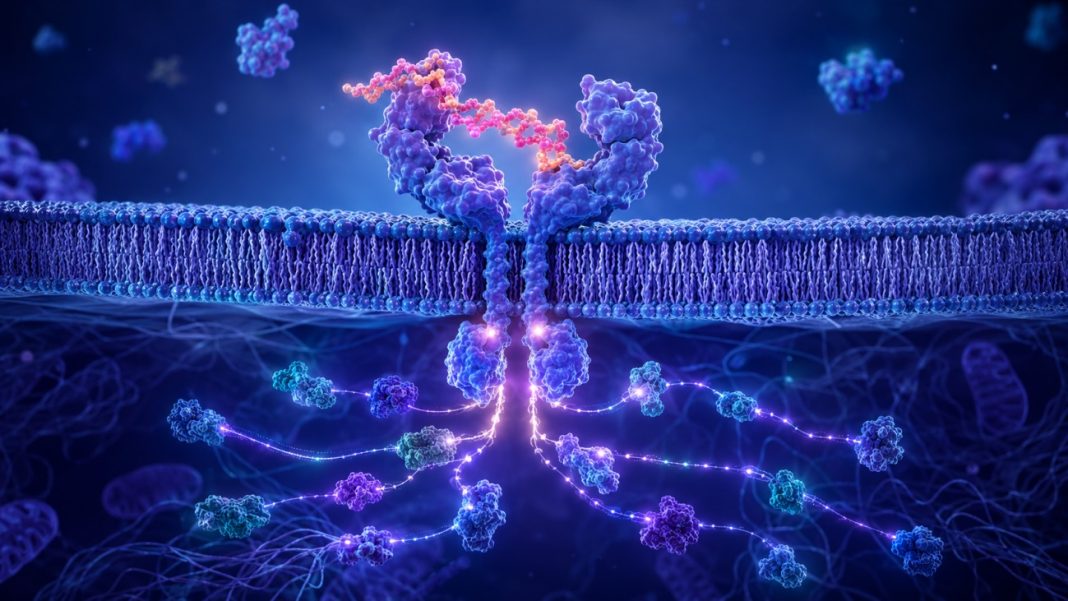
The IGF-1 receptor occupies a pivotal position in cellular signaling systems that regulate proliferation, differentiation, and metabolic coordination. When ligands bind to this receptor, intracellular signaling cascades are initiated through phosphorylation events that activate pathways such as PI3K–Akt and MAP kinase networks. These cascades participate in regulating gene expression, protein synthesis, and cellular adaptation to environmental stimuli.
In experimental settings, IGF-1 LR3 is believed to serve as a probe for understanding how prolonged ligand engagement influences these pathways. Research indicates that extended receptor interaction might alter the temporal dynamics of intracellular signaling. Rather than brief activation cycles typically associated with transient ligand binding, prolonged engagement may influence gene transcription patterns over extended periods.
Cellular Proliferation and Differentiation Pathways
One of the most frequently discussed properties of insulin-like growth factors involves their relationship with cellular growth and differentiation. These processes form the basis of organismal development and tissue maintenance, and they are regulated by a network of growth signals that operate across multiple levels of biological organization.
Investigations suggest that IGF-1 LR3 might interact with signaling networks that regulate protein synthesis and cellular proliferation. Within research models designed to observe cellular expansion or tissue-related molecular processes, the peptide seems to function as a tool to explore how prolonged receptor signaling influences structural protein formation and gene expression patterns.
Metabolic Signaling and Cellular Energy Regulation Studies
Beyond its association with structural growth pathways, insulin-like growth factor signaling also intersects with metabolic regulation. IGF-related pathways are closely integrated with nutrient-sensing networks that influence energy utilization, protein synthesis, and intracellular resource allocation.
Research indicates that IGF-1 LR3 might interact with metabolic signaling frameworks through its influence on Akt pathway activation. Akt signaling participates in numerous metabolic processes, including the regulation of glucose transporter expression and the coordination of anabolic processes within cells. If IGF-1 LR3 indeed maintains extended receptor engagement, investigators theorize that such prolonged signaling might provide a unique lens through which metabolic regulatory systems could be examined.
Receptor Dynamics and Signaling Duration
A particularly intriguing aspect of IGF-1 LR3 lies in its potential influence on receptor dynamics. Growth factor receptors often undergo cycles of activation, internalization, and recycling. These cycles regulate the intensity and duration of signaling events within cellular environments.
Research indicates that modified ligands such as IGF-1 LR3 might alter these dynamics by sustaining receptor engagement. If receptor activation persists for longer intervals, intracellular signaling networks may respond differently compared with brief activation cycles. Investigators have theorized that examining these altered dynamics could provide insights into how signaling duration shapes gene regulatory patterns.
Concluding Perspective
Receptor Grade IGF-1 LR3 occupies a distinctive position within the field of peptide research due to its engineered structural modifications and prolonged signaling characteristics. Derived from the well-studied insulin-like growth factor family, the peptide is speculated to provide investigators with an opportunity to explore how alterations in ligand design influence receptor engagement and intracellular communication.
References
[i] Le Roith, D., Bondy, C., Yakar, S., Liu, J. L., & Butler, A. (2001). The somatomedin hypothesis: 2001. Endocrine Reviews, 22(1), 53–74. https://doi.org/10.1210/edrv.22.1.0419
[ii] Jones, J. I., & Clemmons, D. R. (1995). Insulin-like growth factors and their binding proteins: Biological actions. Endocrine Reviews, 16(1), 3–34. https://doi.org/10.1210/edrv-16-1-3
[iii] Adams, T. E., Epa, V. C., Garrett, T. P. J., & Ward, C. W. (2000). Structure and function of the type 1 insulin-like growth factor receptor. Cellular and Molecular Life Sciences, 57(7), 1050–1093. https://doi.org/10.1007/PL00000744
[iv] Liu, J. P., Baker, J., Perkins, A. S., Robertson, E. J., & Efstratiadis, A. (1993). Mice carrying null mutations of the genes encoding insulin-like growth factor I and type 1 IGF receptor. Cell, 75(1), 59–72. https://doi.org/10.1016/S0092-8674(05)80083-6
[v] De Meyts, P. (2004). Insulin and its receptor: Structure, function and evolution. BioEssays, 26(12), 1351–1362. https://doi.org/10.1002/bies.20139