
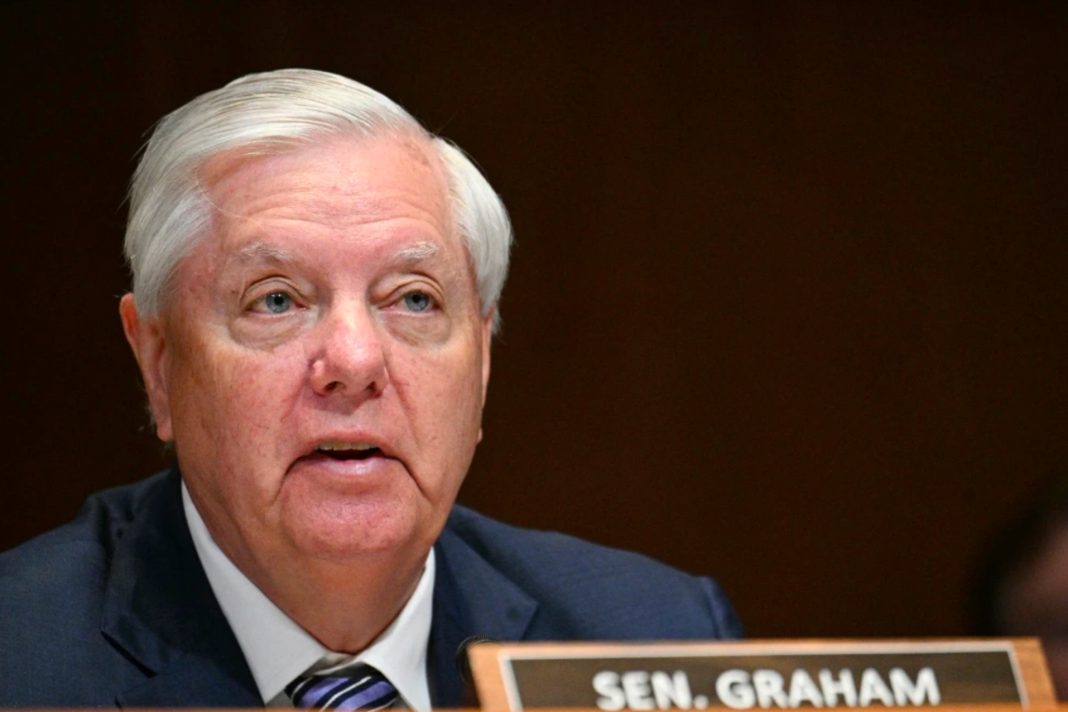

WASHINGTON, United States — Lindsey Graham, the Republican senator from South Carolina whose career spanned more than two decades in the Senate and whose influence reached across foreign policy, judicial confirmations and the politics of Donald Trump’s Republican Party, has died.
Graham, 71, died on Saturday, July 11, 2026, shortly after returning from a trip to Ukraine, one of several visits he made to the country after Russia’s 2022 invasion.
The Lindsey Graham dies announcement came early Sunday after his office said he had died from a “brief and sudden illness.”
“Senator Graham’s family appreciates prayers at this time and asks for privacy during this incredibly difficult period,” his office said.
Graham had been seeking a fifth Senate term in this year’s midterm elections.
At the time of his death, he chaired the Senate Budget Committee and remained one of the Republican Party’s most prominent voices on defence and international affairs.

Lindsey Graham Dies After More Than Two Decades in Senate
Graham was first elected to the Senate in 2002 after serving in the House of Representatives.
Before entering national politics, he served as a city and county attorney in South Carolina and spent six years in the United States Air Force as a prosecutor and defence attorney.
His public life was shaped by both personal loss and a long military identity.
Graham lost both parents within 15 months while he was an undergraduate and helped raise his younger sister, Darline.
In the Senate, Graham became closely associated with the late Senator John McCain of Arizona, with whom he shared a hawkish foreign policy outlook.
He later became one of Trump’s closest allies in Congress after initially emerging as one of his sharpest Republican critics during the 2016 presidential campaign.

Graham briefly ran for the Republican presidential nomination in 2015.
During the primary, he described Trump as the “most flawed nominee in the history of the Republican Party” and declined to vote for him in the general election.
That relationship changed after Trump became president.
Graham later became one of Trump’s most visible defenders and advisers in the Senate, particularly on foreign policy and judicial nominations.
Trump paid tribute to Graham on Truth Social, calling him “one of the greatest people and Senators I have ever known.”
“He was always working, and was a true American Patriot,” Trump wrote. “Lindsey will be greatly missed!!!”

Graham later revisited that early life in My Story, a self-published memoir in which he described growing up in the back of the Sanitary Cafe, the bar his parents ran in Central, South Carolina.
He wrote that he bathed with water heated on a stove, shared a bathroom with mill workers who came through the bar and earned the childhood nickname “Stinkball” after sneaking sips of beer and puffs of cigarettes left behind by customers.
The memoir also offered a rare account of Graham’s private life.
A lifelong bachelor, he wrote that marriage had eluded him because of timing, circumstance and the demands of his career.
“I’ve never married. I guess I attribute that to timing, too,” he wrote, adding that the right person either did not appear at the right moment or “was smart enough not to have time for me.”

Graham wrote that he had come close to marriage more than once, including during law school and while serving in the Air Force in Germany.
One relationship, with a Lufthansa flight attendant named Sylvia, became serious enough that he considered proposing, he wrote, but she returned to Vienna and he chose to go home to South Carolina.
His recollections of the bar also included a frank acknowledgement of segregation.
Graham wrote that Black customers were not allowed to drink inside the establishment for many years and had to take their beer off the premises.
He said the bar was desegregated in the early 1970s, “much later than it should have.”
Graham said the deaths of his parents within 15 months left him devastated, but that his election to Congress later gave him a sense of peace.
He wrote that he believed his parents would have understood that whatever he achieved had been made possible by their sacrifices.

Tributes Follow Death of South Carolina Senator
Emergency crews responded on Saturday evening to a call described in dispatch audio as a “cardiac arrest” at Graham’s residence, according to reporting cited in the notes.
His office did not disclose further details about the illness.
Senate Majority Leader John Thune praised Graham’s military and public service, saying his influence would be felt in the judiciary, national defence and South Carolina.
Graham’s death also drew tributes from foreign leaders who had worked closely with him on matters involving Israel and Ukraine.

Benjamin Netanyahu, the Israeli prime minister, said Israel had lost “one of its greatest friends.”
“Lindsey understood that the security of Israel and America are inseparable,” Netanyahu said.
Volodymyr Zelenskyy, the president of Ukraine, said he was “deeply saddened” by Graham’s death.
Zelenskyy said he had met Graham twice in the week before the senator died.
“Lindsey was a true defender of freedom and the values that make our world safer,” Zelenskyy said.

Foreign Policy Defined His Senate Profile
Graham was one of the Senate’s most consistent advocates of a muscular American role abroad.
He supported the 2003 invasion of Iraq, defended the 2007 troop surge and opposed an early withdrawal of American forces from both Iraq and Afghanistan.
On Iran, he repeatedly called for a hard line, opposing the 2015 nuclear agreement and later backing US-Israeli military action during the 2026 conflict.
He was also among Israel’s strongest defenders in Congress, supporting military assistance and making repeated trips to the region after the October 7 attacks.

After Russia’s invasion of Ukraine, Graham became one of the most persistent advocates for arming Kyiv and tightening sanctions on Moscow.
His final foreign trip was to Ukraine, where he met Zelenskyy shortly before his death.
Graham also chaired the Senate Judiciary Committee and played a major role in Republican judicial strategy, including during Trump’s first presidency.
His death leaves South Carolina with a Senate vacancy at a politically sensitive moment, as Republicans prepare for the midterm elections and as the party continues to navigate Trump’s second term.