

Nigeria’s AI debate is often framed as a race: train more people, deploy more tools, and catch the productivity wave before competitors do. That urgency is understandable. But a country can increase AI use without improving the work that people actually do.
The World Bank’s 2026 development work offers an encouraging reason for Nigeria to aim higher than simple adoption. It argues that, in developing economies, AI is currently more likely to complement workers than replace them, because fewer jobs are concentrated in the cognitive tasks that generative AI can automate. That creates a real opportunity for productivity gains—but only if workers and organisations can translate the technology into better decisions and better services.
Nigeria’s National Artificial Intelligence Strategy already points in the right direction. It treats talent as more than coding skill. The strategy explicitly includes change management, interaction design, communication, innovation management, and business models alongside technical expertise. NITDA’s AI Transformation Roadmap makes the same point operationally: successful implementation depends on people, culture, content, process, and technology, with attention to staff anxiety, training, transparent decision-making, and job evolution.
The next step is to measure whether those elements are changing work.
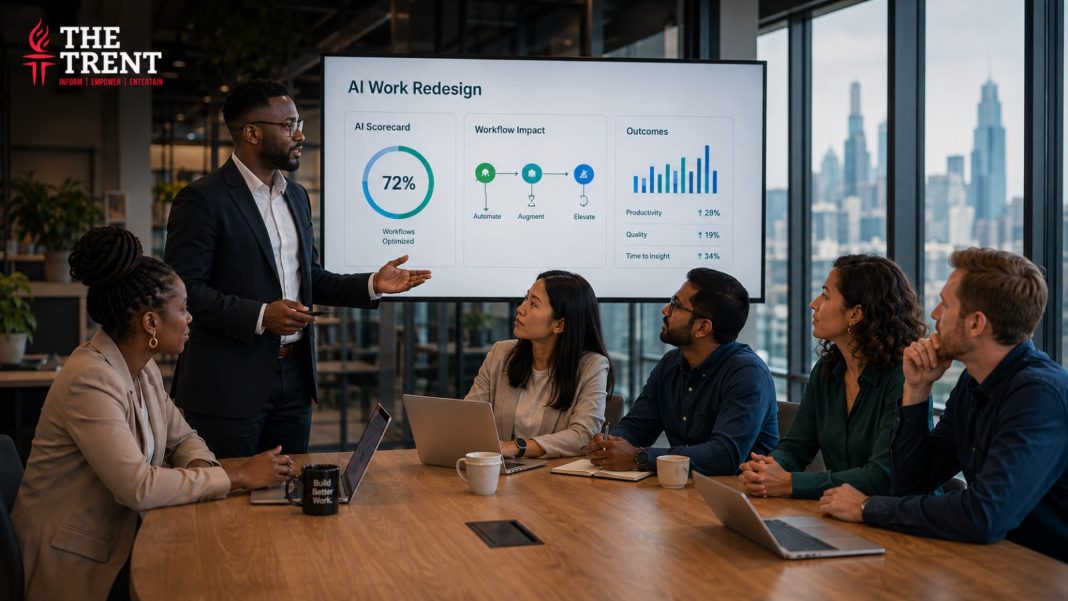
For every significant AI pilot, public agencies and businesses should keep a simple work redesign scorecard. It should answer six questions.
First, what task changed? “We deployed an AI assistant” tells managers almost nothing. The useful question is whether a specific workflow—drafting a customer response, analysing a procurement document, reviewing a loan file, preparing a report—became faster or better.
Second, where does human judgment remain? Every workflow should name the person responsible for checking consequential output and the circumstances that require an override. Clear responsibility is not a brake on adoption. It gives employees confidence about the boundary between assistance and accountability.
Third, how much hidden rework did the tool create? Ten minutes saved on a first draft is not a productivity gain if a manager spends twenty minutes correcting errors, checking sources, or rebuilding context. Organisations should measure verification and correction time alongside the time the tool appears to save.
Fourth, what did workers learn? A one-off AI webinar can create enthusiasm without competence. Staff need protected practice time on their own recurring tasks, with examples of what good use looks like and where the tool fails. Nigeria’s young workforce will benefit most if AI adoption builds judgment and transferable capability rather than simply making entry-level work disappear.
Fifth, did the quality of the outcome improve? Track error rates, cycle time, customer or citizen satisfaction, reopened cases, and other measures that reflect the purpose of the work. Login counts and prompt volumes are activity metrics, not evidence of value.
Sixth, can workers challenge the workflow? Employees often see failure modes before executives do. A safe correction channel lets them flag a bad output, a risky shortcut, or a task that should not be automated. That feedback is especially important when staff fear that raising concerns will make them look resistant to change.
This scorecard would help Nigeria avoid two familiar mistakes. One is treating AI as a procurement project, where buying access is confused with adoption. The other is treating adoption as a training project, where course completion is confused with transformed performance.
The better model is a management project. Middle managers need time to redesign routines, early adopters need permission to demonstrate useful practices, and leaders need evidence about which workflows deserve to scale.
Nigeria does not need to slow down its AI ambitions. It needs a clearer definition of success. If organisations can show that AI reduces rework, strengthens judgment, improves service, and expands worker capability, adoption will earn trust because people can see the result. If they cannot, another dashboard showing how many people used the tool will not solve the problem.
Gleb Tsipursky, PhD, a behavioural scientist, CEO of Disaster Avoidance Experts, and author of The Psychology of AI Adoption at Work: From Resistance to Results, published in 2026.
The opinions expressed in this article are solely those of the author.