
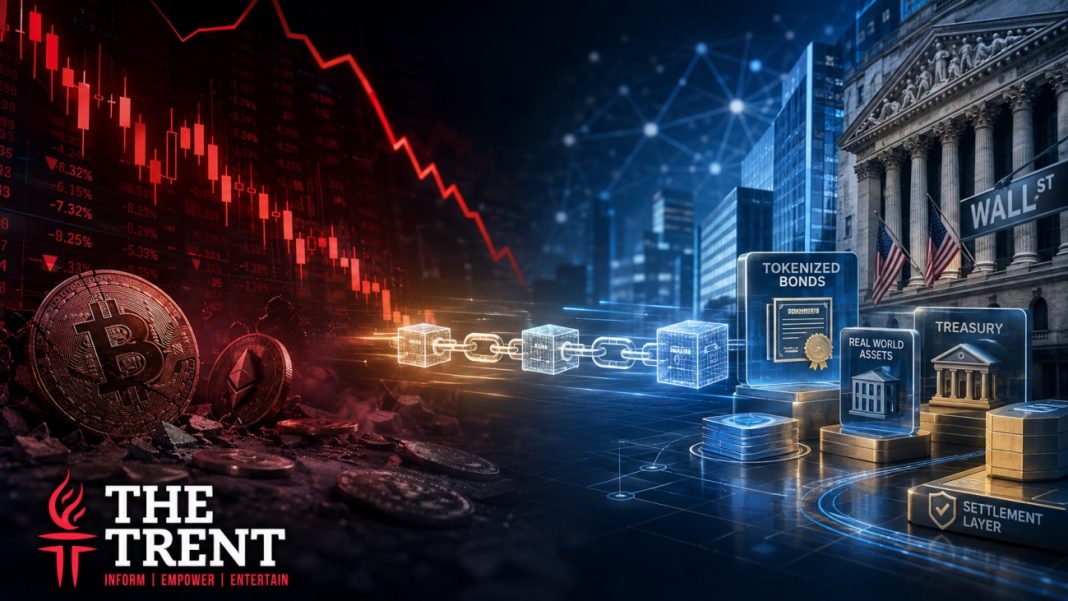

Cryptocurrency markets are once again showing how quickly enthusiasm can fade. Trading activity has weakened, digital-asset prices remain under pressure and businesses dependent on speculative transactions are feeling the consequences.
Coinbase’s transaction revenue fell 21 per cent from a year earlier in the second quarter of 2026, while Robinhood reported a 38 per cent decline in cryptocurrency transaction revenue. In May, combined spot and derivatives trading on centralised exchanges fell to its lowest level since September 2024.
Yet Wall Street blockchain investment continues to grow. Banks are developing digital deposits, asset managers are issuing tokenised funds, and market-infrastructure companies are building blockchain-based systems for collateral and settlement.
The contradiction disappears once cryptocurrency speculation and blockchain infrastructure are treated as separate businesses.

Two Markets Hidden Beneath One Label
Bitcoin and other native cryptocurrencies derive much of their value from scarcity, expected adoption and investor demand. Their prices can therefore rise or fall sharply without any corresponding change in cash flow or underlying assets.
Tokenisation is different. It creates a digital representation of an existing financial claim — such as a Treasury bill, bank deposit, fund share or bond — on a programmable ledger.
A tokenised Treasury fund still earns its return from government debt. A tokenised deposit remains a claim on a bank. The blockchain changes how ownership is recorded, transferred and used; it does not create the underlying value.
An institution can therefore remain cautious about cryptocurrency prices while believing that blockchain technology may improve the machinery of conventional finance.
The Costly Machinery Behind an Ordinary Trade
A securities transaction may appear instantaneous on a trading screen, but completing it requires brokers, exchanges, clearing houses, banks, custodians and transfer agents to coordinate their records.
Each institution may maintain a separate database. When the records disagree, systems or employees must investigate. Cross-border payments, collateral substitutions and transactions made outside normal operating hours can be especially cumbersome.
A shared ledger could reduce some of this duplication. Authorised participants would work from a consistent ownership record, while programmable instructions could perform agreed actions automatically.
A bond, for example, could be transferred only when payment is available. This simultaneous exchange, known as atomic settlement, reduces the period during which one party has delivered its side of a transaction but has not received the other.
The attraction is not simply faster trading. More efficient settlement could reduce administrative work and the amount of cash or collateral that institutions must leave idle while transactions are completed.
Speed nevertheless involves trade-offs. Traditional clearing systems offset numerous obligations before settlement, reducing the total amount of money that must move. Settling every transaction immediately could sacrifice some of that efficiency. Wall Street is therefore seeking selective speed rather than instant settlement at any cost.
Why Treasury Funds Are Leading the Shift
Short-term government securities and money-market funds are natural candidates for tokenisation. Their underlying assets are familiar, comparatively liquid and easier to value than private loans, property or complex securities.
By August 6, 2026, approximately $16.1 billion in United States Treasury products had been distributed in tokenised form. BlackRock’s tokenised institutional liquidity fund accounted for about $2.68 billion.
These figures remain tiny beside the conventional Treasury and money-market sectors. They are significant, however, because they show that tokenisation has progressed beyond small technical demonstrations.
Tokenised fund shares can potentially be transferred between approved participants outside conventional operating hours. They may also be used as collateral for loans, derivatives or other financial obligations.
This is important because collateral is a critical but largely invisible part of finance. Banks and investment firms frequently pledge high-quality assets to secure transactions. If eligible collateral can move rapidly between authorised institutions, firms may not need to maintain separate pools of assets in several locations.
The token becomes useful not because its price is expected to soar, but because it can make a conventional asset more mobile.
Digital Securities Require Digital Money
Moving a security on a blockchain solves only half the settlement problem. Payment must also move through compatible infrastructure.
Stablecoins have performed part of this function. They are digital tokens designed to maintain a stable value, usually through reserves of cash and government securities. Banks, however, are increasingly exploring tokenised deposits.
A tokenised deposit represents money held within the regulated banking system. It can move on a programmable ledger while remaining a claim against the issuing bank.
JPMorgan’s Kinexys platform, for example, has expanded its blockchain deposit accounts to support eight currencies. Participating institutions can use them for continuous liquidity transfers, programmable payments and cross-border settlement.
Tokenised securities become far more useful when the payment side of a transaction can operate on similar technology. The asset and the money can then move together under predetermined conditions, reducing delays and counterparty exposure.
For banks, tokenised deposits also provide a way to modernise payments without surrendering customer deposits and financial relationships to stablecoin issuers.
Why Institutions Are Investing During a Slump
A cryptocurrency downturn can weaken speculative businesses while strengthening the case for diversification.
Exchanges earn less from transaction fees when trading activity falls. That gives them an incentive to develop steadier businesses in custody, payments, stablecoins and tokenised securities.
Asset managers want new distribution channels and products that can function as collateral. Banks want to preserve their role in payments. Clearing organisations want to ensure that emerging digital markets remain connected to established infrastructure.
Some of the investment is therefore defensive. Institutions are preparing for the possibility that financial markets gradually adopt blockchain features, even if today’s cryptocurrencies lose value or disappear.
Regulatory developments have also reduced some uncertainty. The United States Securities and Exchange Commission clarified in January 2026 that securities laws continue to apply when stocks, bonds or fund shares are tokenised. Changing the format does not eliminate disclosure, registration or investor-protection obligations.
That distinction helps established institutions separate regulated tokenisation from the less predictable parts of the cryptocurrency market.
The Technology Does Not Eliminate Risk
Tokenisation cannot improve the quality of an underlying asset. A tokenised loan can still default, a tokenised fund can still face withdrawals and a tokenised bond remains exposed to interest-rate and issuer risk.
Blockchain systems can also introduce new vulnerabilities. Smart-contract errors may automate an incorrect transaction. Stolen credentials or compromised digital keys can make unauthorised activity difficult to reverse. Systems operating continuously require continuous monitoring and incident response.
Fragmentation presents another problem. Banks, asset managers and exchanges are developing products on different public and private networks. If those networks cannot communicate, the financial system could end up with more databases to reconcile rather than fewer.
Institutions may also need to operate blockchain and conventional systems simultaneously for years. During that transition, tokenisation could add complexity and expense before producing meaningful savings.
Faster markets may transmit stress more rapidly as well. Automated collateral sales or redemptions could accelerate during periods of volatility, leaving human decision-makers with less time to intervene.
The crucial questions are therefore legal and operational as much as technological: Who maintains the official ownership record? What rights does the token provide? How can it be redeemed? Who bears losses if the system fails? Can it move safely between networks?
In Conclusion
Wall Street’s investment in blockchain is not necessarily a prediction that cryptocurrency prices will recover. It is a wager that financial assets can be recorded, transferred and settled with fewer delays, less duplication and more programmable control.
Tokenised funds, deposits and settlement systems address genuine institutional problems, but their success is not assured. Legal certainty, interoperability, cybersecurity and reliable redemption remain essential.
The crypto market may be slumping while the technology beneath it is being repurposed. Wall Street is not merely betting on the next digital coin. It is testing whether blockchain can become part of the operating system of modern finance.