
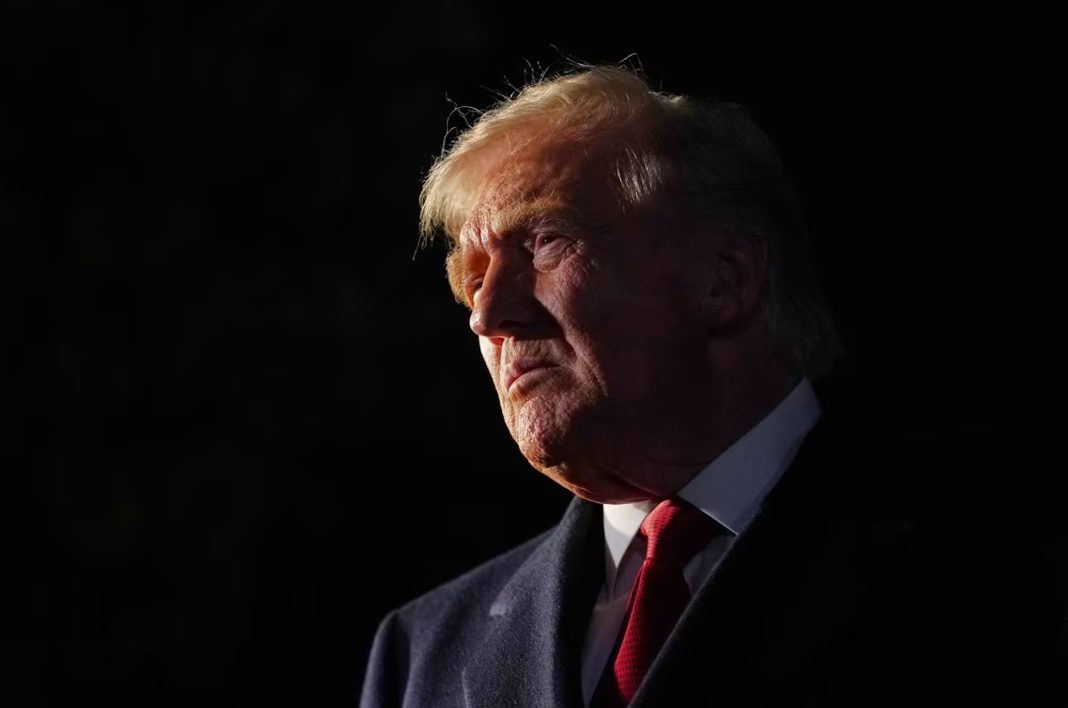

WASHINGTON, United States — President Donald Trump has granted clemency to at least 85 public officials charged with or convicted of corruption-related offences, according to a Reuters investigation published on Tuesday, October 13, 2026.
The investigation found that 75.3 per cent of the recipients were Republicans or publicly identified Trump supporters.
The presidential pardons and sentence commutations, issued across Trump’s two terms in office, have allowed former governors, lawmakers, judges, and other government officials to avoid prosecution, escape prison sentences, or regain rights lost following criminal convictions.
Reuters found that the clemency decisions collectively spared recipients approximately 130 years in prison and more than $15 million in financial penalties.
The investigation also found that more than half of those granted clemency have continued participating in politics, either by holding public office or supporting Trump and his agenda.
The findings have intensified questions about the exercise of presidential power, political favouritism, and the consequences for efforts to prosecute corruption within the American government.
Republicans Account for Most Recipients
The Reuters investigation, conducted by Marisa Taylor, Chris Prentice, and Mike Spector, examined federal clemency decisions involving public officials accused or convicted of offences including bribery, fraud, racketeering, conspiracy, and obstruction of justice.
Of the 85 officials identified, 36 had been elected as Republicans, while another 19 were Republican political appointees.
Nine additional recipients had either campaigned for Trump or publicly supported his political programme.
Only four were identified as Democrats. Reuters could not establish the political affiliations of the remaining 17.
The investigation also found that Trump had granted clemency to at least 11 of the 15 Republican members of Congress convicted of wrongdoing over the past two decades.
Those findings do not establish that political affiliation was the determining factor in each decision. They do, however, reveal a pronounced partisan imbalance among the recipients.
The 85-person tally covers both of Trump’s presidencies, from 2017 to 2021 and from January 2025 onwards. It excludes at least 18 active-duty military personnel, police officers, and government employees who received clemency for offences associated with the January 6, 2021, attack on the US Capitol.
| Political affiliation | Number | Percentage |
|---|---|---|
| Elected Republicans | 36 | 42.4% |
| Republican political appointees | 19 | 22.4% |
| Other Trump supporters or MAGA-aligned figures | 9 | 10.6% |
| Total GOP and Trump-aligned | 64 | 75.3% |
| Democrats | 4 | 4.7% |
| Undetermined affiliation | 17 | 20.0% |
Charity Fraud Conviction Overturned by Pardon
Among the cases examined was that of Michele Fiore, a former Nevada state lawmaker and Las Vegas city councillor who became a prominent supporter of Trump.
In October 2024, a federal jury convicted Fiore on seven fraud-related charges involving donations raised for a memorial honouring a police officer killed in the line of duty.
Prosecutors established that nearly $80,000 intended for the memorial had been diverted to personal expenses, including cosmetic surgery, rent, and her daughter’s wedding.
Trump issued Fiore a full pardon in April 2025, before she could be sentenced.
The decision spared her a possible prison sentence and prevented the criminal court from imposing financial penalties and restitution arising from the conviction.
Fiore maintains that she was wrongly prosecuted and denies personally misusing the donations.
The White House defended the pardon, arguing that her conservative political views had made her a target of federal prosecutors.
The decision nevertheless attracted criticism from Republicans in Nevada, including people associated with the memorial fundraising effort.
Fiore remains a justice of the peace in Nye County, although she has been suspended from performing judicial duties.
According to Reuters, county records indicate she will have received approximately $252,536 in salary and benefits between her indictment and the scheduled end of her judicial term in January 2027.
Convicted Lawmakers Receive Presidential Mercy
Another case involved Glen Casada, a former speaker of the Tennessee House of Representatives, and Cade Cothren, a former legislative aide.
A federal jury convicted the two men in May 2025 in connection with a scheme involving taxpayer-funded legislative communications.
Prosecutors said Casada helped direct approximately $52,000 in public funds to a company operated under an assumed name by Cothren, receiving at least $7,100 in bribes and kickbacks.
Casada was sentenced to three years in prison, while Cothren received a 30-month sentence.
Both were pardoned in November 2025.
Country musician John Rich, a Trump supporter, acknowledged publicly that he had advocated for clemency in the case.
The White House characterised the prosecution as excessive.
Attorneys for the men have challenged the government’s interpretation of the case, with Cothren’s lawyer maintaining his innocence.
The pardons drew criticism from Tennessee’s Republican lieutenant governor, Randy McNally, who said elected officials should be held to a higher standard of conduct.
Former Connecticut Governor John Rowland also received a pardon in May 2025.
Rowland had served prison sentences arising from two separate criminal cases. In 2004, he pleaded guilty to accepting improper gifts while governor. A decade later, he was convicted of offences involving concealed payments for political consulting.
His pardon prompted criticism from former Republican Congressman Christopher Shays, who questioned the implications of granting clemency to repeat offenders.
The White House did not publicly provide a detailed explanation for Rowland’s pardon.
Trump Pardoned Democrat Who Refused to Change Parties
The investigation also examined the pardon granted to Democratic Representative Henry Cuellar of Texas.
Cuellar and his wife, Imelda, were indicted in 2024 on charges alleging that they accepted nearly $600,000 in bribes from an Azerbaijani energy company and a Mexican bank.
The allegations had not been tested at trial when Trump pardoned them in December 2025.
Cuellar denied wrongdoing.
Trump initially defended the decision by accusing the Biden administration of pursuing Cuellar because he had criticised its immigration policies.
The pardon subsequently became a political dispute when Cuellar announced that he intended to seek re-election as a Democrat.
Trump publicly criticised the congressman and accused him of being ungrateful. He has since expressed support for Cuellar’s Republican opponent.
The episode illustrates the distinction between a president’s legal authority to grant clemency and the political expectations that can surround its exercise.
No evidence cited in the Reuters investigation established that Cuellar had agreed to change parties in exchange for the pardon.
Traditional Pardon Review Process Sidelined
The latest findings build on an earlier Reuters investigation published in June, which examined how presidential clemency decisions are being made during Trump’s second administration.
Historically, most applications have been reviewed through the Justice Department’s Office of the Pardon Attorney.
That process considers factors including an applicant’s criminal record, conduct since conviction, acceptance of responsibility, and the opinions of prosecutors and judges.
The president is not legally required to follow those recommendations.
Reuters found that 96 per cent of clemency grants during Trump’s second term, as assessed in its June review, involved recipients who did not meet longstanding Justice Department guidelines.
It also identified 290 advocates who had helped 197 people obtain clemency, including lawyers, political allies, consultants, and individuals with access to the president’s associates.
Some intermediaries were reported to have charged substantial fees for assistance.
The findings do not establish that every pardon involving an influential advocate was improperly granted, or that the president personally received money in exchange for clemency.
They have nevertheless raised concerns about whether access to political connections can determine whose applications receive attention.
The White House has disputed suggestions that clemency decisions are made without appropriate scrutiny, insisting that the administration follows a rigorous review process.
Anti-Corruption Prosecution Unit Shrinks
Beyond the pardons themselves, the Reuters investigation examined changes to the federal government’s capacity to pursue public corruption cases.
The Justice Department’s Public Integrity Section, created in the aftermath of the Watergate scandal, has long been responsible for prosecuting politically sensitive corruption cases.
According to Reuters, the unit had approximately 30 lawyers at the end of the Biden administration but now has only two full-time prosecutors.
The news agency attributed the staffing figures to four people familiar with the section’s operations.
Some prosecutors resigned following changes in departmental policy, while others transferred to different assignments.
More than half of the public officials identified in the Reuters review had been charged or convicted in prosecutions involving the Public Integrity Section.
Separately, a June 2026 study by former federal anti-corruption prosecutors found that the Justice Department had not publicly announced a new bribery prosecution during the period of Trump’s second term examined by the researchers.
The Justice Department rejected suggestions that presidential pardons had weakened its commitment to enforcing corruption laws.
Department spokeswoman Audrey Cook said prosecutors remained committed to bringing cases where the facts and law justified them.
She stressed that presidential clemency should not be interpreted as permission to engage in criminal conduct.
Congressional Inquiry Examines Political Influence
The growing scrutiny has also reached Congress.
On October 9, four Democratic lawmakers announced an investigation into the possible influence of senior Trump administration officials on presidential pardons.
Senators Peter Welch and Richard Blumenthal, alongside Representatives Mary Gay Scanlon and Dave Min, sought information from Health and Human Services Secretary Robert F. Kennedy Jr. and Environmental Protection Agency Administrator Lee Zeldin.
The inquiries concern their reported involvement in clemency decisions benefiting two convicted men, former electric-vehicle entrepreneur Trevor Milton and businessman Troy Lake.
Milton was convicted of defrauding investors in his electric-truck company, Nikola, while Lake pleaded guilty to an offence involving the alteration of emissions-control equipment.
The lawmakers questioned whether personal relationships, political contributions, or access to senior officials had influenced the decisions.
Those allegations remain matters of congressional inquiry, not findings of criminal wrongdoing.
The Limits of Presidential Pardon Power
The US Constitution gives presidents broad authority to pardon federal offences and commute criminal sentences, except in impeachment cases.
A pardon generally forgives a federal offence and its legal consequences, while a commutation reduces an imposed punishment without necessarily setting aside the conviction.
The president does not need congressional approval to exercise either power.
The authority has attracted controversy under previous administrations.
Former President Bill Clinton faced criticism for pardoning fugitive financier Marc Rich in 2001, while former President Joe Biden was criticised for granting clemency to his son Hunter Biden after previously saying he would not do so.
Supporters of presidential clemency argue that the power is an essential safeguard against unjust prosecutions and excessive punishment.
Trump has repeatedly maintained that political considerations improperly influenced prosecutions conducted during the Biden administration, including those brought against him and his supporters.
His administration says the pardons are intended to correct miscarriages of justice.
Critics counter that repeated intervention in cases involving politically connected public officials risks weakening accountability and discouraging future investigations.
The separate question raised by the Reuters findings is whether a constitutionally authorised act of mercy is being exercised consistently, or in a way that disproportionately benefits those with political influence.
With at least 85 public officials now identified as recipients of corruption-related clemency, the debate extends beyond the individual prosecutions to the standards governing accountability in public office.




