

When several Nigerian investment platforms buckled under a rush of applications for shares in Dangote Petroleum Refinery & Petrochemicals, the outages revealed more than a technical weakness. They showed the depth of public interest in owning a piece of one of Africa’s most consequential industrial projects ever built.
The initial public offering, launched on Monday, September 14, 2026, is the largest in Africa’s history. Dangote Group is offering 4.1 billion shares at ₦525 each, seeking to raise ₦2.15 trillion, or about $1.6 billion. An overallotment could increase the proceeds. With a minimum subscription of 10 shares, an investor can enter with ₦5,250 — an unusually low threshold for an offering of this scale. The subscription period is scheduled to close on October 13, with trading expected to begin in late November.
Yet the numbers alone do not explain why the offering matters.
In a recent video commentary, American finance scholar Dr Boyce Watkins argued that the real story is about more than oil; it is about ownership. His central idea is that lasting economic power comes not simply from earning wages or consuming products, but from owning the productive assets that make those products possible.
The Dangote Refinery IPO brings that argument into sharp focus. It connects three questions that have shaped Nigeria’s economy for decades: Who processes the country’s resources? Who controls the infrastructure? And who owns the companies that collect the profits?
Breaking the Crude-Export Trap
Nigeria has long been one of the world’s major crude-oil producers, yet it spent decades relying heavily on foreign refineries for petrol, diesel, aviation fuel, and other products. Crude left the country, was processed elsewhere, and returned as a more valuable finished product.
That arrangement transferred important parts of the petroleum value chain abroad. Foreign refineries collected processing margins. Overseas ports, shipping companies, insurers, and traders earned fees. Skilled industrial work, technical knowledge, and supporting businesses developed around facilities in other countries. Nigeria supplied the raw material, then used scarce foreign currency to buy back what that material became.
The pattern is not unique to petroleum. It is one of the oldest problems confronting resource-rich developing economies: they export what nature provides and import what industry produces.
The Dangote Refinery begins to reverse that equation. Built near Lagos at a cost of about $20 billion, the facility processes roughly 700,000 barrels of crude a day. Its scale allows Nigeria to retain more refining, logistics, petrochemical, and trading activity within the domestic economy.
The effect is already measurable. According to the United States Energy Information Administration, Nigeria imported nearly 400,000 barrels a day of petroleum products in 2023. By the second quarter of 2026, seaborne imports had fallen below 130,000 barrels a day. Over the same period, petroleum-product exports rose sharply, including shipments to other African countries and Europe.
This does not mean that every fuel-import problem has disappeared, or that the refinery depends entirely on Nigerian crude. It has imported some feedstock when domestic supply has been insufficient or commercially unsuitable. It does mean, however, that Nigeria now possesses productive capacity capable of changing the direction of its petroleum trade.

Why Owning Infrastructure Matters
Natural resources are not the same as economic power. Oil beneath the ground is potential wealth. The infrastructure that extracts, transports, stores, processes, and distributes it determines where much of the actual value is created.
A refinery is therefore more than a factory. It is a strategic platform connected to pipelines, storage tanks, marine terminals, power generation, laboratories, engineering services, transport networks, and petrochemical production. Around it, businesses can develop in packaging, plastics, textiles, construction materials, maintenance, shipping, and other industries.
This is the deeper force in Watkins’s argument. Countries remain economically vulnerable when they own raw commodities but depend on outsiders for the systems that transform them. Control of productive infrastructure improves resilience because it reduces exposure to foreign refinery shutdowns, shipping disruptions, import bottlenecks, and pressure on foreign-exchange reserves.
Local refining does not automatically guarantee cheap petrol. Crude oil and refined products remain connected to global prices, while taxes, exchange rates, financing costs, regulation, and competition also shape what consumers pay. The greater significance is that a larger share of the industrial process can now occur within Nigeria rather than being purchased entirely from abroad.
From a Private Megaproject to a Public Asset
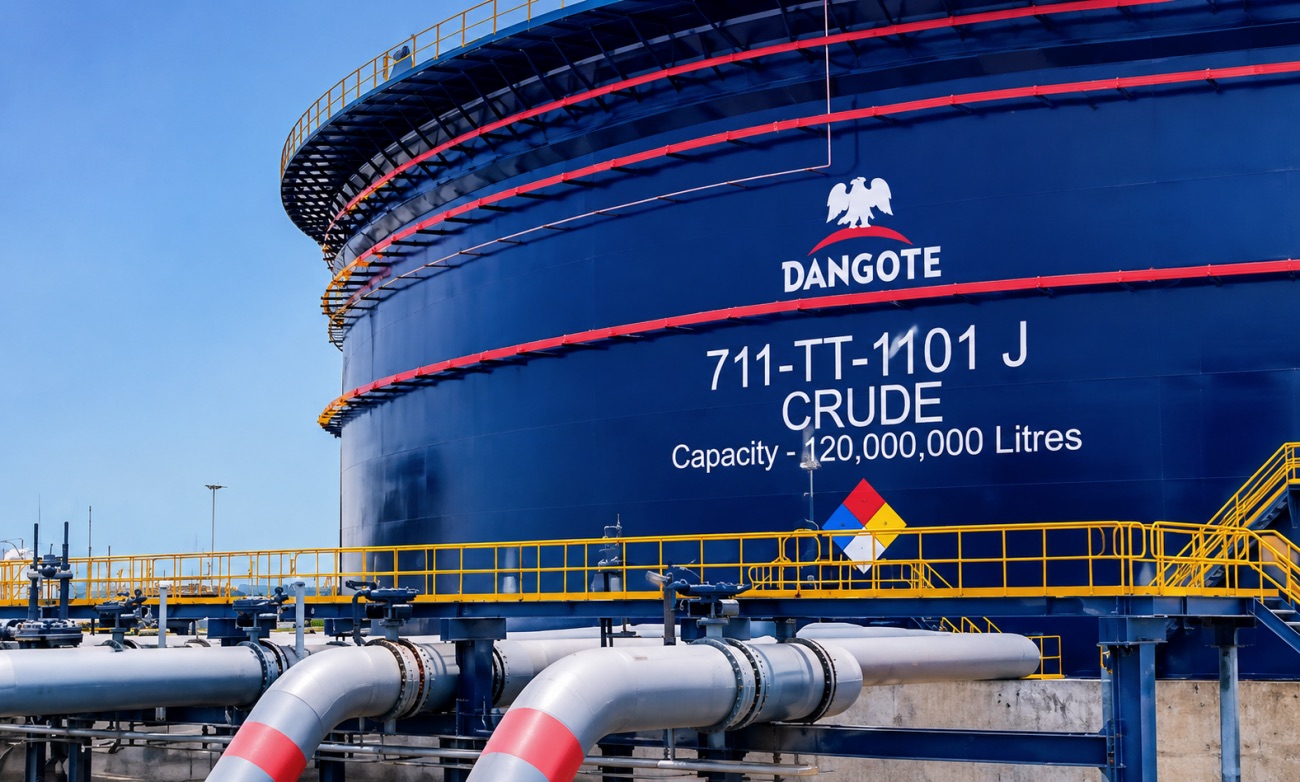
A privately controlled Nigerian company built the refinery; the Nigerian state does not own it. That distinction matters. It is more accurate to describe it as Nigerian-controlled productive infrastructure than as a government-owned national asset.
The IPO creates another layer of ownership by allowing members of the public to buy shares. A customer pays for fuel and receives fuel. A shareholder owns a fractional interest in the company, participates in its risks, and may benefit from dividends or a rise in the value of the shares.
That is the shift Watkins emphasises: from consumer to owner.
For ordinary Nigerians, the minimum investment of ₦5,250 makes the idea unusually tangible. It allows people who could never build a refinery, finance a pipeline, or operate a petrochemical complex to acquire a small claim on the earnings of such infrastructure. It also gives younger and first-time investors a possible entry into the formal capital market.
The public response has been striking. Reuters reported that traffic on one investment application rose tenfold within 30 minutes of the offer opening, while several platforms experienced outages. The surge does not establish how many shares will ultimately be allotted, but it shows that the appetite for productive ownership is real.
Ownership, however, should not be confused with guaranteed profit. Shareholders can lose money, dividends are not assured, and the price paid for an asset matters. The cultural importance of the IPO is therefore not that everyone must buy the shares. It is that millions of people are being invited to think about the difference between buying a company’s product and owning part of the company itself.

A New Source of Capital for African Industry
The IPO also matters because it shows how large African projects can be financed.
The proceeds are intended to help fund a planned expansion that would double the refinery’s capacity to 1.4 million barrels a day by 2029. If successful, the offering will demonstrate that African capital markets can mobilise domestic savings for infrastructure on a scale usually associated with foreign banks, sovereign lenders, or international exchanges.
That could have effects beyond Dangote. A successful listing may encourage other large, privately held African businesses to enter public markets. It can create new opportunities for pension funds, asset managers, diaspora investors, and households to invest in domestic productive enterprises rather than concentrating capital in property, government debt, or assets abroad.
Public listing can also impose disciplines that private ownership does not. Listed companies must publish financial information, face shareholder scrutiny, meet governance requirements, and explain major decisions to the market. Those protections are only as strong as their enforcement, but greater disclosure can make an economically important company more visible and accountable.
The Continental Significance
The lesson extends beyond Nigeria. Across Africa, economies still export crude oil, minerals, cocoa, coffee, cotton, and other primary commodities, while importing fuels, machinery, chocolate, clothing, and manufactured goods at higher prices.
The central development question is not simply whether Africa possesses resources. It is whether African countries and companies can own the processing plants, technology, distribution systems, and financial assets that convert those resources into sustained wealth.
The Dangote model offers one possible answer: build at industrial scale, replace imports with local production, expand into regional exports, and then use public markets to broaden ownership and finance further growth.
It is not a model that can be copied mechanically in every country or industry. The refinery benefited from the scale of Nigeria’s market, access to crude, government policy, and the resources of an unusually large conglomerate. Still, it challenges the assumption that the continent must remain primarily a supplier of raw materials and a buyer of finished goods.

A ‘People’s IPO’ With Important Limits
The offering should not be romanticised. Only a small portion of the refinery is being sold to the public. Dangote retains 87 per cent ownership, according to The Associated Press, while the IPO represents roughly 3 per cent of the company. Public participation is meaningful, but it does not amount to dispersed public control.
A serious valuation debate also remains. The IPO values the refinery at close to $49 billion, above the $40 billion valuation attached to a private placement completed in July. Retail investors are therefore being asked to pay more than the institutional investors who entered earlier, although those investors accepted restrictions that partly explain the discount.
Reuters Breakingviews has noted that the refinery’s valuation multiple exceeds those of several large United States refiners. The company’s recent earnings are strong — it reported a net profit of $1.82 billion on more than $13 billion in revenue during the first half of 2026 — but they have also benefited from unusually tight global fuel markets. Investors must judge whether those conditions, and the planned expansion, justify the price.
Other questions are equally important. Will minority shareholders receive strong protection? Will the company maintain high disclosure standards? Will regulators preserve competition in Nigeria’s fuel market? Can the refinery secure reliable crude supplies without depending heavily on imports? Can the expansion be delivered on time and within budget? And, over the longer term, how will a vast petroleum asset adapt to the global energy transition?
These concerns do not erase the IPO’s importance. They define the conditions under which it can fulfil its promise.

The Real Measure of the Moment
The Dangote Refinery has already turned a Nigerian natural resource into a Nigerian-based production system. The IPO now seeks to turn part of that productive system into a financial asset the public can own.
Neither step, by itself, guarantees broad prosperity. A refinery can become too dominant. A public listing can enrich controlling owners more than small shareholders. Local production can coexist with high consumer prices. National pride can also tempt investors to overlook valuation and risk.
But the direction of travel matters.
Nigeria cannot consume its way to industrial strength. Nor can any country build enduring wealth merely by exporting what lies beneath its soil. Prosperity depends on the ability to process, build, finance, own, and govern productive assets.
That is why the Dangote IPO is a big deal. It is not simply the sale of shares in an oil refinery. It is a public test of whether economic power can move closer to the people who live where the resources are found — from crude to industry, from consumption to ownership, and from watching wealth being created to holding a stake in its creation.
Aziza Uko is one of Nigeria’s leading political and leadership communication strategists, a respected brand consultant, and the Executive Editor of The Trent. A seasoned communications professional with over two decades of experience across media, marketing, political strategy, and corporate communications, she has shaped some of the country’s most influential political campaigns and public narratives. Aziza is also a publisher, writer, and media entrepreneur. She can be reached via email [email protected].