
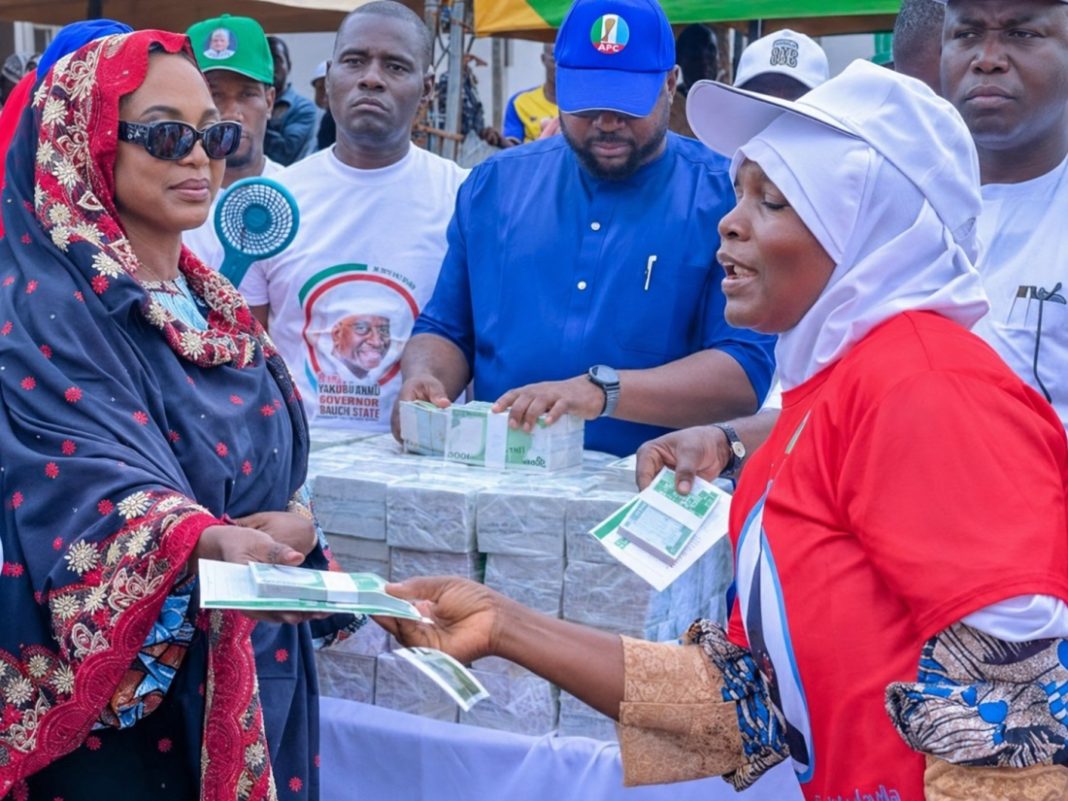

LAFIA, Nigeria — Hajiya Maryam Wadada, wife of the All Progressives Congress governorship candidate in Nasarawa State, Senator Ahmed Wadada, has come under scrutiny after a video showed her distributing wads of naira notes to supporters.
The footage was recorded during the launch of the Hajiya Maryam Ahmed Wadada Aliyu Women Empowerment Scheme 2026.
Under the initiative, ₦325 million is being distributed to 6,500 women across Nasarawa State’s 13 local government areas.
The programme provides ₦50,000 to each beneficiary.
In the video circulating on social media, Mrs Wadada is seen with two men standing beside a table stacked with bundles of apparently mint naira notes.
One of the men unwraps a bundle and passes portions of the cash to another man. He, in turn, hands some of the notes to Mrs Wadada, who distributes them directly to supporters, many of them women.
The event took place on Monday, August 10, 2026, shortly before the opening of the campaign season for the 2027 general elections.
Presidential and National Assembly campaigns are scheduled to begin on August 19, while the campaign period for governorship and State Assembly elections opens subsequently under INEC’s timetable.
View this post on Instagram
Cash Distribution Draws Online Reactions
Organisers have described the empowerment scheme as a grassroots intervention intended to provide direct financial assistance to women across Nasarawa State.
The timing and manner of the cash distribution, however, have generated criticism from some Nigerians on social media.
Some commentators portrayed the gesture as a subtle form of voter inducement ahead of the February 2027 elections.
Others questioned the decision to distribute large quantities of physical cash at a public event involving the wife of a governorship candidate so close to the election season.
There has been no finding by INEC or any other authority that the programme constitutes vote-buying, and no evidence has been presented showing that beneficiaries were required to support Senator Wadada or the APC in exchange for the money.
The political questions surrounding the programme are nevertheless separate from another issue raised by the video: the treatment of the naira notes themselves.
Some social-media users called the attention of the Economic and Financial Crimes Commission to the footage and questioned whether the manner in which the currency was handled could amount to an offence under Nigeria’s laws against naira abuse.
What Nigerian Law Says About Naira Abuse
Section 21 of the Central Bank of Nigeria Act 2007 prohibits deliberate and wilful abuse of the national currency.
Under the law, a banknote is considered to have been tampered with when it has been defaced or damaged through acts including mutilation, piercing, stapling, writing, tearing, soiling or squeezing.
The provision also covers “any other form of deliberate and willful abuse”.
The Act expressly prohibits spraying naira notes, dancing or stepping on the currency and trading in banknotes.
A person convicted of tampering with the naira is liable to imprisonment for a term of not less than six months, a fine of not less than ₦50,000, or both.
The existence of the video does not by itself establish that Mrs Wadada violated Section 21.
Whether the treatment of the notes shown in the footage crosses the legal threshold for naira abuse would be a matter for the relevant enforcement authorities to determine.
The controversy comes at a time when the EFCC has intensified enforcement of the provisions governing the treatment of Nigeria’s currency.
12 Convicted in Warri in July
In July 2026, the EFCC secured the conviction of 12 people before the Federal High Court in Warri, Delta State, for offences relating to the abuse of the naira.
The defendants pleaded guilty to charges arising from the spraying of naira notes while dancing at a social event.
Justice Hyeladzira Nganjiwa sentenced them to six months in prison, with options of fines ranging from ₦150,000 to ₦200,000.
The prosecutions were part of a broader EFCC campaign against the spraying, mutilation and other improper treatment of Nigerian banknotes.
The commission has repeatedly warned that practices commonly regarded as part of celebrations or social displays can constitute criminal offences when they fall within the conduct prohibited by the CBN Act.
Bobrisky, Samha Inuwa Cases Put Law in Spotlight
One of the most prominent recent prosecutions involved Nigerian social-media personality Idris Okuneye, popularly known as Bobrisky.
In 2024, a Federal High Court in Lagos convicted Okuneye after he pleaded guilty to charges involving abuse of the naira.
He was sentenced to six months in prison without the option of a fine.
The case attracted national attention and significantly increased public awareness of Section 21 of the CBN Act.
The EFCC has since pursued other cases involving celebrities and public displays of the currency.
In February 2026, the commission arrested Kannywood actress Saadatu Mohammed Inuwa, popularly known as Samha Inuwa, after a video circulated online allegedly showing her using naira notes to wipe her nose.
The EFCC said at the time that the footage amounted to suspected mutilation and abuse of the currency.
She was subsequently prosecuted and convicted by the Federal High Court in Kano.
₦325 Million Scheme Targets 6,500 Women
Mrs Wadada’s programme is being implemented across all 13 local government areas of Nasarawa State.
The scheme targets 6,500 women, with each beneficiary receiving ₦50,000.
Organisers have presented it as an economic intervention intended to help women establish or strengthen small businesses and improve household income.
The initiative comes as Senator Wadada prepares to contest the 2027 Nasarawa governorship election on the APC ticket.
Wadada, who represents Nasarawa West in the Senate, emerged as the party’s candidate in May after winning the APC governorship primary.
For supporters of the empowerment scheme, the ₦325 million intervention represents direct assistance to thousands of women at the grassroots.
For critics, however, the combination of physical cash distribution, its proximity to an election campaign and the public handling of bundles of naira notes has raised questions about both electoral propriety and compliance with currency regulations.
As of Tuesday, neither the EFCC nor INEC had publicly announced an investigation into Mrs Wadada or the empowerment programme.
No allegation of vote-buying or naira abuse arising from the event has been established against her.
The video nevertheless places the programme under heightened public scrutiny at a time when Nigerian authorities have demonstrated an increasing willingness to prosecute alleged abuse of the national currency.