

Strong legs do far more than improve physical appearance. They make it easier to walk, climb stairs, lift objects, maintain balance, and remain independent as the body ages. Lower-body strength also supports the hips, knees, and ankles during everyday movement.
“Toned” is not a precise medical term. It generally describes muscles that have become stronger and more defined. Resistance exercise can build that muscle, but overall definition is also influenced by body composition, nutrition, genetics, and regular aerobic activity. Exercising the legs alone cannot guarantee fat loss from the thighs or calves.
Public-health guidelines recommend muscle-strengthening activities involving all major muscle groups on at least two days each week. Research consistently shows that resistance training can improve muscular strength, size, endurance, balance, and physical function.
Begin with a short warm-up, move within a comfortable range, and prioritise controlled technique over speed. Stop if an exercise causes sharp pain, dizziness, or unusual shortness of breath.
1. Squats
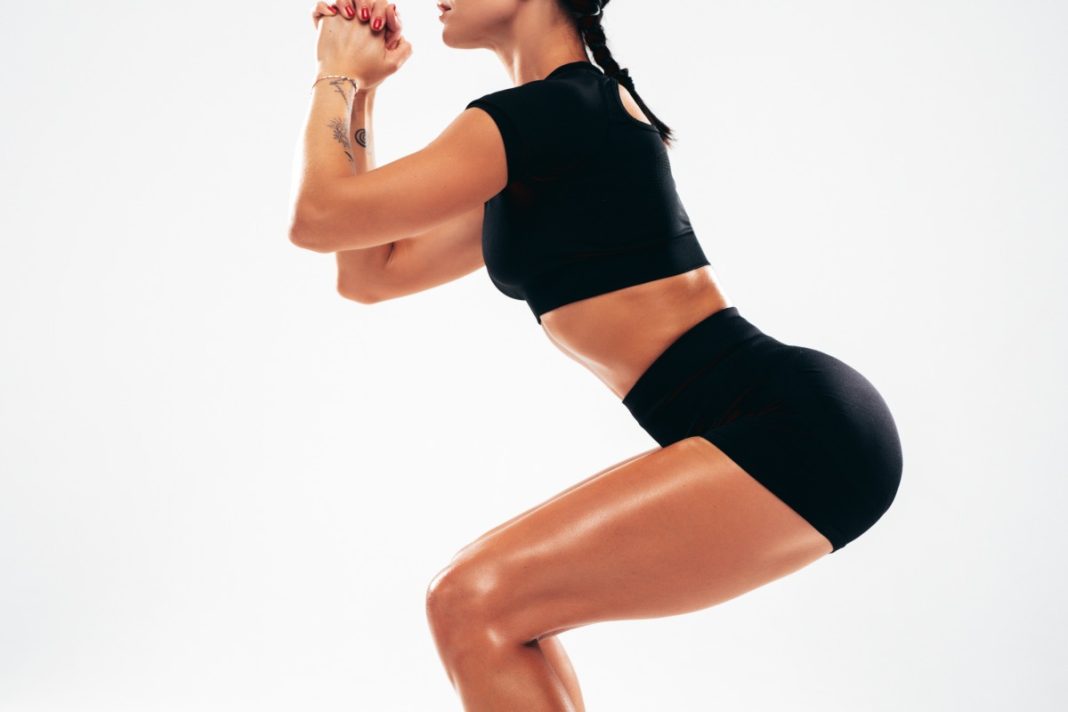
Squats strengthen the quadriceps at the front of the thighs, the gluteal muscles, the hamstrings, and the core. They also train the basic movement used when sitting down and standing up.
Stand with your feet roughly shoulder-width apart. Brace your abdomen, push your hips backwards, and bend your knees as though lowering yourself into a chair. Keep your chest lifted and your knees aligned with your toes. Press through your whole foot to stand.
Beginners can practise by sitting onto a sturdy chair before standing again. Aim for eight to 12 controlled repetitions.
2. Reverse Lunges
Lunges train each leg separately, helping to improve balance and reduce strength differences between sides. The reverse variation is often easier to control than stepping forwards.
Stand upright, step one foot backwards, and lower the rear knee towards the floor. Keep most of your weight over the front foot, with the front knee tracking in the same direction as the toes. Push through the front foot to return to standing.
Hold a wall or chair for balance if necessary. Complete six to 10 repetitions on each side.
3. Step-Ups
Step-ups strengthen the quadriceps and gluteal muscles while reproducing the movement required to climb stairs. Because one leg performs most of the work at a time, the exercise also develops coordination and stability.
Place one foot fully on a low, stable step. Drive through that foot to lift your body, bringing the other foot onto the step without jumping. Step down slowly and repeat before changing sides.
Avoid pushing excessively from the lower foot. Begin with a modest step height and complete eight to 12 repetitions per leg.
4. Glute Bridges
Glute bridges target the buttocks and hamstrings, which produce hip extension and help propel the body forwards. Strong gluteal muscles also support the pelvis and contribute to stable movement at the knees.
Lie on your back with your knees bent and your feet flat on the floor. Tighten your abdomen, squeeze your buttocks, and lift your hips until your body forms a straight line from shoulders to knees. Pause briefly, then lower with control.
Avoid arching the lower back. Perform 10 to 15 repetitions.
5. Romanian Deadlifts
The Romanian deadlift develops the hamstrings, gluteal muscles, and back of the hips. More importantly, it teaches the hip-hinge pattern used when safely lifting objects from the floor.
Stand with soft knees and your feet about hip-width apart. Keeping your back neutral, push your hips backwards as your torso inclines forwards. Stop when you feel tension through the hamstrings, then squeeze the gluteal muscles to return to standing.
Learn the movement without weights before adding light resistance. Perform eight to 12 repetitions.
6. Side Lunges
Most daily movement occurs forwards and backwards, but the body must also remain strong when moving sideways. Side lunges train the inner thighs, outer hips, quadriceps, and gluteal muscles while improving lateral stability.
Take a wide step to one side, push your hips backwards, and bend the knee of the stepping leg while keeping the opposite leg relatively straight. Press through the bent leg to return to the centre.
Keep both feet facing forwards and move only as deeply as you can control. Complete six to 10 repetitions on each side.
7. Calf Raises
Calf raises strengthen the muscles that lift the heels and propel the body during walking, running, and stair climbing. Strong calves and ankles also contribute to balance.
Stand tall with your feet hip-width apart, holding a stable surface if needed. Slowly rise onto the balls of your feet, pause at the top, and lower your heels without dropping them.
Begin with both legs and progress to single-leg raises when ready. Perform 12 to 20 controlled repetitions. The NHS includes squats and calf raises among accessible exercises for improving lower-body strength.
How to Build an Effective Routine
Choose four to seven of these exercises and perform two or three sets of each, resting briefly between sets. Two weekly sessions on non-consecutive days can provide an effective starting point.
As the exercises become easier, progress gradually by adding repetitions, slowing the lowering phase, increasing the range of movement, or introducing modest resistance. Muscles become stronger when they are challenged beyond what they are accustomed to, but progress does not require training to exhaustion.
Strength That Serves Everyday Life
A useful leg workout should train the front, back, inner, and outer portions of the lower body. Squats, lunges, hinges, bridges, step-ups, and calf raises collectively develop the strength needed for both appearance and function.
Consistency matters more than a punishing workout. Practised with sound technique and gradual progression, these seven exercises can build stronger, more capable legs that support movement well beyond the gym.