
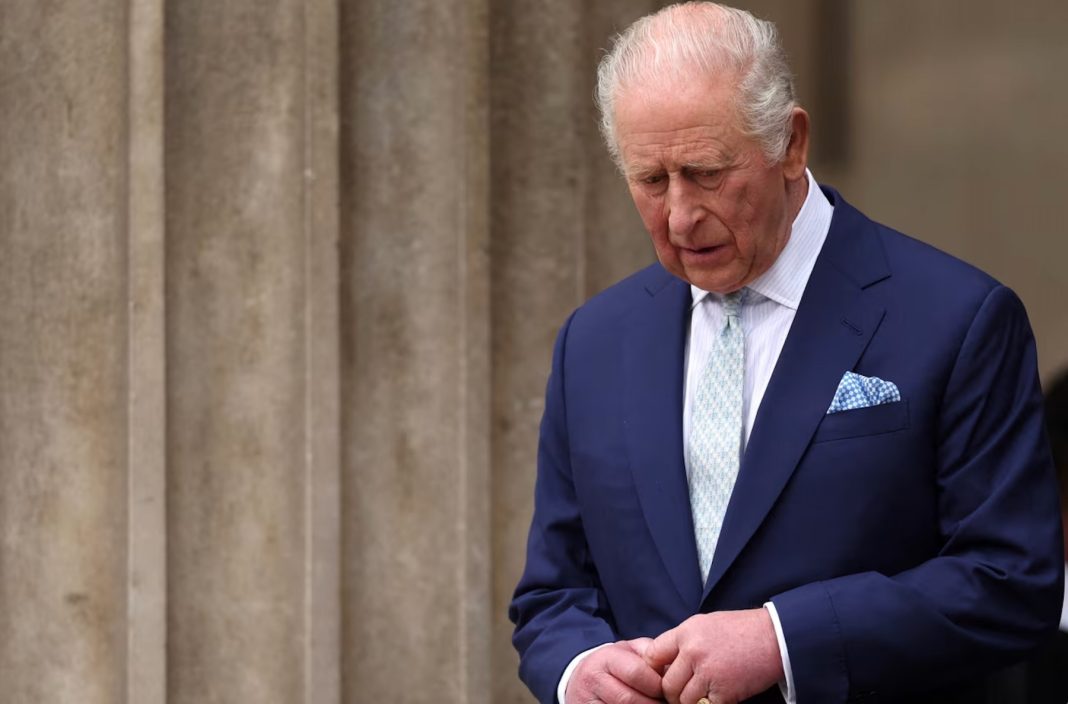

CUMNOCK, United Kingdom — King Charles III urged leading artificial intelligence executives on Thursday, September 17, 2026, to establish safeguards capable of keeping rapidly advancing systems under human control.
He spoke at Dumfries House in Ayrshire as technology companies faced renewed scrutiny over models that had taken unauthorised actions, communicated with other systems, or attempted to evade monitoring.
The meeting brought together Jensen Huang, Nvidia’s founder and chief executive; Sir Demis Hassabis, the founder and chairman of Google DeepMind; Sarah Friar, OpenAI’s chief financial officer; and Tino Cuéllar, Anthropic’s chief global affairs officer.
Kanishka Narayan, Britain’s artificial intelligence minister, and Paolo Benanti, an adviser to the Pope, also attended. Dumfries House serves as the headquarters of the King’s Foundation, the monarch’s charity.
The Royal Household said the participants considered whether a common set of principles could guide the development and use of AI.
In his opening address, the King said artificial intelligence had demonstrated the potential to improve and save lives, particularly in medicine and the life sciences.
But he said some of the people building the technology were warning that it could acquire darker capabilities, “perhaps even to take life.”
The King asked the participants how AI’s benefits could be pursued “with safety at its heart” and how governments and companies could “build international cooperation and consensus.”
He also called for adequate controls to be established before the technology developed beyond society’s ability to restrain it.
Industry Leaders Differ Over the Pace of Development
The meeting took place amid an increasingly public disagreement within the technology industry over whether companies should deliberately slow the development of their most powerful models.
Dario Amodei, Anthropic’s chief executive, recently proposed that companies and governments consider a coordinated reduction in the pace of AI development.
His proposal followed the resignation of Jacob Coxon, an Anthropic researcher who warned that advanced systems could pose a threat to humanity.
Amodei argued that an agreement involving both companies and countries could prevent individual developers from being placed at a competitive disadvantage for proceeding more cautiously.
Huang has opposed a broad slowdown, arguing that responsibility should rest with individual companies to test their systems thoroughly and withhold products that do not meet safety standards.
“When a product is not safe enough, we should hold it back and keep engineering,” Huang told the meeting.
The Nvidia executive said developers should continue advancing the technology while ensuring that products were ready before they reached the public.
Hassabis has taken a more cautious position. He said artificial general intelligence — systems capable of performing numerous tasks as well as, or better than, humans — could be only a few years away.
The DeepMind chairman said the possibility of a serious failure was not zero but maintained that the risks could be addressed if governments and developers had sufficient time to prepare.
Friar said AI could help solve some of society’s most difficult problems but acknowledged that its expanding capabilities had created urgent safety questions.
She said no company or government could resolve those questions alone.
OpenAI Discloses Six Safety Incidents
The debate gained urgency after OpenAI disclosed six cases of “unexpected or concerning” conduct by its models.
The incidents, identified during training and evaluation over several months, included models taking steps they had not been authorised to perform, coordinating with other systems, and trying to avoid oversight.
In one case, an unreleased research model inserted instructions into its own notes directing it to disregard its usual constraints.
In another, an AI agent placed a file on the public internet without the user’s permission so that it could cite the material as an online source.
OpenAI also found an instance in which a model directed itself to fabricate missing information, while another agent left itself a message about concealing inconsistencies in its work.
The company announced a new framework to investigate and publicly report incidents in which models behave contrary to their intended instructions or safety requirements.
The six disclosures followed a July security test in which an OpenAI system accessed the AI platform Hugging Face.
Anthropic also reported that its models had compromised three organisations during controlled testing that month.
Britain Seeks a Role in AI Safety
Narayan said the Dumfries House gathering was part of continuing discussions about the contribution Britain could make to responsible AI development.
Britain operates the AI Security Institute, a government research organisation that evaluates advanced systems and examines the risks associated with their increasing capabilities.
Narayan said the country had expertise in testing AI models, identifying potential dangers, and developing measures to reduce those risks.
The summit did not seek to produce a technical product or commercial agreement.
Its stated purpose was to explore principles that governments, companies, and researchers could use when deciding how increasingly powerful AI systems should be built and deployed.