

“May I never boast except in the cross of our Lord Jesus Christ.” — Galatians 6:14
I first came across this story through a devotional piece by Dick Innes of ACTS International, a short reflection that stopped me in my tracks and sent me down a rabbit hole of historical research. The story is set in early 19th-century Prussia, and while it is often told in Christian devotional circles, the history behind it is both real and remarkable. What began as a king’s desperate wartime appeal became one of the most compelling examples of voluntary sacrifice ever recorded, and it carries a spiritual weight that transcends the centuries.
A Kingdom in Crisis
The year was 1813. Prussia was in a precarious state. King Frederick William III had led his nation through the brutal upheaval of the Napoleonic Wars, and the financial toll was devastating. The royal treasury was strained, the economy was depleted, and the king found himself caught between two equally unacceptable options: disappoint the people who trusted him, or surrender to an enemy that had already humiliated his kingdom at the Battle of Jena in 1806.
He chose neither.
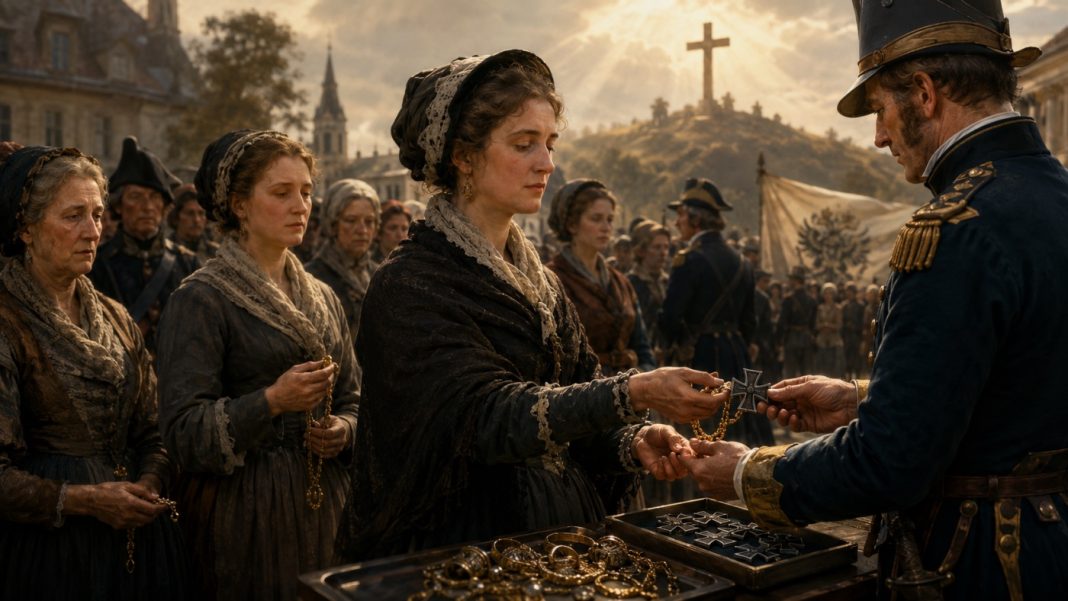
Instead, Frederick William III did something quietly radical. He turned not to his generals or his bankers, but to the women of Prussia. He appealed to them with a request that would have seemed extraordinary in any other age. He asked them to voluntarily surrender their jewelry. Their gold. Their silver. The ornaments of status and sentiment that women had worn for generations, including wedding rings, heirlooms, gifts from mothers, and tokens of love, were requested by the crown to be melted down and recast into weapons and resources for the war effort.
In return, each woman who gave would receive something in exchange: a simple decoration of iron or bronze, inscribed with the words: “I GAVE GOLD FOR IRON, 1813.”
Iron Worth More Than Gold
What happened next confounded every expectation of human nature.
The response was not reluctant. It was not grudging. It was overwhelming.
Women across Prussia lined up to give. And something remarkable followed. Those plain iron decorations, cast from the humblest of metals, became the most prized adornments in all of Prussian society. The reason was unmistakable: they were proof. They were visible evidence that the wearer had sacrificed something precious for someone worth sacrificing for.
It became, in time, socially unfashionable to wear gold or silver at all. To display expensive jewellery was to announce that you had not given. The iron decoration was not just a token; it was a testimony. And from this extraordinary chapter of history was born what became known as the Order of the Iron Cross, an institution that would outlast the war itself and endure as one of Germany’s most recognised military honours for more than two centuries.
The genius of the king’s exchange was not economic. It was deeply human. He did not merely take. He gave something back. But what he gave back was not equivalent in material value. It was superior in meaning. The iron cross carried the weight of sacrifice, and that weight made it precious beyond measure.
The Question That Changes Everything
When I read this story, first in Innes’ devotional reflection and later while tracing its historical threads, I found myself sitting with a question I could not easily put down.
If women in 19th-century Prussia were willing to surrender their most cherished possessions for an earthly king facing a political crisis, what does that say to those of us who claim allegiance to a far greater King?
King Jesus did not ask His followers to give gold for iron. He gave everything, including His life, and asks in return not for our jewelry, but for our hearts, our will, our best. The cross He carried was not iron. It was wood. Rough, splintered, ordinary wood. And yet no throne, no crown, no decoration in the history of the world has carried more weight than that wooden cross on the hill of Golgotha.
The Apostle Paul, writing to the Galatians, made his position clear: “May I never boast except in the cross of our Lord Jesus Christ, through which the world has been crucified to me, and I to the world” (Galatians 6:14). For Paul, the cross was not a source of shame. It was the singular boast of his entire existence. Everything else, including status, religion, achievement, and reputation, had been rendered worthless in its light.
The Order of the Wooden Cross
Here is the invitation that Innes placed before his readers, and that I now place before you:
What if Christians wore their sacrifice the way Prussian women wore their iron decorations?
Not with pride in themselves, but as testimony, as evidence that they had given their best to a King who gave everything for them. That they had surrendered comfort for service, ease for obedience, personal ambition for the Kingdom of God. That the things the world calls precious, including status, security, and material wealth, had been laid down in exchange for something of infinitely greater worth.
The Order of the Iron Cross was born because a community decided, collectively, that what you had sacrificed was more worth displaying than what you had kept.
The Order of the Wooden Cross, if we dare call it that, is the daily invitation of every Christian. It is not a medal. It is a life. A life that says, by its choices and its priorities and its generosity: I know what this cross cost. And I know it was worth everything.
A Prayer Worth Praying
In the spirit of Dick Innes’ original reflection, I close with this prayer, not as a formality, but as a genuine response to a story that deserves one:
“Dear God, in light of all that You have done for me, in giving me the gift of life, pardon for all my sins, and the gift of eternal life, please give me a truly grateful and willing heart, so that I will always give of my best to You in all that I am and do. May I never cling to gold when You are asking for it. May I wear whatever iron You give me in return as the highest honor I have ever known. Thank You for hearing and answering my prayer. Gratefully, in Jesus’ name, amen.”