
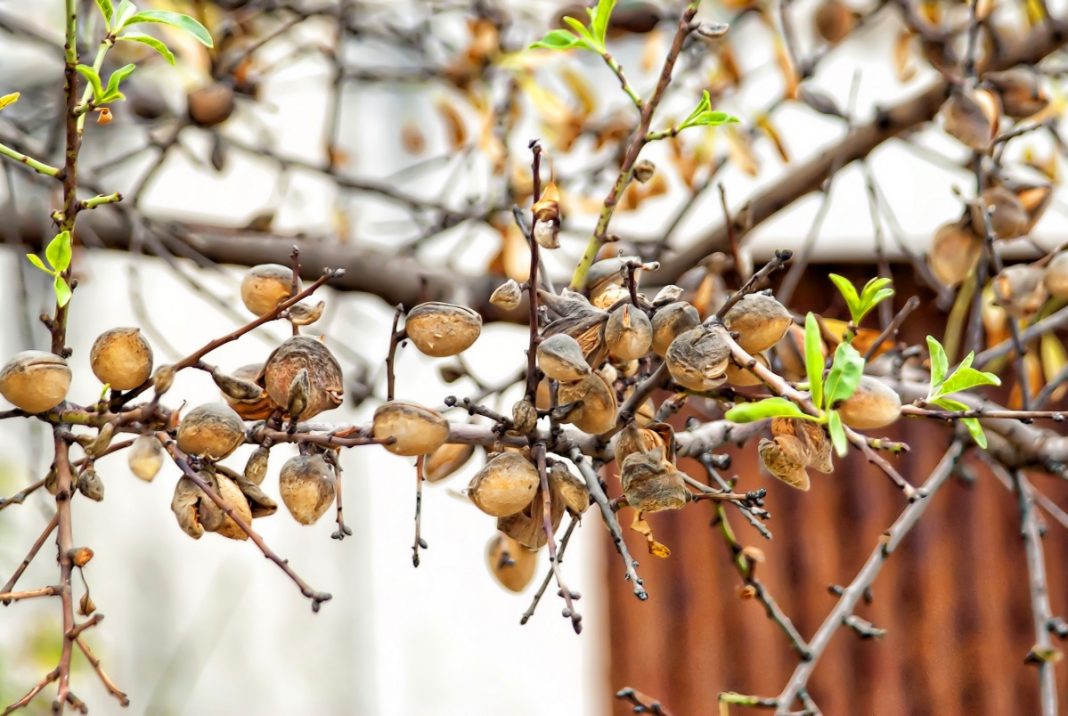

Across the landscape of the ancient Near East, the almond tree was both familiar and remarkable. Its fruit was valuable enough to be presented as a diplomatic gift, while its blossoms appeared before those of many other fruit trees, sometimes opening while winter still held the land.
The Old Testament draws upon these qualities repeatedly. Almonds appear in stories of famine, priestly controversy, sacred worship, prophetic calling and human mortality. Yet the almond does not carry precisely the same meaning in every passage. It represents value in Genesis, divine choice in Numbers, ornamental beauty in Exodus, watchful action in Jeremiah and, most likely, advancing age in Ecclesiastes.
Taken together, these references transform an ordinary tree into one of the Old Testament’s richest natural images.
A Tree That Awakened Early
The cultivated almond is a deciduous tree belonging to the rose family. The accepted botanical name is Prunus amygdalus, while Prunus dulcis is widely used as a synonym. It was cultivated across the ancient Near East and became well established in the Levant, including the lands associated with biblical Israel and Judah. Botanical and archaeological research confirms the almond’s long association with the region.
Its most striking characteristic is its unusually early flowering. The tree produces delicate white or pale-pink blossoms in late winter, often before its leaves emerge. In a landscape where most trees still appear dormant, the almond seems to awaken ahead of everything around it.
That natural behaviour lies behind one of the most important Hebrew wordplays in the Old Testament.
The common Hebrew noun for almond is shaqed—שָׁקֵד. In Jeremiah 1:12, the word translated as “watching” is shoqed—שֹׁקֵד—a form of the verb shaqad, meaning to watch, remain alert or be ready to act.
The words are not completely identical in meaning, as is sometimes claimed. Rather, they share the same consonants and sound very similar. Jeremiah uses that similarity deliberately: the prophet sees a shaqed, an almond branch, and God declares that He is shoqed, watching over His word.
The tree that appeared to awaken first became the perfect image of a God who was neither asleep nor inattentive.
Almonds Among the Choice Products of Canaan
The first unambiguous reference to almonds as food appears in Genesis 43.
A severe famine had driven Jacob’s sons to Egypt to buy grain. When they prepared to return, this time with Benjamin, Jacob instructed them to take a gift for the powerful Egyptian official whom they did not yet recognise as Joseph.
“Take of the best fruits in the land in your vessels,” Jacob told them, naming balm, honey, spices, myrrh, nuts and almonds among the items to be carried to Egypt.
The passage does not describe almonds alone as “the best of fruits”. They formed part of a collection of the land’s choice products. Their inclusion nevertheless reveals their economic and social value. Almonds were portable, nourishing and durable enough to survive a journey. They could be offered as a mark of respect and used to secure goodwill.
Their presence in Jacob’s gift is particularly striking because the land was suffering famine. Grain was scarce, but Jacob’s household still possessed small quantities of valuable regional produce. The almonds therefore represented something costly surrendered in a moment of vulnerability.
There is no explicit spiritual symbolism attached to them in this passage. They are valuable because they are among the finest goods Jacob can offer. Even so, the story establishes the almond as a product associated with worth, generosity and honour.
The Almond Wood in Jacob’s Flocks
A less obvious reference appears earlier in Genesis 30:37, during Jacob’s years of service to Laban.
Jacob took branches from several trees, peeled away portions of their bark and placed the striped rods before the animals at the watering places. Many modern translations identify one of the branches as almond wood, although the King James Version calls it “hazel”.
The difference comes from the Hebrew word luz, which is distinct from shaqed but is commonly understood to refer to an almond tree, possibly a wild variety.
The passage does not explain any special religious meaning attached to the wood. Its importance lies in showing that the almond tree belonged to the pastoral and agricultural world in which the patriarchal stories are set. Before it became a prophetic sign or a feature of sanctuary design, it was part of the vegetation encountered in everyday life.
Aaron’s Rod and the Vindication of Divine Choice
The most dramatic appearance of almonds in the Old Testament occurs in Numbers 17.
The Israelites had repeatedly challenged the leadership of Moses and the priestly position of Aaron. Following the rebellion associated with Korah, God ordered that a staff representing each tribe be placed before the testimony in the Tabernacle. Aaron’s name was written on the staff representing the tribe of Levi.
God declared that the staff belonging to the man He had chosen would blossom. The sign was intended to settle the dispute and bring the people’s complaints to an end.
When Moses returned the following day, Aaron’s staff had undergone an extraordinary transformation:
“The rod of Aaron for the house of Levi was budded, and brought forth buds, and bloomed blossoms, and yielded almonds.” — Numbers 17:8, KJV
The description is carefully constructed. The staff did not merely produce a small shoot. It displayed buds, open blossoms and mature fruit—the different stages of plant development—at the same time.
A dry staff, separated from its roots and incapable of natural growth, had become fruitful overnight.
The miracle was not principally a lesson about almonds. It was God’s answer to a dispute over whom He had appointed to the priesthood. Aaron did not establish his authority through persuasion, political influence or force. God identified him by causing life and fruitfulness to appear where human power could produce neither.
The rod was subsequently kept as a sign against continued rebellion. Its almonds testified that legitimate spiritual authority ultimately came from God’s choice, not human competition.
The account also develops a wider biblical pattern: God demonstrates His power by bringing life out of what appears lifeless. The dead staff becomes productive because the divine presence acts upon it. In that sense, the fruitfulness of Aaron’s rod communicates both election and transformation.
What Numbers Does Not Say
Some popular accounts add details that do not appear in the biblical text.
Numbers 17 does not call the almonds “sweet”, nor does it promise that they will become bitter if the people forsake God’s law. The chapter says that Aaron’s rod produced almonds and was preserved as evidence of God’s decision concerning the priesthood.
Hebrews 9:4 later refers to “Aaron’s rod that budded”, but Hebrews belongs to the New Testament, not the Old Testament. It also does not introduce a contrast between sweet and bitter almonds.
The distinction matters because the genuine meaning of the passage is already powerful. Aaron’s flowering rod is a sign of divine appointment, not a magical instrument for testing whether people have remained obedient.
Almond Blossoms in the Menorah
The almond’s most enduring influence on biblical art and worship is found in the design of the golden lampstand, or menorah.
In Exodus 25:31–40, Moses receives instructions for constructing the sacred furnishings of the Tabernacle. The menorah was to be made from one hammered piece of pure gold. It consisted of a central shaft with six branches extending from its sides, producing seven lamps in total.
The branches were decorated with cups shaped like almond blossoms, together with buds and flowers. Four additional almond-shaped cups were placed on the central shaft. The instructions are repeated in Exodus 37:17–24 when the lampstand is constructed.
Although older English translations call it a “candlestick”, the menorah was an oil lampstand, not an object designed to hold wax candles. Its lamps were supplied with oil and tended so that they could provide light within the sanctuary.
The almond motif gave the golden structure an organic quality. Its shaft and branches resembled a stylised tree, while its ornamental buds and blossoms suggested growth emerging in the place of worship. Light appeared to shine from a golden tree in bloom.
This design has encouraged some interpreters to associate the menorah with the tree of life, creation and the life-giving presence of God. Such associations are possible, but they should be presented with care. Exodus gives exact instructions for the almond-shaped decorations but does not explicitly explain why that particular flower was chosen.
What can be said with confidence is that the almond blossom was deliberately built into one of the holiest objects in Israel’s worship. The same plant that flowered early in the natural world was reproduced in gold around the sanctuary’s source of light.
The seven-branched biblical menorah should also be distinguished from the nine-branched hanukkiah used during Hanukkah. The former originated in the Tabernacle instructions and later became one of Judaism’s most recognisable symbols.
Jeremiah’s Almond Branch: God Watching Over His Word
The almond’s linguistic and prophetic significance reaches its clearest expression in Jeremiah 1:11–12.
Jeremiah had just been called to serve as a prophet to the nations. He protested that he was too young and did not know how to speak, but God rejected his fear, placed His words in his mouth and commissioned him “to root out, and to pull down, and to destroy, and to throw down, to build, and to plant”.
God then asked Jeremiah what he saw.
“I see a rod of an almond tree,” the prophet replied.
God answered:
“Thou hast well seen: for I will hasten my word to perform it.” — Jeremiah 1:12, KJV
Many modern translations render the final statement as, “I am watching over my word to perform it.” Both translations attempt to convey the Hebrew wordplay between shaqed, almond, and shoqed, watching. The NET Bible’s textual note explains that the image announces God’s readiness to act upon the word He has spoken.
The vision is often treated solely as a comforting promise of protection, but its immediate context is more serious. Jeremiah’s next vision is of a boiling pot tipping from the north, symbolising the judgment that would fall upon Judah because of its idolatry and disobedience.
God’s watchfulness therefore includes accountability. He watches over His word of judgment as surely as He watches over His promises of restoration.
Later, in Jeremiah 31:28, the same theme is applied in both directions. God declares that just as He had watched over the people “to pluck up, and to break down, and to throw down, and to destroy”, He would also watch over them “to build, and to plant”.
The almond branch means that God is awake to His own declaration. His word will not be abandoned, forgotten or rendered powerless by delay. Whether the word concerns correction or restoration, He remains ready to bring it to pass.
The Blossoming Almond and the Approach of Old Age
The final major almond reference appears in Ecclesiastes 12, a poetic description of ageing and mortality.
The chapter urges readers to remember their Creator in the days of their youth, before physical strength declines and death approaches. It describes trembling limbs, failing sight, diminished hearing and increasing fear. Within this sequence, Ecclesiastes 12:5 says that “the almond tree shall flourish”.
The precise meaning has been debated, but the most familiar interpretation connects the almond’s pale blossoms with hair turning white in old age. As the almond tree suddenly covers itself in white flowers, age becomes outwardly visible upon the human body.
Other interpretations are possible, and the verse itself does not provide a direct explanation. Its placement within a sustained portrayal of physical decline, however, makes ageing the most natural context.
Here, the almond is not a symbol of priestly authority or prophetic fulfilment. Its flowering becomes an image of mortality. Human beings, like trees and seasons, pass through recognisable stages. The instruction is therefore urgent: remember the Creator before the body weakens and life reaches its earthly end.
One Tree, Several Meanings
The Old Testament does not present a single universal definition of the almond. Its significance grows from the different roles it plays in different passages.
In Genesis, almonds are choice produce and a gift of considerable value. In Numbers, mature almonds appearing on a lifeless staff confirm God’s choice of Aaron. In Exodus, almond blossoms shape the golden lampstand that illuminates the sanctuary. In Jeremiah, the sound of the Hebrew word becomes a declaration that God is watching over His word. In Ecclesiastes, the pale blossom becomes an image of age and mortality.
These meanings are connected, but they are not interchangeable. The menorah passage, for example, does not explicitly say that its almond decorations represent watchfulness. Numbers does not state that Aaron’s almonds symbolise old age. Responsible interpretation begins by allowing each passage to speak within its own literary and historical setting.
What unites the references is the almond’s capacity to make invisible truths visible. Its fruit reveals value. Its early blossom suggests alertness. Its miraculous appearance on Aaron’s rod demonstrates divine choice. Its form adorns sacred light. Its whitening flowers evoke the passing of human life.
The significance of the almond in the Old Testament is therefore not based upon an abstract religious code. It arises from close observation of creation. Biblical writers looked at a tree their audiences knew well and used its fruit, wood, flowering pattern and name to communicate truths about authority, worship, time, judgment and the unwavering fulfilment of God’s word.